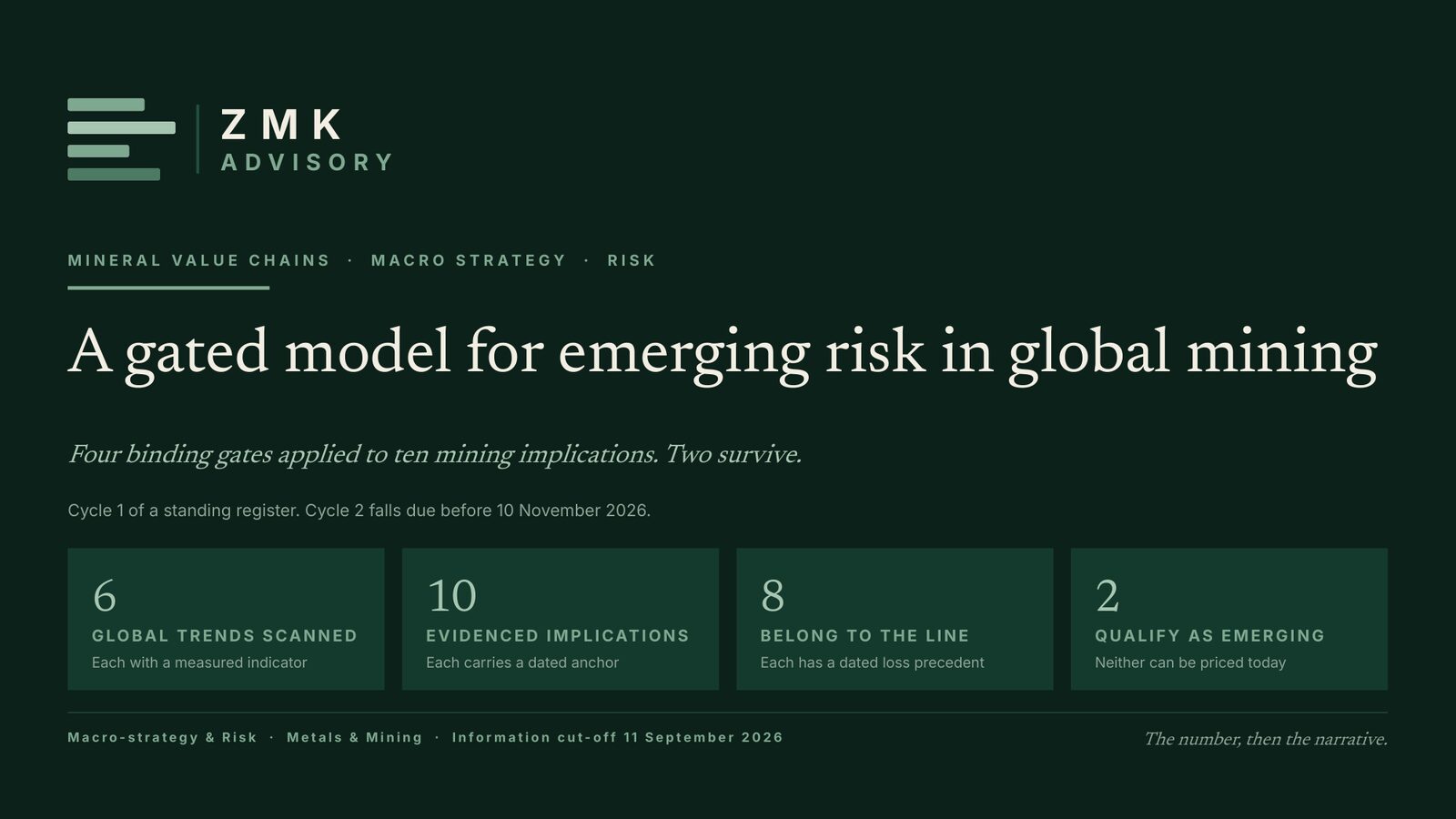
Four binding gates applied to ten mining implications. Two survive.
A gated model for emerging risk in global mining, published in full: the method, the twelve-page pack and every source.
Cycle 1, 2026 · Information cut-off 11 September 2026 · Twelve pages · Seventeen named sources, fifteen open access
Eight carry a dated loss precedent. Two cannot be priced yet.
Six global trends were scanned against the mining and metals sector. Ten mining implications were derived, each anchored to a dated, attributable event rather than to a forecast. Four gates were then applied to all ten.
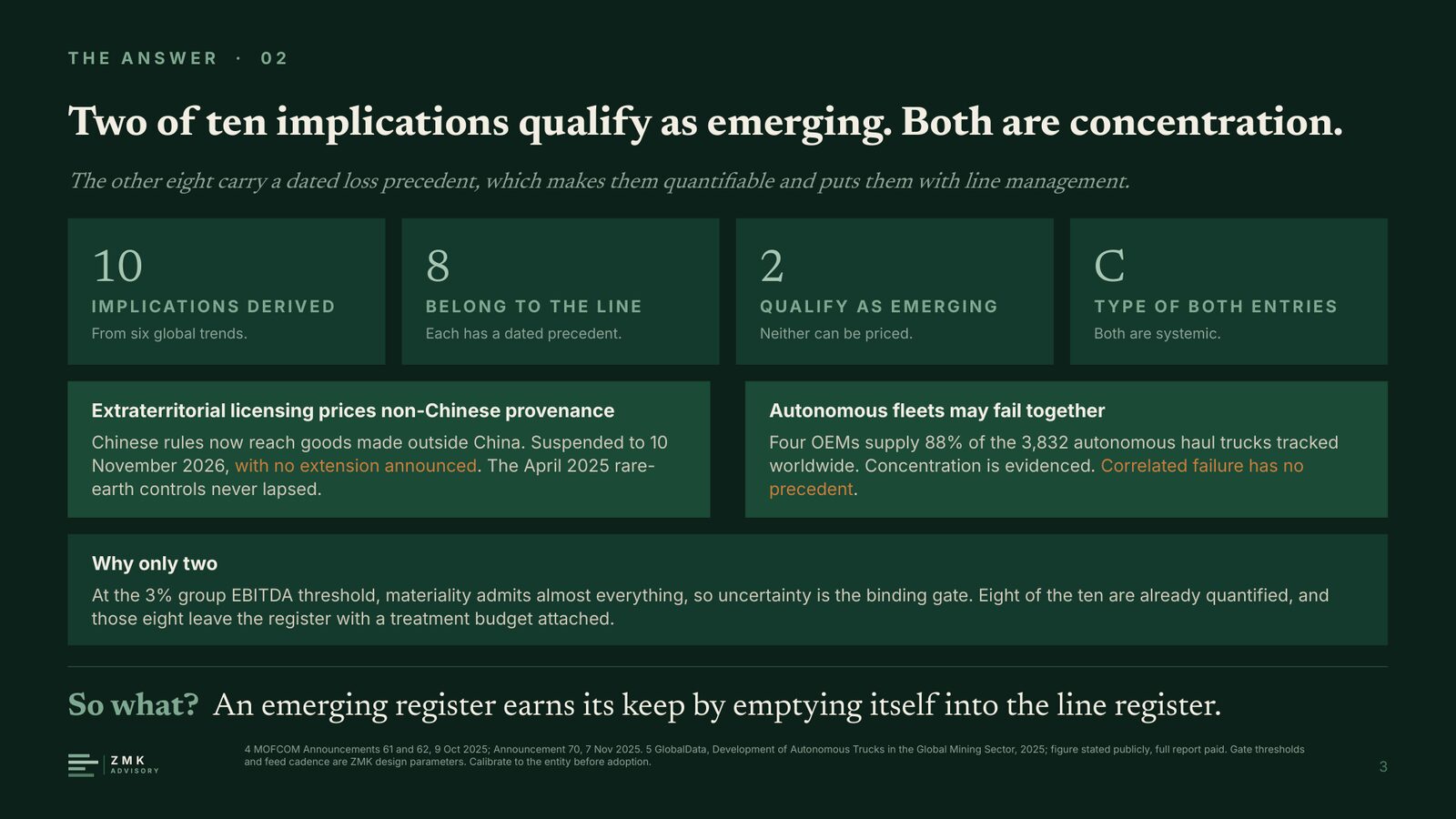
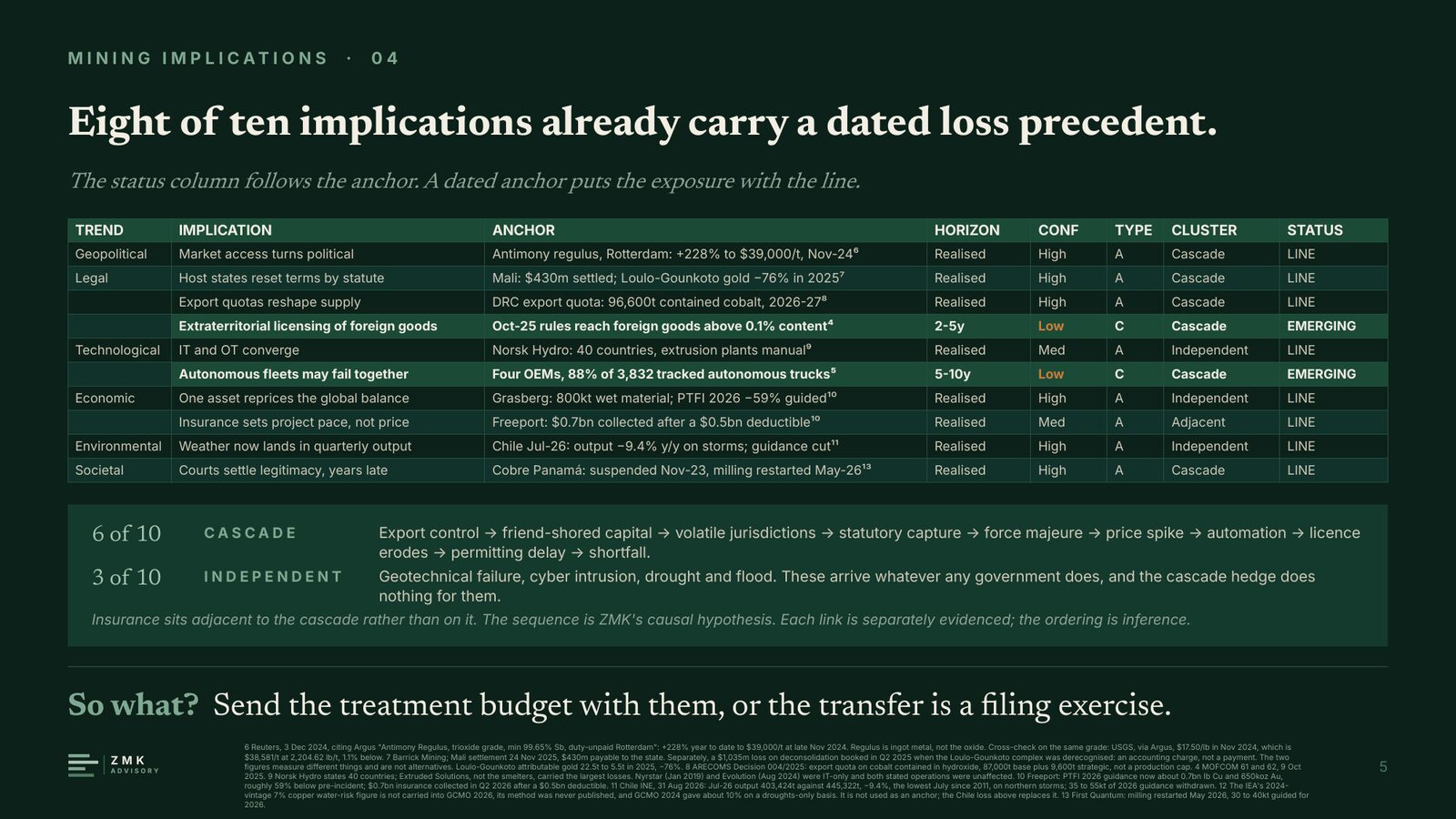
Eight were routed to the line register. Each of those eight already carries a dated loss precedent, which is what makes them quantifiable, and what makes them somebody’s operating budget rather than a board-level unknown. Antimony at $39,000 a tonne. Mali at $430m settled. Grasberg at 800kt of wet material, with 2026 output guided 59% lower. Cobre Panamá, 350kt a year of copper, suspended from November 2023 to May 2026. Chile’s July output, the lowest since 2011.
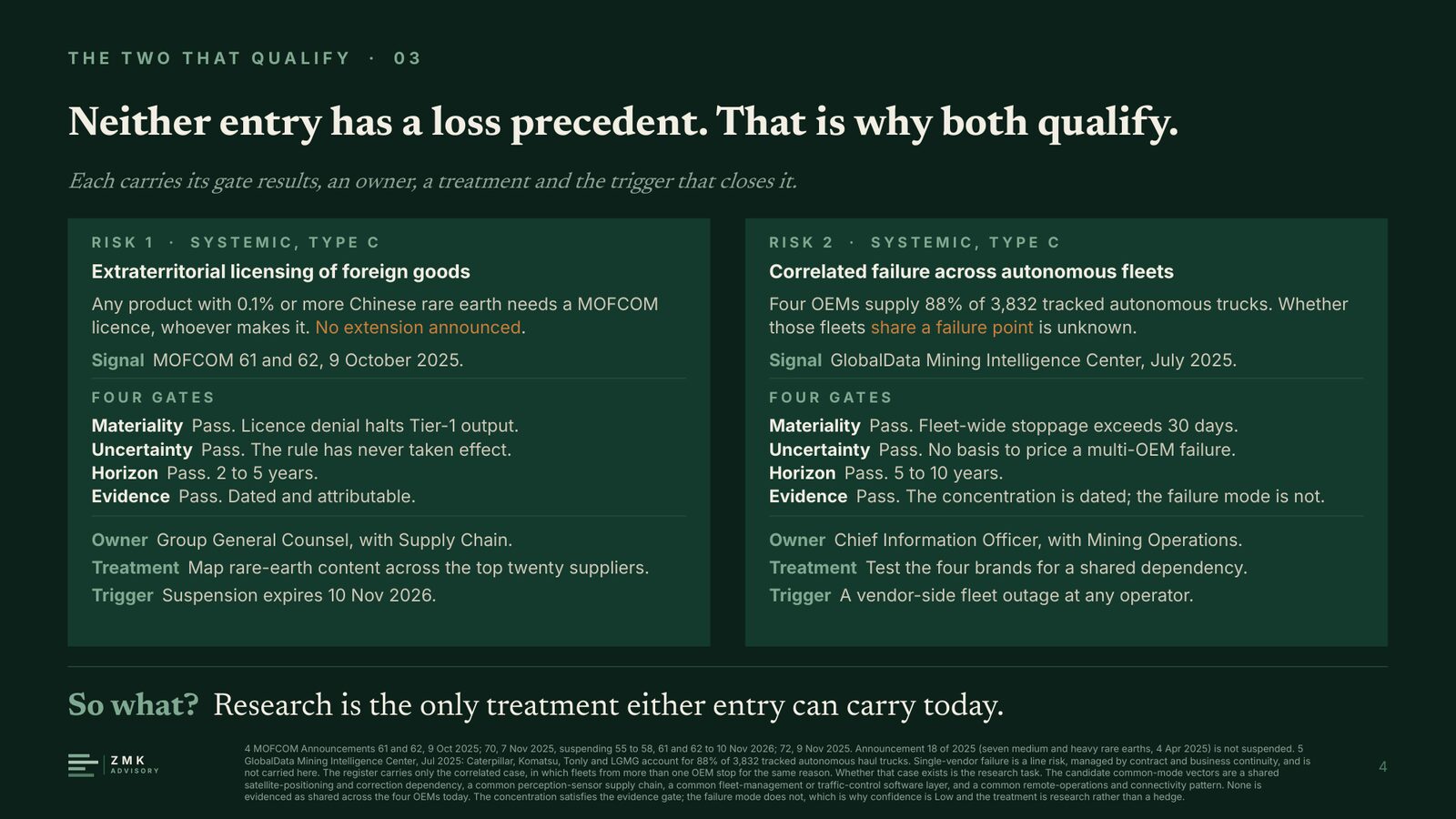
Two survive as genuinely emerging. Extraterritorial licensing of foreign goods under the October 2025 MOFCOM rules, suspended to 10 November 2026. And correlated failure across autonomous haul fleets, where four OEMs supply 88% of the 3,832 trucks tracked worldwide and nobody has established whether those fleets share a failure point.
Both are systemic. Neither can be priced today. That is the whole reason they are still on the register.
A list without a gate only ever grows
In our experience registers accumulate. Items go on and nothing comes off, because nothing in the process defines what leaving looks like. Within two cycles the register is a dumping ground for operational line items, and executive attention is spread across forty entries instead of the two that nobody can price.
The fix is not a better list. It is a gate at the front and an exit at the back.
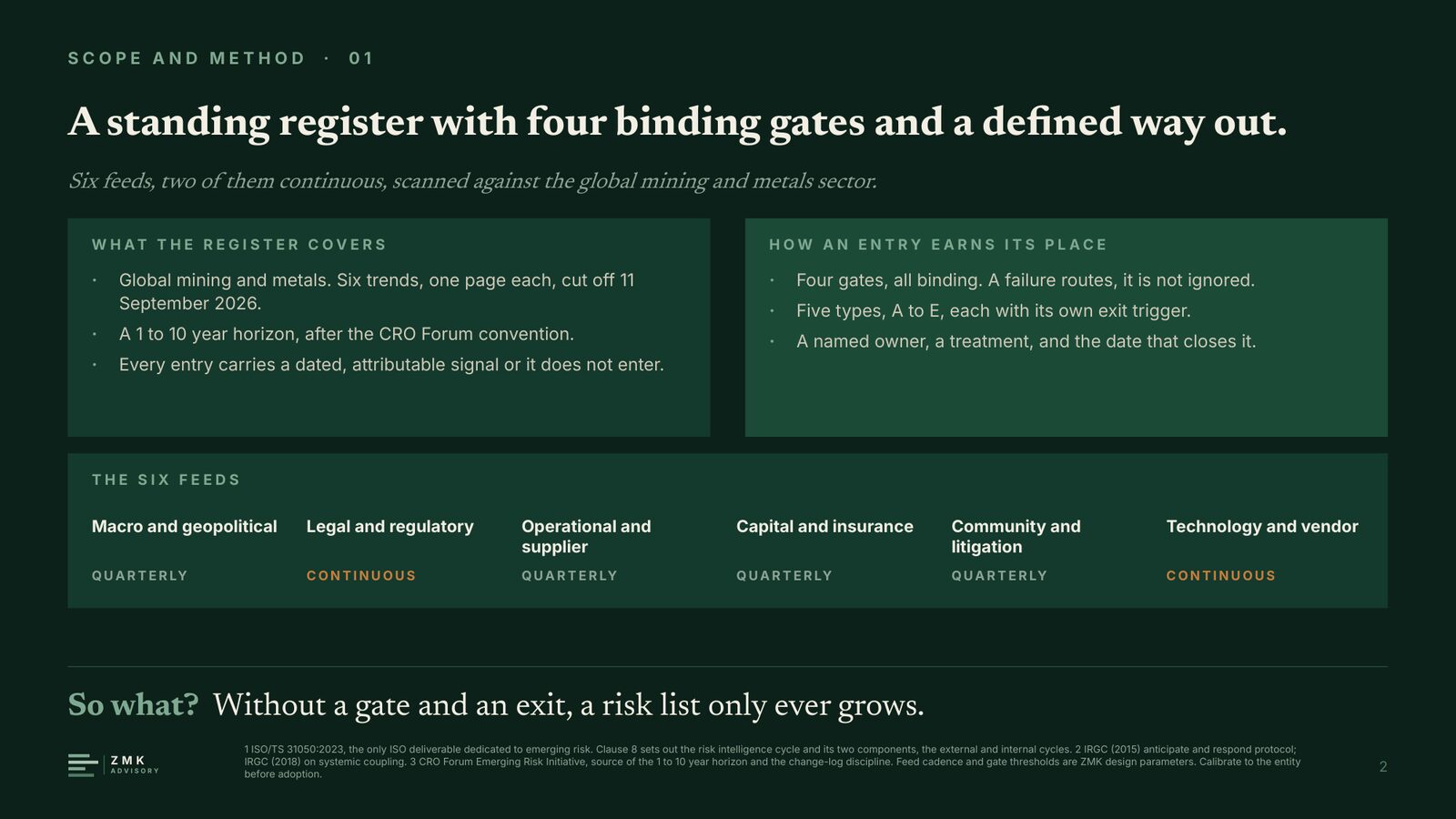
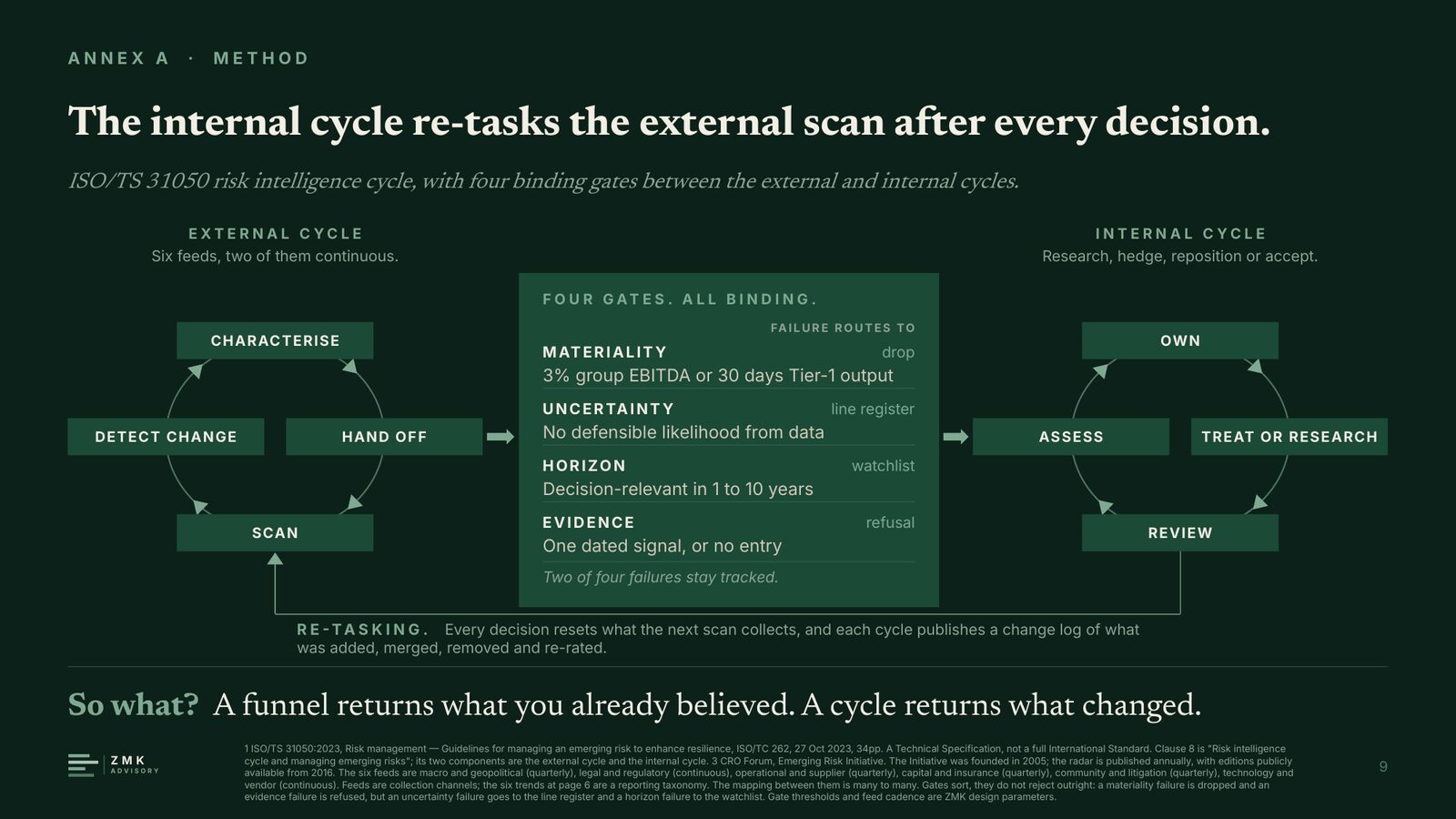
Four gates, all binding
Materiality. 3% of group EBITDA, or thirty days of Tier-1 output. A failure here is dropped.
Uncertainty. No defensible likelihood can be derived from the available data. A failure here routes to the line register, because a risk you can price belongs with the people who hold the budget.
Horizon. Decision-relevant within one to ten years, following the CRO Forum convention. A failure here routes to the watchlist.
Evidence. One dated signal, or no entry. A failure here is refused.
The gates sort, they do not simply reject. Two of the four failure routes keep the item tracked. Materiality is the loosest gate in practice, which means uncertainty is the one that binds: eight of the ten implications this cycle were already quantified, and they left.
Thresholds and feed cadence are ZMK design parameters. They are calibrated to the entity before adoption, and they are stated rather than assumed.
Every entry carries the date that closes it
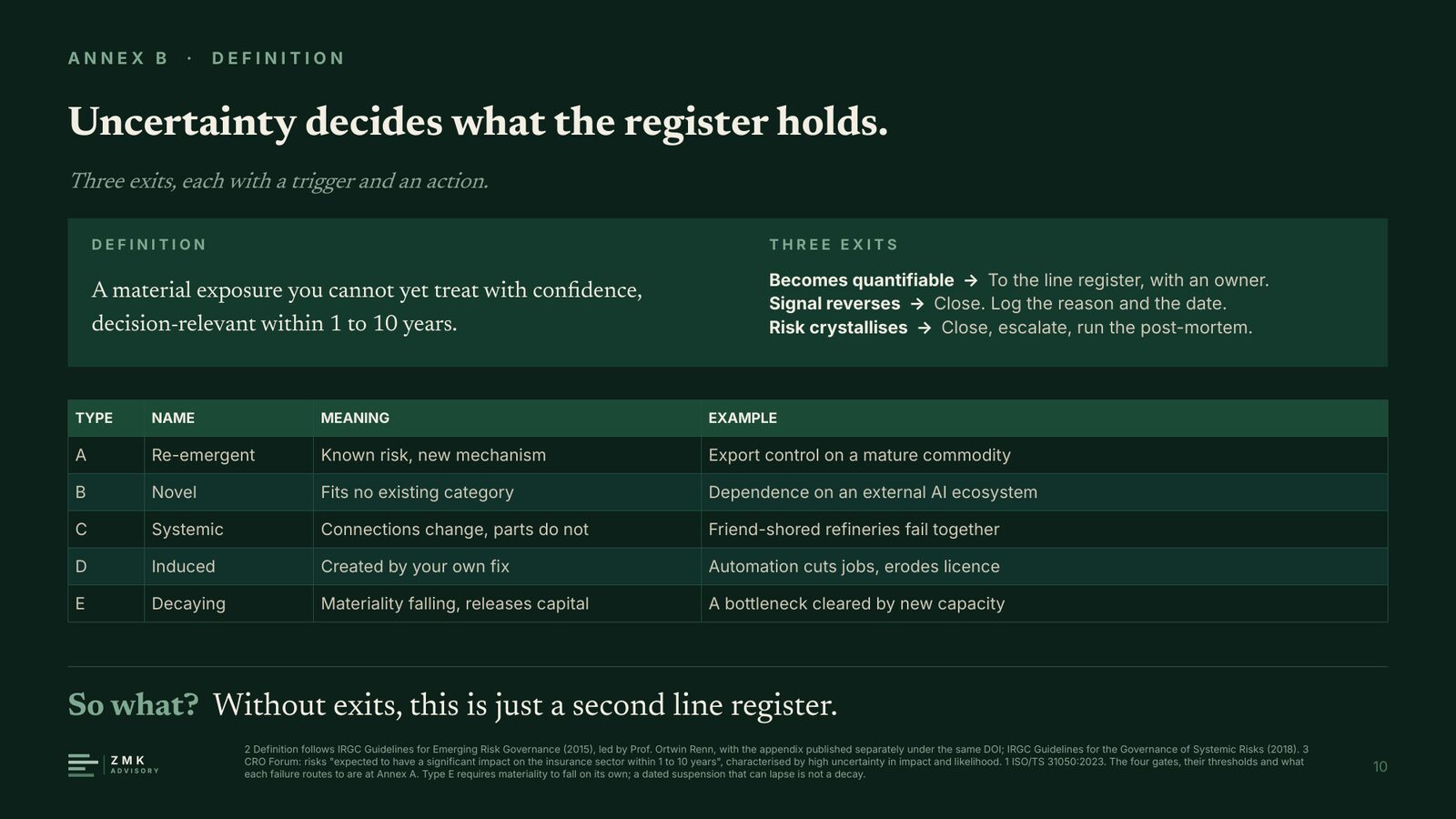
An entry is typed on the way in: re-emergent, novel, systemic, induced or decaying. Both entries that survived this cycle are systemic.
Every entry also carries three exits. It becomes quantifiable, and transfers to the line register with an owner. Its signal reverses, and it closes with the reason and the date logged. Or the risk crystallises, and it closes into incident management with a post-mortem.
Without those exits the register becomes a second copy of the line register, carrying the same items with less authority.
Six feeds are read, two of them continuously
Macro and geopolitical, quarterly. Legal and regulatory, continuous. Operational and supplier, quarterly. Capital and insurance, quarterly. Community and litigation, quarterly. Technology and vendor, continuous.
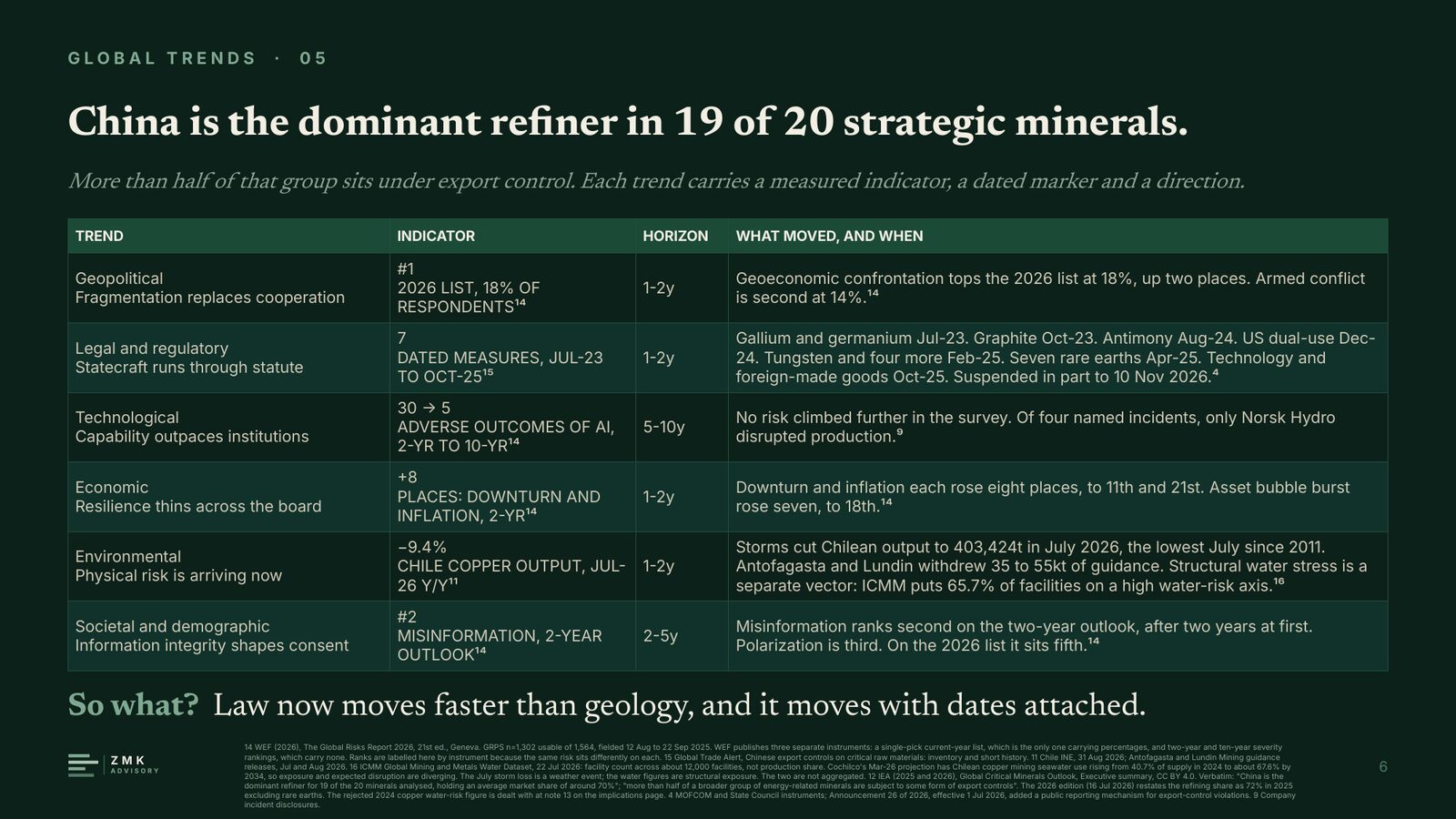
Two of the six run continuously because that is where the dated signals arrive fastest. Seven separate Chinese export-control measures landed between July 2023 and October 2025. A quarterly read would have found them a quarter late, every time.
A published change log, or the cycle did not run
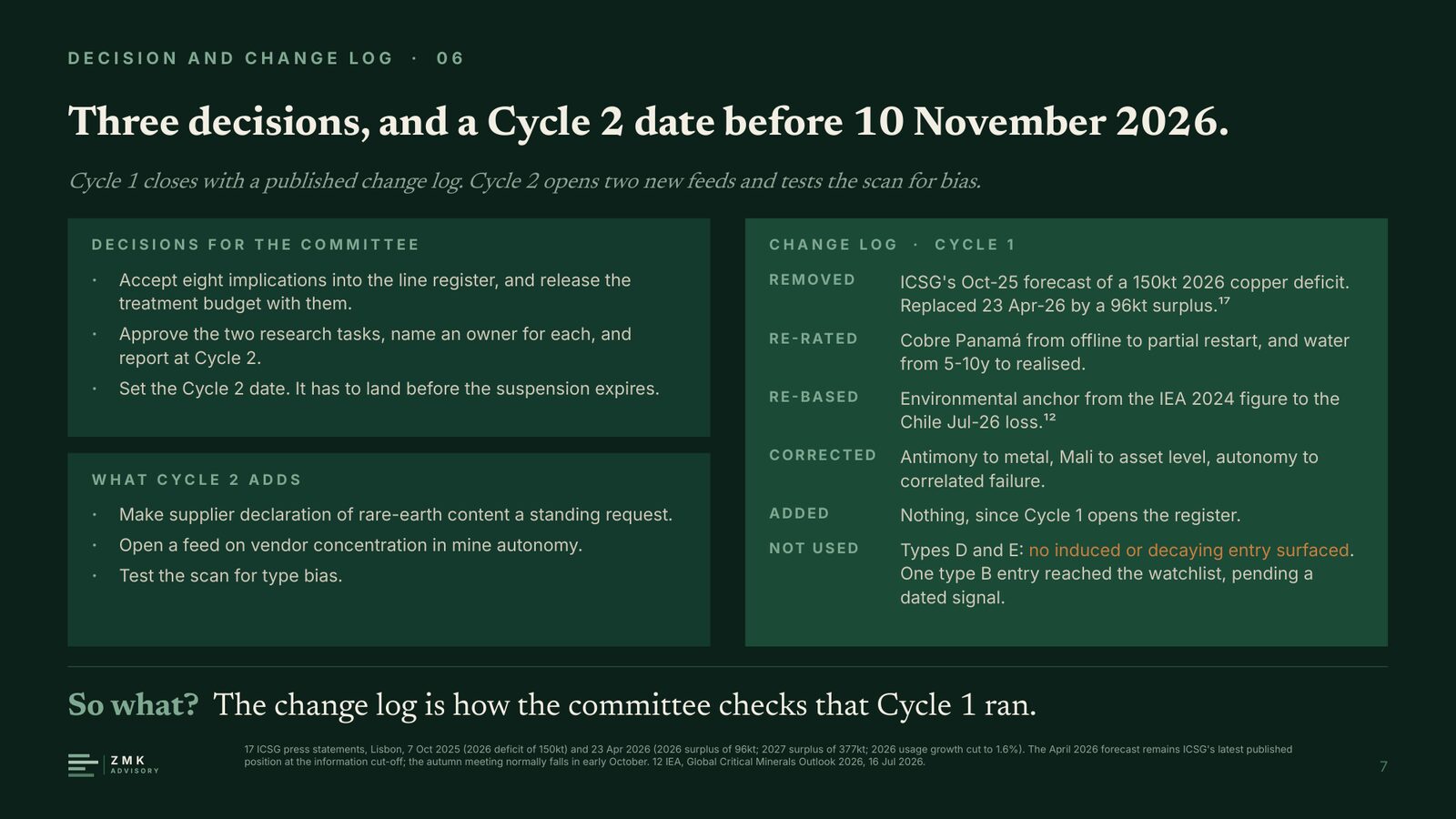
Cycle 1 closes with a change log: what was removed, what was re-rated, what was re-based, what was corrected, what was added and what went unused. This cycle removed the ICSG October 2025 forecast of a 150kt copper deficit, superseded on 23 April 2026 by a 96kt surplus. It re-based the environmental anchor from a 2024 IEA figure to a dated Chilean loss. It added nothing, because Cycle 1 opens the register.
A cycle that publishes no change log has not been run. It has been repeated.
Cycle 2 falls due before 10 November 2026, when the MOFCOM suspension expires.
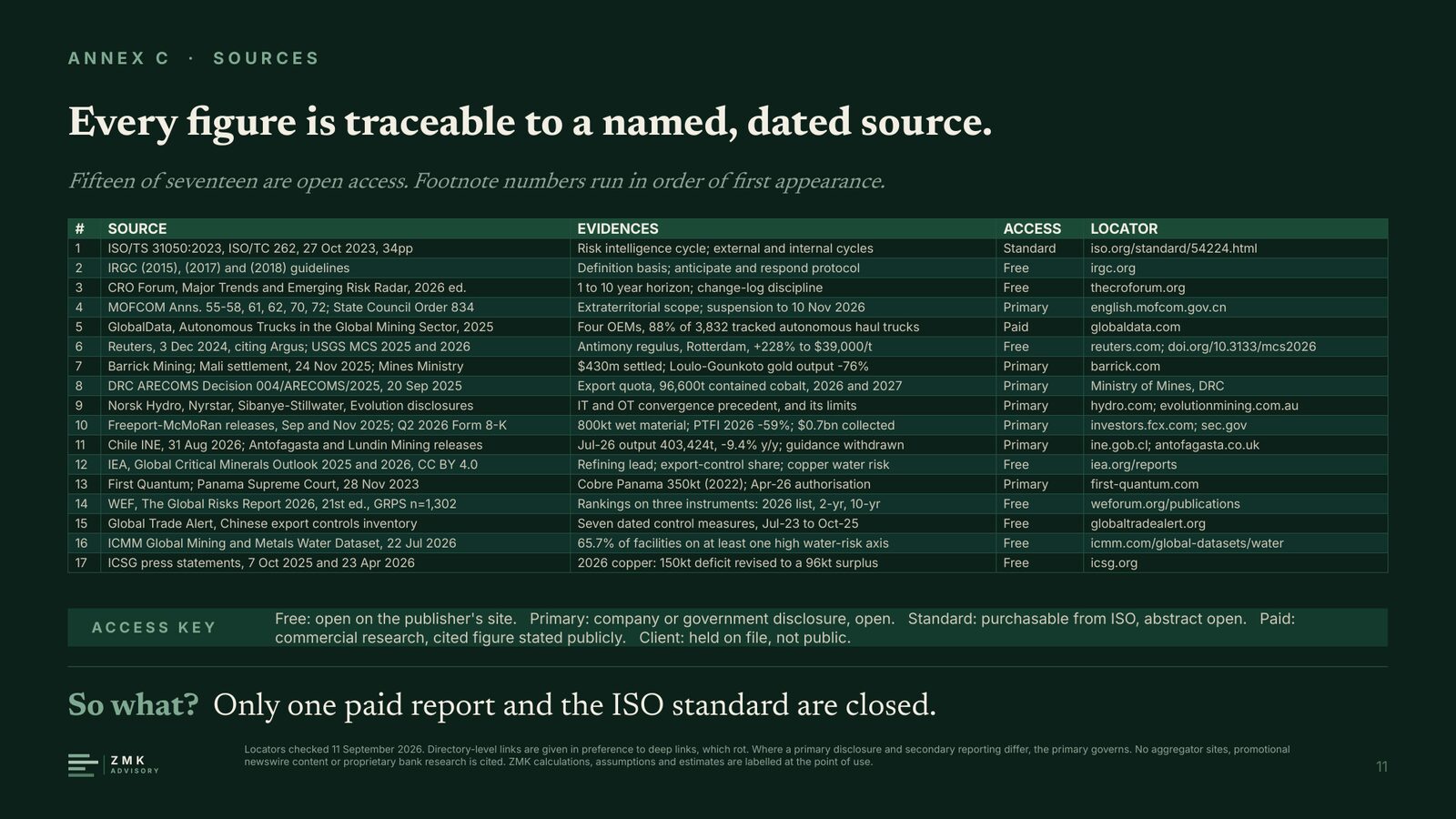
Every figure traces to a named, dated source
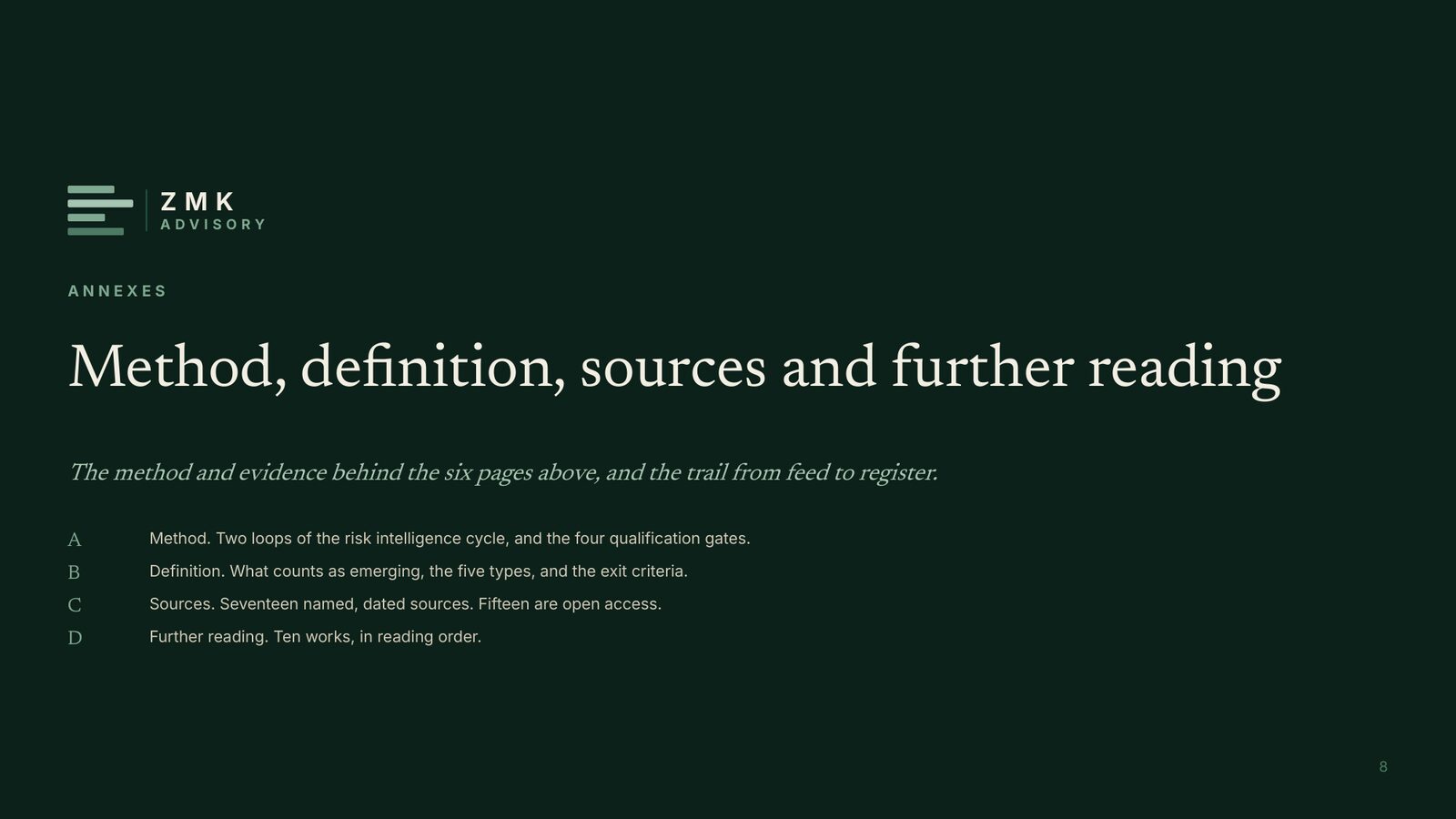
Seventeen sources. Fifteen are open access and can be checked without paying anyone. One is a paid commercial report whose cited figure is stated publicly. One is the ISO technical specification, which is purchasable from ISO.
Directory-level links are given in preference to deep links, which rot. Where a primary disclosure and secondary reporting differ, the primary governs. No aggregator sites, no promotional newswire content and no proprietary bank research is cited. ZMK calculations, assumptions and estimates are labelled at the point of use.
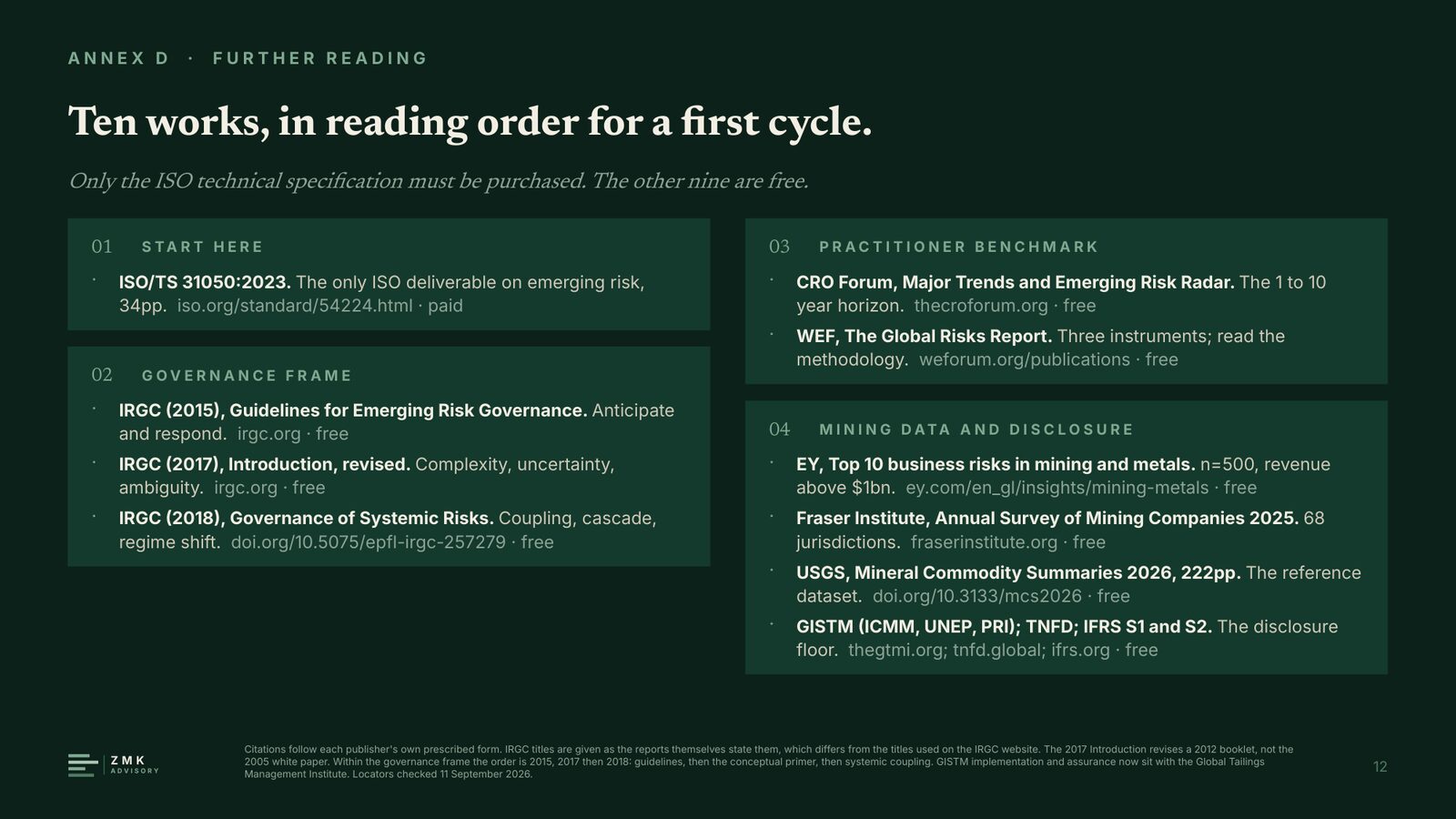
The method is benchmarked against ISO/TS 31050:2023, the only ISO deliverable dedicated to emerging risk, with the definition basis from IRGC and the horizon convention from the CRO Forum. All three are in the annexes with their locators.
The thresholds above are ours. On a mandate they become yours: the materiality gate is set against your EBITDA and your Tier-1 assets, the feeds are pointed at your jurisdictions, and the owners are your people.
Request an introduction