Practice 03 · Resource Risk & Governance
The risks that sit outside the model.
We find the political, jurisdictional, governance and supply-chain risks a valuation treats as a footnote until they become the valuation, and gate them down to the few a board can act on, each with an owner and the date that closes it. Documentation is not control.
Commissioned bySovereign-wealth funds and state holdings, operator boards, and investment committees.
What we cover
Four domains where value is lost to risks the plan never priced.
Political & sovereign
Transition · nationalism · renegotiation
Changes of government, resource nationalism and the renegotiation of terms once capital is sunk and leverage has shifted to the host state.
We deliver
Sovereign risk map · scenario brief
Licensing & jurisdiction
Permits · fiscal regime · export controls
Cross-border licensing, permitting and fiscal stability, including extraterritorial rules that reach an asset from outside its own jurisdiction.
We deliver
Jurisdictional review · licence exposure register
Governance & assurance
Reporting · assurance · board oversight
The gap between what is reported and what is controlled: reporting lines, assurance and decision rights, and whether the board is told about the risk the asset actually carries.
We deliver
Governance review · board risk brief
Supply-chain sovereignty
Chokepoints · processing · concentration
Where processing, logistics or a single counterparty controls the route to market, and what happens to the asset when that control is used.
We deliver
Chokepoint map · exposure assessment
From register to decision
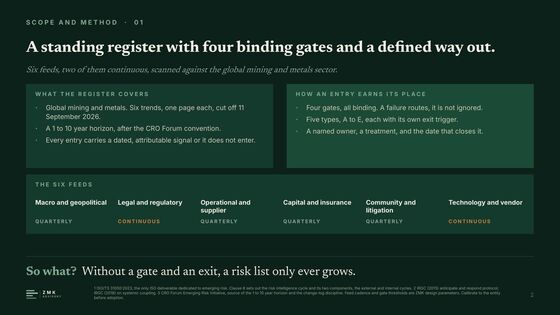
Three steps take the register down to the entries a board can act on.
A risk register without a gate only ever grows.
01
Scan
Trends and events, each anchored to a dated, attributable source rather than to a forecast.
02
Gate
Four binding gates: materiality, uncertainty, horizon and evidence. Each failure is dropped, refused, or routed to the line register or the watchlist.
03
Own
What survives gets an owner, a treatment and the date that closes it, so it can leave the register.
The method, published in full
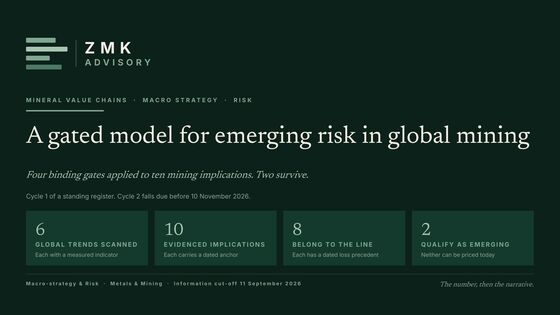
A gated model for emerging risk in global mining: ten implications in, two out.
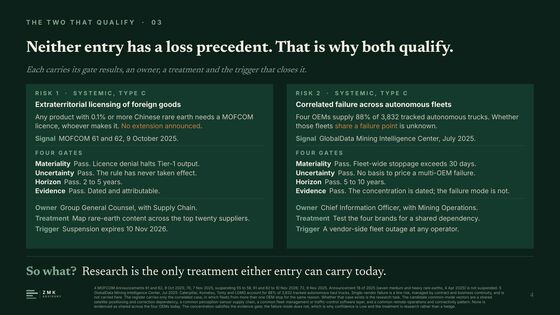
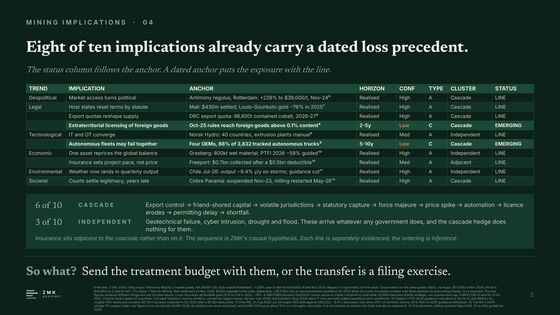
Our Context, Framework, Quantified Impact method, executed and published. Six trends scanned, ten implications evidenced, four gates applied. Two entries survive.
6
Trends scanned
10
Implications
8
To the line
2
Survive
Cycle 1, 2026 · Information cut-off 11 September 2026 · Twelve pages · Seventeen sources, fifteen open access
The method, applied in public
Two published Field Notes on risk the market priced late.
Documentation mistaken for control, and ownership mistaken for control of a market.
21 Jul 2026 · Latin America · Risk
The $100 Billion Illusion of Control
The confusion of documentation with control, priced in lives and market cap.
$19bn Erased in one session
27 Jul 2026 · SE Asia · Nickel
6% to 60%. Control not included.
Owning a market is not controlling it: supply sovereignty, and who actually took the margin.
60% Of world supply
Jurisdictions where the bench has worked are shown on the coverage map →
Priced before it becomes the valuation.
Discuss a risk mandate