Kutei North: The 33-Month Bet
Eni and Petronas have sanctioned up to 2 billion cubic feet a day of deepwater gas off East Kalimantan and set first gas 33 months after the decision. The public record shows how rarely standalone floating facilities meet a date like that, why the closure of the Strait of Hormuz has raised the value of meeting it, and who in Jakarta decides where the gas goes.
- 33 monthsfrom final investment decision on 18 March 2026 to the North Hub first-gas target at the end of 2028
- 2 of 11large floating developments in our sample reached first production within 33 months of sanction, and both were simpler than the North Hub
- 20.6 centswhat the contractor group keeps of each dollar of North Hub gross revenue, on SKK Migas’s plan-approval figures and our calculation
- US$385 millionwhat a US$1 billion overrun would cost the contractors on our simplified calculation; the contract recovers no cost of delay
- 72 per centthe share of North Hub gas Jakarta has allocated to the domestic market
- 2 monthsthe gap between Bontang LNG Train F’s due return in October 2028 and North Hub first gas
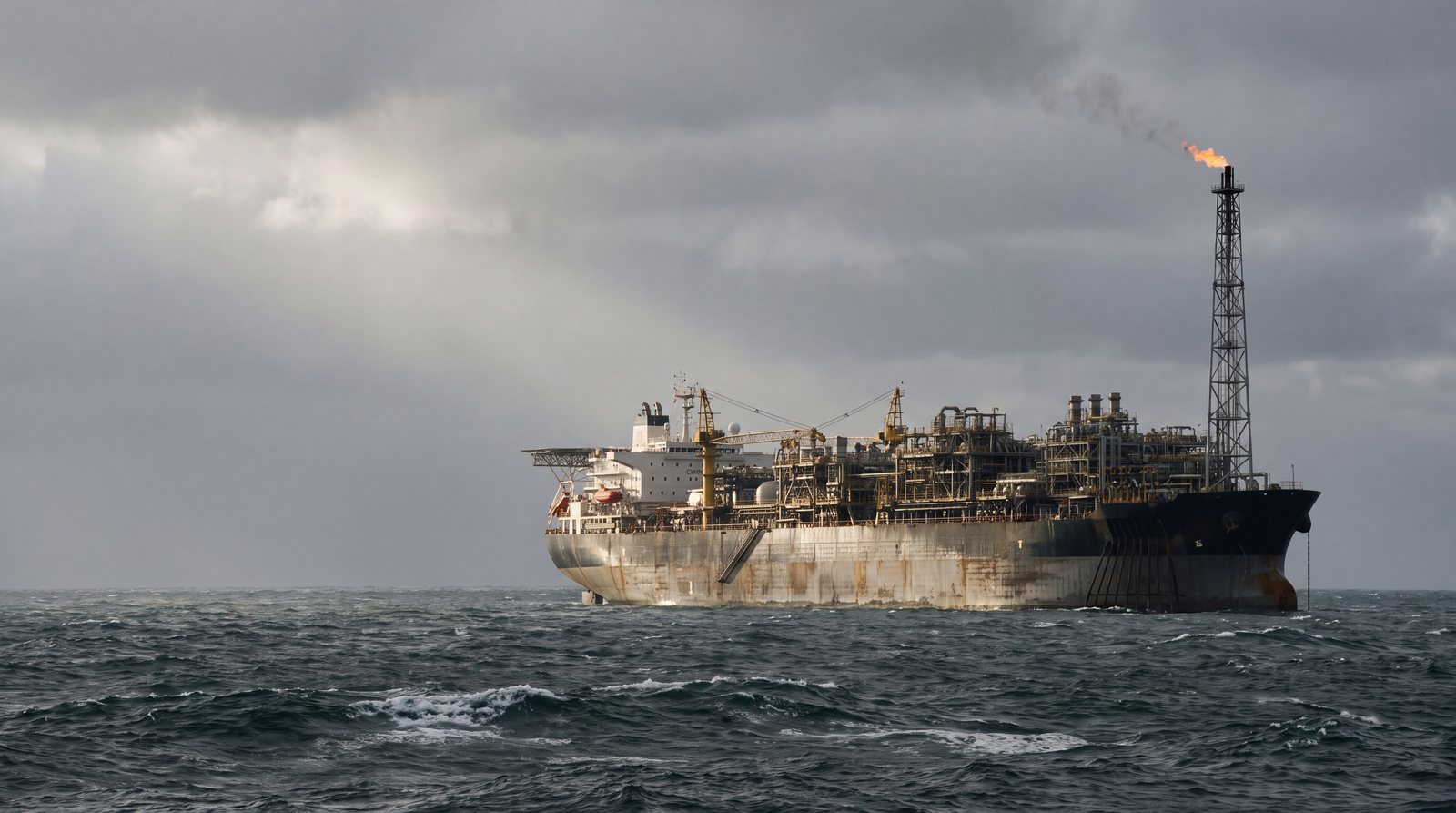
The argument in brief. Kutei North’s value in 2026 depends more on the calendar than on the reservoir. First, the schedule is fast by any public benchmark: of eleven large floating developments reviewed for this article, two reached first production within 33 months of sanction, and both were simpler than the North Hub. Second, the market has made time more valuable: Hormuz has removed about a fifth of the world’s LNG and delayed the easing effect of the expected supply wave by at least two years, so gas that arrives in 2028 meets a tighter market than gas that arrives in 2030. Third, the contract shares an overrun with the state but recovers none of the cost of a delay, and the state decides where 72 per cent of the gas goes. The owner’s task until first gas is to defend the date at the interfaces: a Chinese hull, an Indonesian topsides yard, an uncontracted subsea installation scope and a 1994 LNG train that is due back two months before the gas.
Thirty-three months
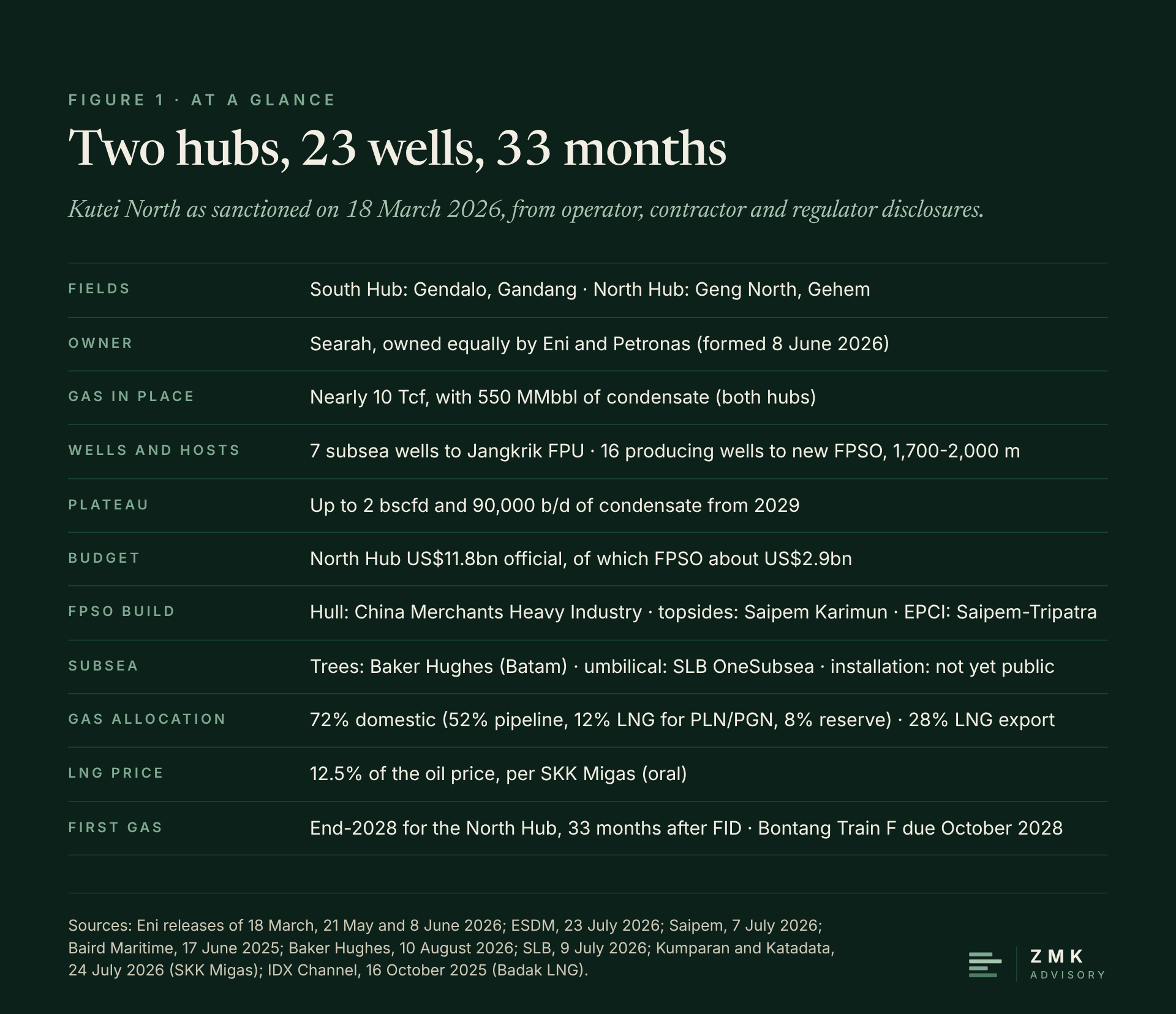
33 months. On 18 March 2026 Eni announced final investment decisions on two deepwater gas hubs in the Kutei Basin, with combined gas initially in place of nearly 10 trillion cubic feet (Tcf), 550 million barrels of condensate, start-up in 2028 and a plateau from 2029 of up to 2 billion standard cubic feet a day (bscfd) and 90,000 barrels a day of condensate.1 Four months later, at the cutting of the first topsides steel, the operator’s director said first gas from the North Hub had been agreed for the end of 2028, under three years from FID.2 From March 2026 to December 2028 is 33 months.
The public record suggests that is a demanding target. The North Hub is a new-build floating production, storage and offloading unit (FPSO) rated above 1 bscfd. Across the eleven large floating developments in ZMK Advisory’s sample (Figure 9), the time from sanction or award to first production ranged from 28 to 85 months. The two that came in under 33 months were Merakes, a subsea tie-back to an existing host,3 and Agogo, an oil FPSO in Angola.4 The other nine took between 39 months, Eni’s Jangkrik, and 85 months, and most clustered between 52 and 85.
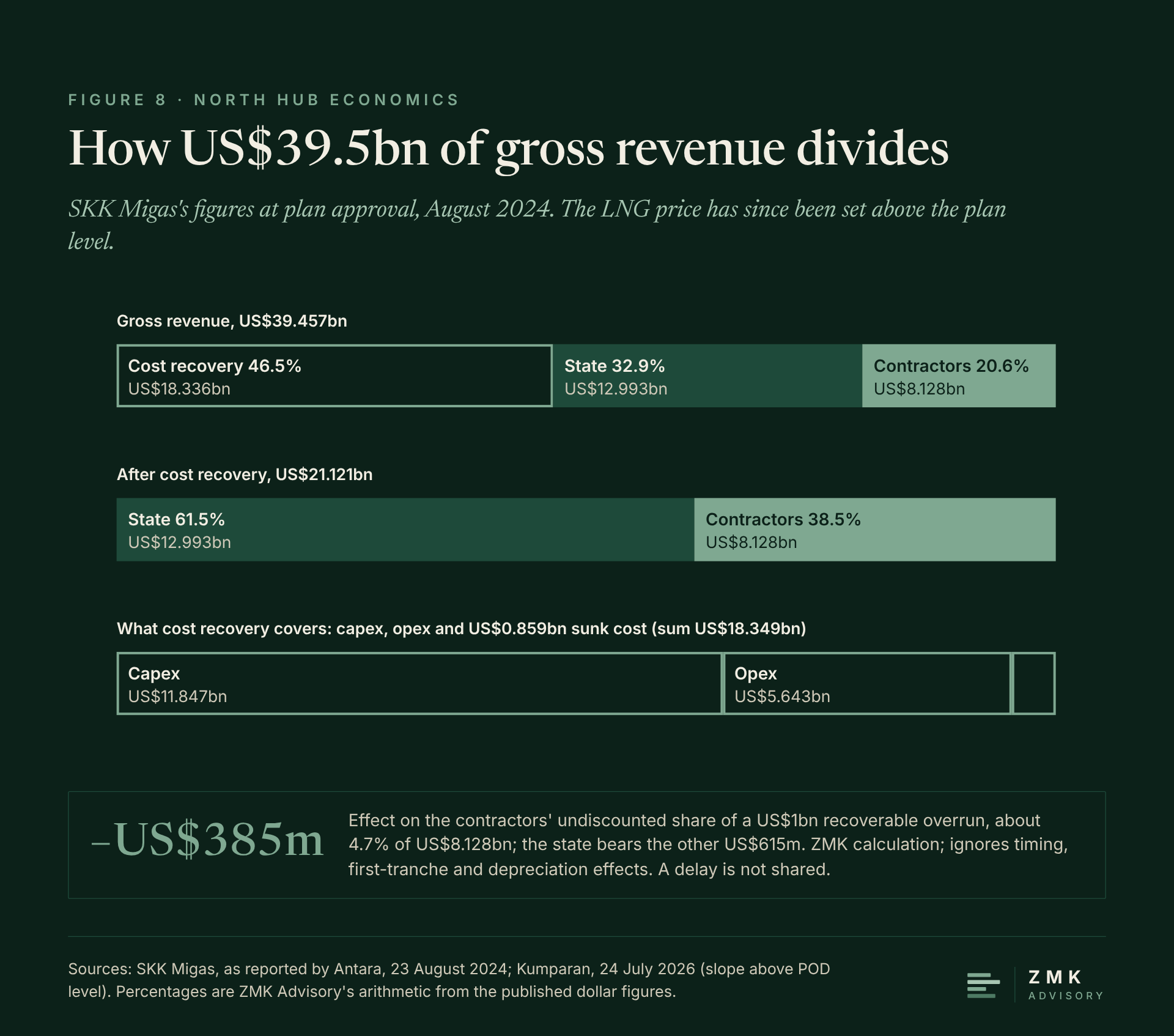
That matters because of what the contract rewards and what the market now pays. On the economics SKK Migas published at plan approval, the contractor group keeps 20.6 cents of every dollar of North Hub gross revenue, after 46.5 cents of cost recovery and 32.9 cents to the state (Section VI).5 A share of that shape absorbs cost overruns better than delay. Since 28 February 2026, when the Strait of Hormuz closed, the market has raised the price of delay as well.6
Why the calendar is worth more in 2026
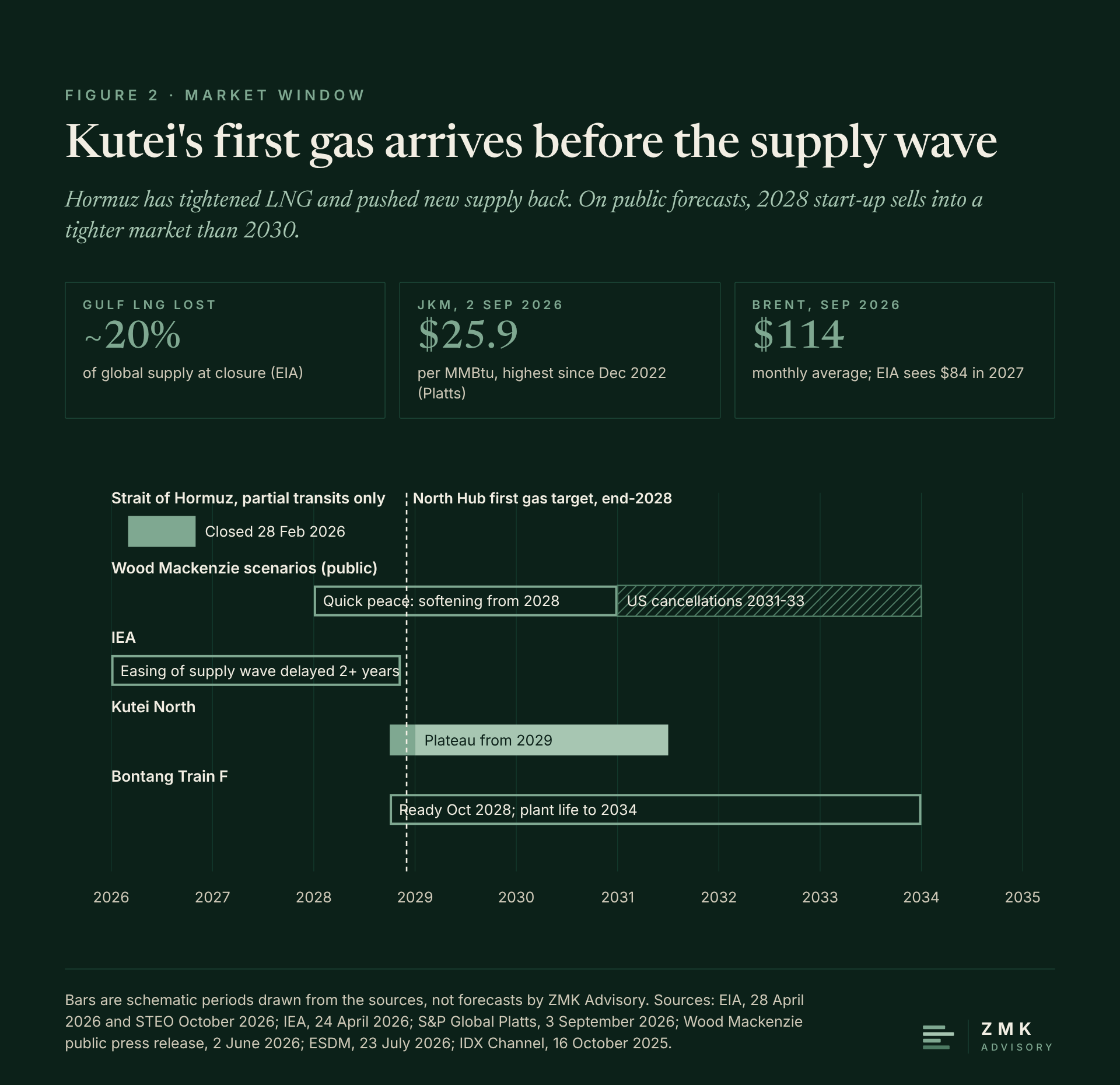
The closure removed about 20 per cent of global LNG supply, mostly from Qatar’s Ras Laffan, and no laden LNG carrier is known to have crossed the strait between 1 March and 24 April, the US Energy Information Administration reported, citing Kpler data.6 The International Energy Agency has since put the cumulative loss of LNG supply from the conflict over 2026 to 2030 at 140 billion cubic metres and expects 2026 supply from Qatar and the UAE to fall by about 45 per cent.7 In April it judged that the easing effect of the wave of new LNG supply expected later this decade would be delayed by at least two years.8
Prices followed. The Asian spot benchmark, JKM, reached about US$25.9 per million British thermal units (MMBtu) for October delivery on 2 September, its highest since December 2022.9 Brent averaged US$114 a barrel in September, and the EIA expects US$105 in the fourth quarter and US$84 in 2027.10
The tight market has a horizon. Wood Mackenzie’s public scenarios of June 2026 show markets softening from 2028 if peace comes quickly, with US cargo cancellations concentrated in 2031 to 2033; a later settlement pushes the imbalance back about a year, and an extended disruption keeps markets tight through 2030.11 On any of those paths, LNG from Kutei that starts in 2028 and 2029 arrives in a tighter market than LNG that starts two years later.
Kutei’s LNG is linked to oil, not to spot LNG. The head of SKK Migas, Djoko Siswanto, said in July that North Hub LNG would be priced at 12.5 per cent of the world oil price, higher than the level assumed in the plan of development.12 On a ZMK Advisory calculation, before any constant term, that is US$13.1 per MMBtu at the EIA’s fourth-quarter Brent forecast and US$10.5 at its 2027 average. The oil link captures part of the crisis premium while it lasts, and less of it as Brent falls.
Twenty-eight years from discovery
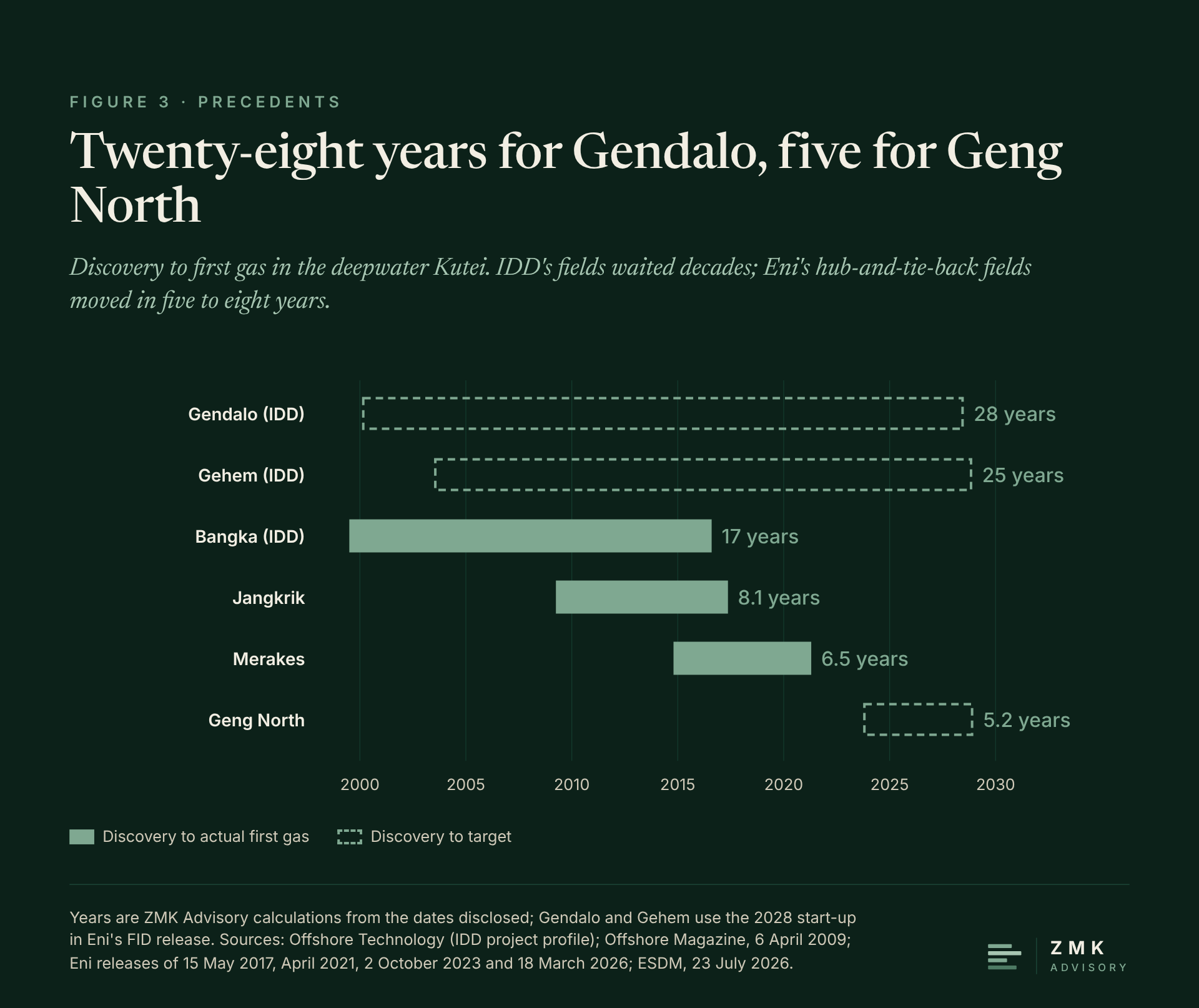
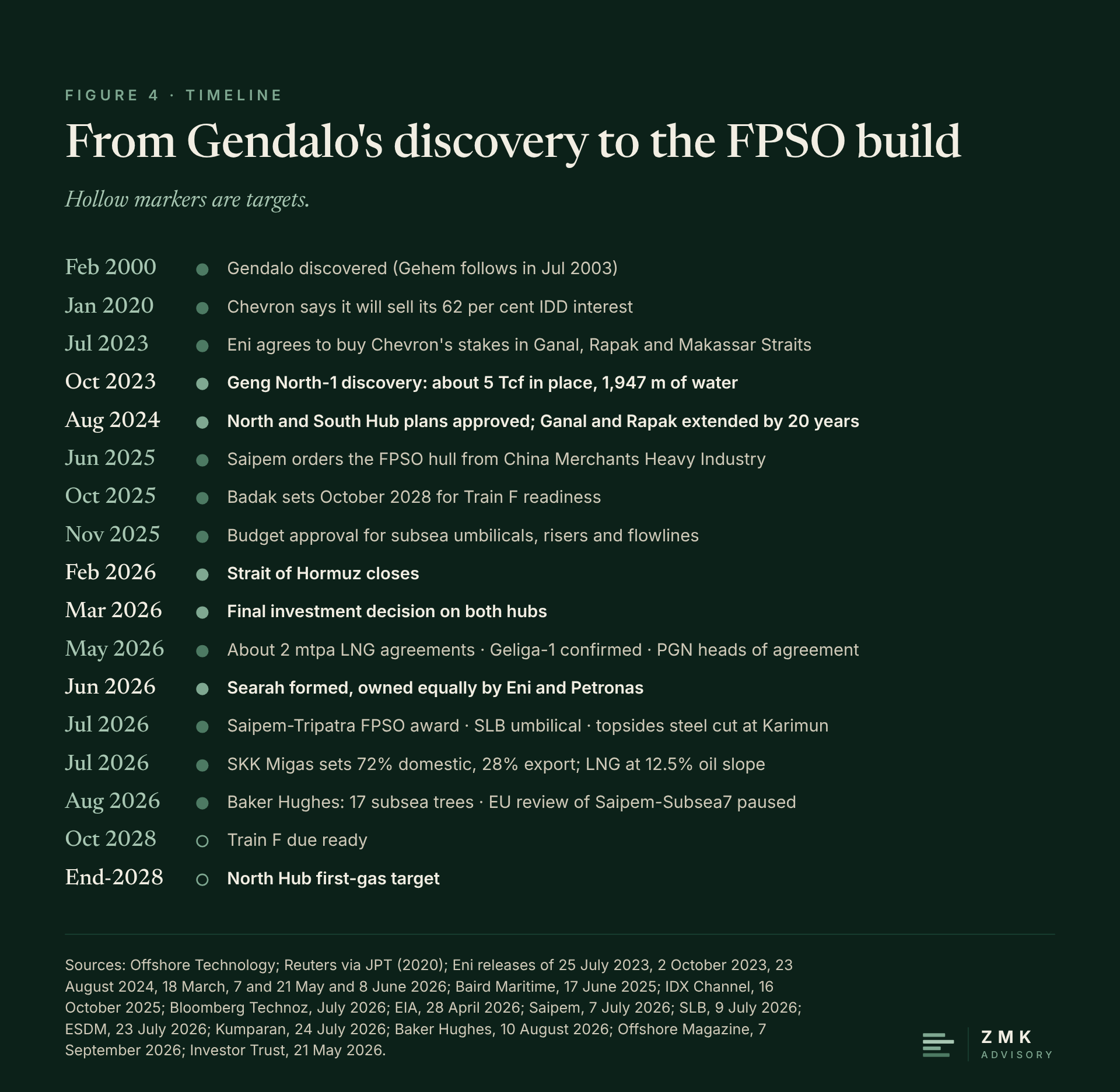
The North Hub’s speed stands out against the basin’s history. Gendalo was discovered in February 2000 and Gehem in July 2003, in the area later known as the Indonesia Deepwater Development (IDD), operated by Chevron; only the small Bangka field, found in 1999, reached production, in August 2016.13 In its annual report for 2019, filed in February 2020, Chevron said the IDD did not compete in its portfolio and that it was evaluating strategic alternatives for its 62 per cent interest; the same filing gave 2027 and 2028 as the expiry dates of its offshore eastern Kalimantan contracts.14
Eni consolidated the basin. Already a 20 per cent partner in Ganal and Rapak, it agreed in July 2023 to buy Chevron’s 62 per cent in both and 72 per cent of Makassar Straits.15 Ten weeks later the Geng North-1 well, in 1,947 metres of water about 85 kilometres offshore, found a gas column of about 50 metres in Miocene sandstone; it tested at a facility-limited 80 to 100 million standard cubic feet a day (mmscfd), and Eni estimated 5 Tcf of gas and up to 400 million barrels of condensate in place.16 The plan of development was approved ten months later, in August 2024,5 alongside a 20-year extension of the Ganal and Rapak licences.17 The South Hub kept cost recovery, and SKK Migas put the overall tax rate at 37.5 per cent, against the 44 per cent initially set for the IDD block.18 FID followed in March 2026, which Eni described as 18 months after plan approval.1
On the dates now in the record, Gendalo reaches first gas about 28 years after discovery and Gehem about 25. Geng North’s target is about 5.2 years. Eni’s own Kutei precedents sit between: Jangkrik, discovered in April 2009, started in May 2017;19 Merakes, found in 2014, started in April 2021.3 Indonesia’s other LNG projects show the range of outcomes. BP’s Tangguh expansion, sanctioned in 2016 for start-up in 2020 at an expected US$8 billion,20 shipped its first cargo from the new train in October 2023.21 INPEX’s Abadi, in the Masela block, was targeting FID by 2027 as of February 2025, when the energy minister threatened to revoke the concession unless the project showed progress.22
The corporate wrapper changed in June 2026. Eni and Petronas formed Searah, owned equally, with 19 gas assets (14 in Indonesia, five in Malaysia), more than 3 billion barrels of oil equivalent (boe) of discovered resources, more than 300,000 boe a day at start, a target above 500,000 within three years, more than US$20 billion of planned investment over five years and a US$6 billion revolving credit facility.23 Searah’s Malaysian arm took over operatorship of five Malaysian assets from Petronas Carigali on 1 July.24 The pipeline behind the hubs keeps growing: Konta-1 in the Muara Bakau block found about 600 billion cubic feet of gas in place in December 2025, near existing facilities;25 Geliga-1 in the Ganal block found about 5 Tcf and 300 million barrels in April 2026, next to the 2 Tcf Gula discovery, and Eni proposes a third hub on the North Hub design.26
The machine
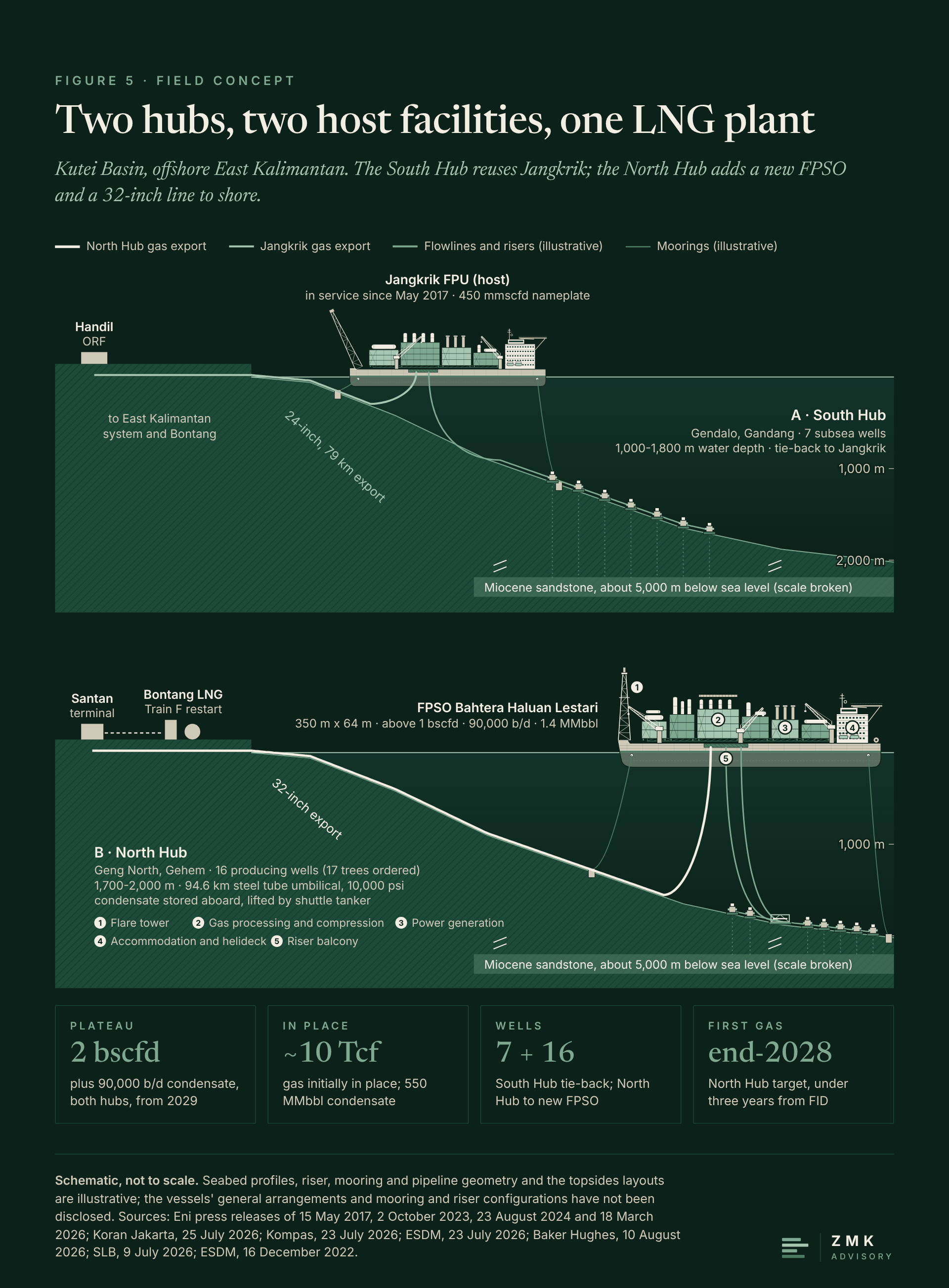
The South Hub is the lower-risk half. Seven subsea wells in 1,000 to 1,800 metres of water tie back to the Jangkrik floating production unit.1 Eni started Jangkrik in May 2017, three and a half years after sanction and ahead of schedule, with output rising to 450 mmscfd;27 by December 2022 it was handling 670 mmscfd against that design capacity, with Merakes gas, and exporting through a 24-inch, 79-kilometre line to Handil.28 Gendalo and Gandang are planned to hold Jangkrik’s plateau, then close to 750 mmscfd, for at least 15 more years.17
The North Hub is new-build. Sixteen producing wells in 1,700 to 2,000 metres of water feed an FPSO rated above 1 bscfd of gas and 90,000 barrels a day of condensate, with 1.4 million barrels of storage.1 The vessel, Bahtera Haluan Lestari, will be 350 metres long and 64 metres wide, the operator’s director told Kompas.29 Gas goes ashore through a 32-inch export line to the Santan terminal; the official budget is US$11.8 billion, of which about US$2.9 billion is the FPSO.2
The build is spread across a Chinese hull yard and four Indonesian sites. Saipem ordered the hull from China Merchants Heavy Industry in June 2025, its second hull from that group after the Kaminho FPSO.30 The FPSO contract itself, worth about US$2 billion to Saipem over an estimated 48 months, went to PT Saipem Indonesia and PT Tripatra on 7 July 2026, and Saipem disclosed it as a related-party transaction.31 Topsides steel was cut at Saipem’s Karimun yard on 23 July 2026,2 the yard where PT Saipem Indonesia built Jangkrik’s topside modules.28 SKK Migas named fabrication at Bintan, Batam and Karimun and more than 8,000 Indonesian jobs.29 Baker Hughes will build 17 deepwater horizontal trees in Batam, after an earlier order for the FPSO’s flash gas compressors.32 SLB OneSubsea will make 94.6 kilometres of steel tube umbilical rated to 10,000 psi for depths to 2,200 metres.33
The hull order resolves part of a puzzle. A 48-month contract counted from the July 2026 award runs to July 2030, about nineteen months after the first-gas target. Counted from the hull order a year earlier, it runs to mid-2029, about six months after it. On that reading, which neither company has confirmed, first gas would precede contractual completion by a few months, a common pattern when a contract runs through performance testing. The inference is ZMK’s; the dates are the companies’.
Who gets the gas, and at what price
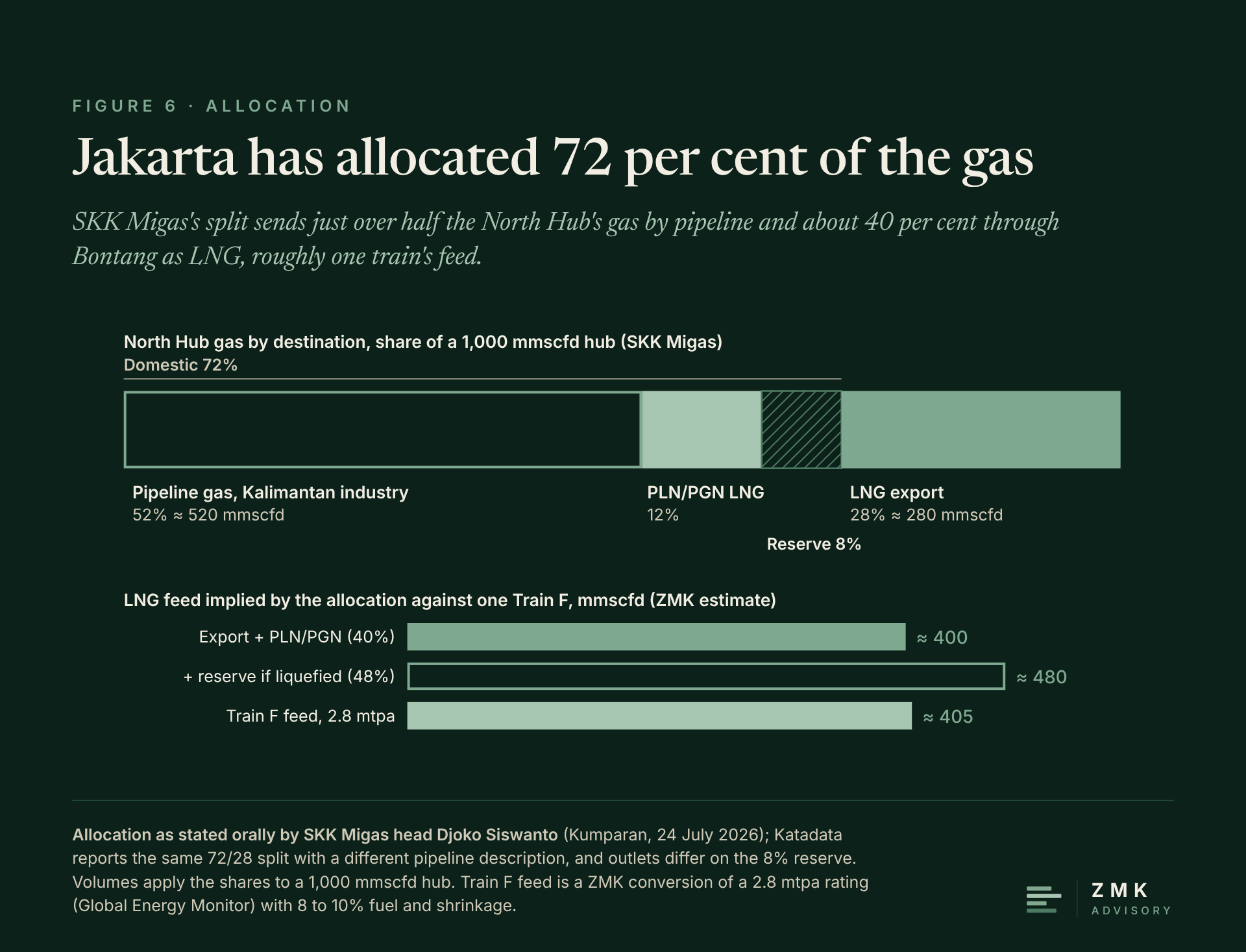
Jakarta has decided most of it. SKK Migas says 72 per cent of North Hub gas will go to the domestic market and 28 per cent to export. Within the domestic share, Djoko Siswanto gave 52 per cent as pipeline gas for industry in Kalimantan, 12 per cent as LNG for PLN and PGN and 8 per cent as a reserve.12 Katadata reported the same 72 to 28 split with a different description of the pipeline share, and outlets differ on what the 8 per cent reserve is for.34
The numbers fit together better than the earlier disclosures did. Eni’s three long-term agreements for about 2 million tonnes a year (mtpa) of LNG from the two hubs,35 equivalent on a ZMK conversion to roughly 290 mmscfd of feed gas, are of the same order as the 28 per cent export tranche of a 1,000 mmscfd North Hub, although the agreements also draw on South Hub gas. The export tranche and the PLN and PGN tranche together come to 40 per cent of the gas, about 400 mmscfd, roughly the feed for one train the size of Bontang’s Train F. If the 8 per cent reserve is also liquefied, the requirement passes one train.
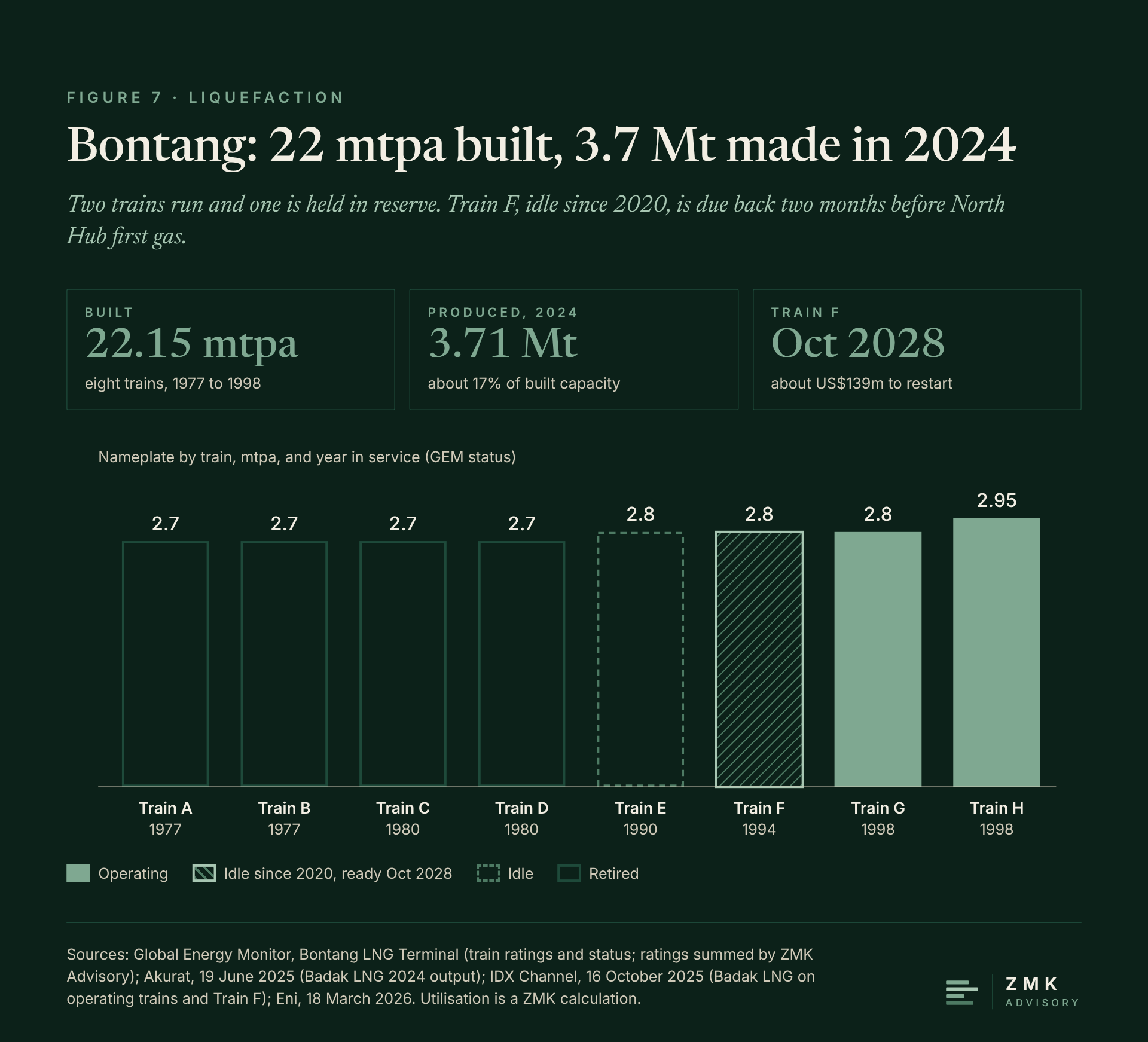
That puts the restart of Train F on the critical path. Bontang was built as eight trains between 1977 and 1998, about 22 mtpa on ZMK’s sum of the ratings in Global Energy Monitor’s register.36 In 2024 it produced 3.71 million tonnes, Badak LNG reported.37 Two trains operate and one is held in reserve; Train F has been idle since 2020, and Badak expects it ready in October 2028 at a cost of about US$139 million, extending the plant’s expected life from 2028 to 2034.38 On those dates the train is due back two months before the gas. Badak’s spokesman was reported as warning that upstream must not start before the train is ready.38
The domestic share follows from a national shortage. PGN told parliament in April 2025 that Indonesia faced gas shortfalls rising from 177 mmscfd in 2025 to 390 mmscfd in 2028 and 534 mmscfd by 2034, concentrated in West Java and Sumatra.39 In January 2025 the energy minister asked the President to approve prioritising all gas concessions for domestic needs, with exports only once those needs are met, a plan reported as an export moratorium; in the first nine months of 2024, 23.9 per cent of Indonesia’s gas had been exported as LNG and 7.7 per cent by pipeline.40 Seven industrial sectors buy gas at a regulated US$6.5 per MMBtu for feedstock and US$7 for fuel.41 There is no pipeline from East Kalimantan to Java, which on ZMK’s reading is why 12 per cent of the gas is allocated as LNG for PLN and PGN. PGN signed heads of agreement for North Hub and South Hub LNG in May 2026 without disclosing volumes.42 SKK Migas says the pipeline gas will be priced on a floor plus a product-linked formula;12 those terms have not been published.
What the contract shares
SKK Migas’s plan-approval figures divide the North Hub’s projected gross revenue of US$39.457 billion into US$18.336 billion of cost recovery, US$12.993 billion to the state and US$8.128 billion to the contractors.5 On ZMK’s arithmetic that is 46.5, 32.9 and 20.6 per cent; after costs are recovered, the state takes 61.5 per cent of what remains and the contractor group 38.5 per cent. The projection’s price assumptions were not published, and the LNG slope has since been set above the plan level, so these shares describe the approved case rather than today’s.
Cost recovery shares an overrun. Recoverable cost comes out of gross revenue before the split, so on the plan ratio the contractors bear about 38.5 cents of each extra dollar and the state about 61.5 cents. On that simplified, undiscounted ZMK calculation, which ignores timing and first-tranche effects, a US$1 billion overrun would cut the contractors’ share by about US$385 million, or 4.7 per cent of US$8.128 billion. Tangguh’s expansion illustrates the mechanism: when it ran late and over budget, analysts expected the state ultimately to pay for the overrun because the train sat under cost recovery.43
Delay is not shared. A year’s slip defers every party’s revenue and the contract recovers no cost of time. In 2026 it also moves the first cargoes out of the tightest part of the market cycle (Section II). Recoverability is administered as well: on approving the plan, SKK Migas said it would work to make cost recovery more efficient.5 The balance of the contract, and of the market, therefore weights the calendar above the budget.
How floating projects lose time
The best public evidence on FPSO delivery is old but consistent. The Independent Project Analysis study of 96 FPSOs found that fewer than one in five delivered close to schedule, returned unused contingency and operated as expected; the average overran its sanction estimate by US$270 million, and projects without an integrated owner team showed 22 per cent more cost growth and 15 per cent more schedule slip.44 Douglas-Westwood found 30 of 45 FPSOs installed in 2008 to 2012 were delayed, and in a review of nine of them identified hull and topsides integration as the main cause.45 More recently, Welligence put the average for standalone offshore projects sanctioned since 2019 at about 50 months to delivery, with a typical year of delay and a 22 per cent cost overrun.46 In the US Gulf of Mexico, large floating units sanctioned after 2014 took about 47 months from sanction to first production, against about 34 before.47
The named cases show where the time goes. Equinor’s Johan Castberg, planned for first oil in 2022,48 came on stream on 31 March 2025.49 Equinor attributed a first one-year delay to welding quality on the hull at the Sembcorp Marine yard in Singapore,50 and later slippage to a heavier than expected workload at Stord in Norway.51 Woodside’s Sangomar, sanctioned in January 2020 for first oil in early 2023,52 started in June 2024;53 its FPSO needed unexpected remedial work at the Singapore yard.54 Equinor’s Bacalhau, sanctioned in June 2021 for 2024, started in October 2025.55 Santos’s Barossa, sanctioned in March 2021, slipped about three months to September 2025 for legal rather than yard reasons.56 The projects that held their dates involve Eni: Agogo, operated by Eni’s Angolan joint venture Azule Energy, reached first oil 29 months after FID,4 Merakes 28 months after FID as a tie-back,3 and Coral Sul FLNG, though not fast at 65 months, shipped its first cargo in November 2022 in line with the plan set at its 2017 FID.57
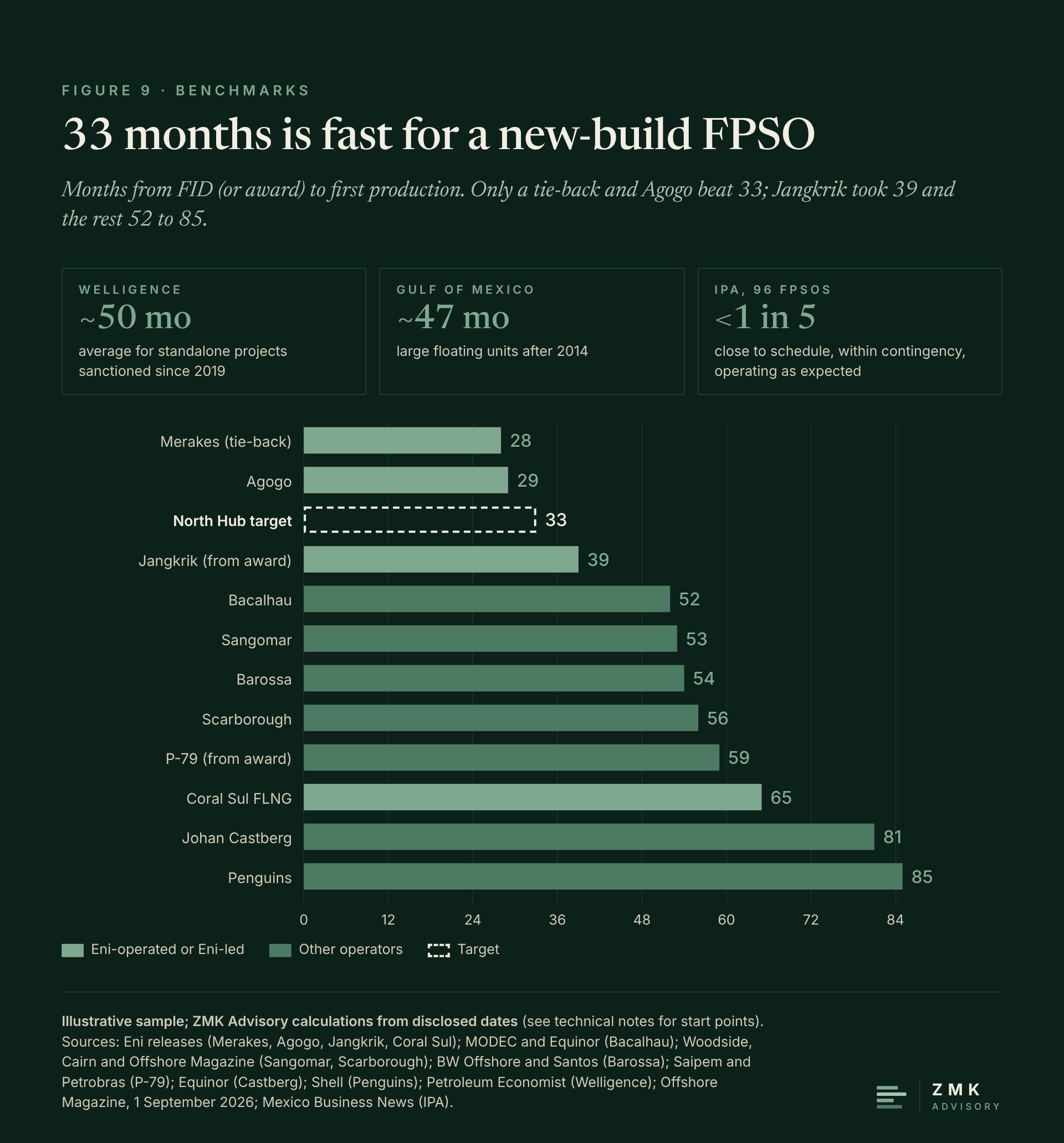
The pattern is ZMK’s reading, not a statistic. Projects that slipped did so late, at integration, commissioning or hook-up, when design changes and late vendor packages meet. The North Hub’s hull is in China, its topsides at Karimun and its trees in Batam, and the integration site, sail-away date and hook-up window have not been published. Eni’s record at Jangkrik and Agogo is the strongest argument that the date can hold.
The risk register
Ten risks follow, ordered by ZMK Advisory’s judgement of their consequence for value. The ratings are qualitative judgements on the public record.
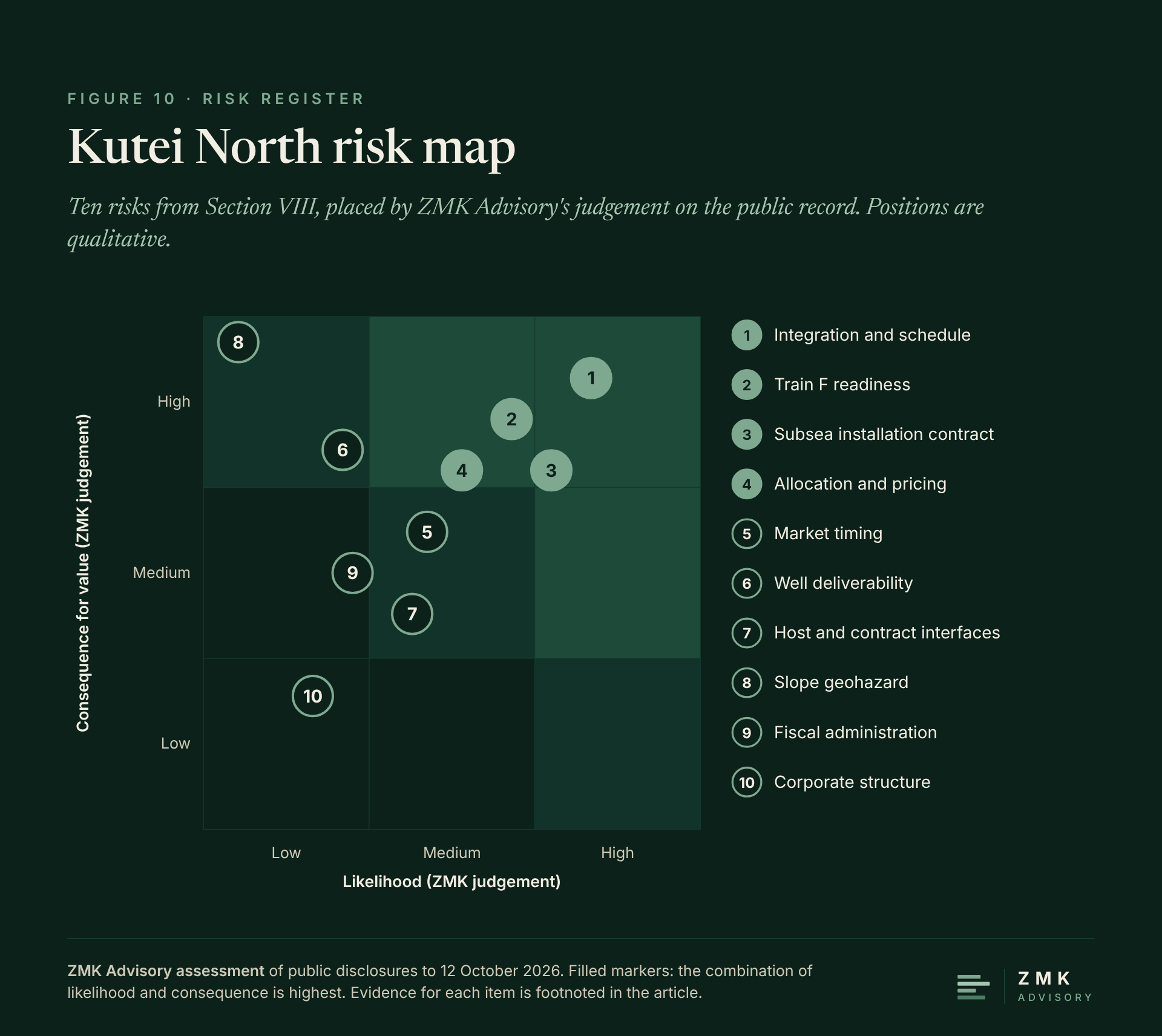
1. Integration and schedule (high). A 33-month target for a new-build FPSO of this capacity has few public precedents (Section VII), and the FPSO grew after the plan: from about 1 bscfd, 80,000 barrels a day and 1 million barrels of storage in August 202417 to above 1 bscfd, 90,000 barrels a day and 1.4 million barrels at FID,1 40 per cent more storage on ZMK’s arithmetic. Baird Maritime’s report of the June 2025 hull order still described 1 million barrels of storage,30 which on ZMK’s reading means the larger specification was set after the hull was ordered. Watch: integration site, sail-away date, topsides weight control.
2. Train F readiness (high). Badak’s October 2028 readiness date leaves about two months before first gas, for a train idle since 2020.38 If the LNG tranches exceed one train’s feed, a second restart is needed. Watch: Badak’s assessment results and the recommissioning contract.
3. Subsea installation contract (high). The budget for umbilicals, risers and flowlines was approved in November 2025,58 but no installation award was located in the public record reviewed for this article. Two of the leading contractors for that work are mid-merger: the European Commission opened an in-depth investigation in July, describing Saipem and Subsea7 as two of the three market leaders in subsea umbilicals, risers and flowlines with very few credible alternatives,59 and trade press reported the clock stopped on 25 August.60 Watch: the installation award and vessel allocation.
4. Allocation and pricing (medium to high). The 72 per cent domestic allocation, the 12.5 per cent slope and the pipeline formula are oral statements and press reports, not published contract terms.12 Indonesia’s energy minister proposed an export moratorium in 2025,40 and its domestic shortfall widens through the decade.39 Watch: signed gas sales agreements and export approvals for 2028 and 2029 cargoes.
5. Market timing (medium). The window favours 2028 start-up only if it stays open. A quick peace would soften markets from 2028, and the oil link would pass a falling Brent straight through to the LNG price.11 Watch: Hormuz transits and the EIA’s Brent path.10
6. Well deliverability (medium). Sixteen wells must deliver more than 1,000 mmscfd, at least 62.5 mmscfd a well on ZMK’s arithmetic; Geng North-1 tested at a facility-limited 80 to 100 mmscfd.16 Single-well tests, the only ones in the public record, support the volumes in place; development wells will establish connectivity. Baker Hughes’s order is for 17 trees against 16 producing wells,32 which the releases do not explain. Watch: development well results.
7. Host and contract interfaces (medium). Jangkrik sits in the Muara Bakau contract, whose term the energy ministry records as 2002 to 2032,28 while Gendalo-Gandang is planned to hold its plateau for at least 15 years. ZMK has not located a public record of an extension. Gehem spans the Ganal and Rapak areas and Geng North lies in North Ganal,5 so one FPSO serves contract areas with different partners. Watch: Muara Bakau’s term and unitisation agreements.
8. Slope geohazard (low frequency, high consequence). A peer-reviewed study maps mass transport deposits in the Makassar Strait of up to 650 cubic kilometres, mostly sourced from the Mahakam pro-delta with the largest skewed to the south, and tentatively puts failures above 100 cubic kilometres at about one every 500,000 years.61 The exposure matters for routing a 32-inch line across the slope. Watch: route survey disclosures.
9. Fiscal administration (medium). The overall tax rate was revised from the 44 per cent initially set for the IDD block to 37.5 per cent,18 and cost recovery is approved item by item. Terms that were revised once can be revised again. Watch: the pace of SKK Migas cost approvals.
10. Corporate structure (low to medium). Searah is new and equally owned. The North Ganal operating company appears as Eni North Ganal in Saipem’s July award31 and as Searah North Ganal in Baker Hughes’s August release.32 Agra Energi, holder of 16.7 per cent of North Ganal, was reported by Bloomberg in October 2024 to be weighing a sale valued at US$300 million to US$500 million,62 which would imply US$1.8 billion to US$3.0 billion for the whole block on a simple pro rata ZMK calculation; no completed sale has been reported. On 12 October 2026 Eni signed agreements to sell its retained 10 per cent: to Pertamina in North Ganal, Rapak and East Sepinggan, the North Hub blocks, and to Medco in Ganal, West Ganal, East Ganal and Muara Bakau, the South Hub and Geliga blocks. Both sales await government approval, and no price was disclosed.63 Watch: approval and closing of both sales, any disclosed price, and the Agra Energi stake.
What decides the outcome
Three dates will show whether Kutei North earns its 20.6 cents. The first is first gas from Bahtera Haluan Lestari against the end-2028 target. The second is Train F’s readiness against the same date. The third is the subsea installation award, a major scope not yet visible in the public record. The Geliga plan sits behind them: Eni puts Geliga and Gula at a combined potential of about 1,000 mmscfd and 80,000 barrels a day,26 enough for a third hub on the same design, but Bontang has no spare capacity for it without further restarts.
The near-term tests for partners, lenders and contractors:
- the integration site, sail-away date and hook-up window for the FPSO;
- Badak’s recommissioning contract and schedule for Train F;
- the subsea installation award, and the Commission’s decision on Saipem and Subsea7;
- signed gas sales agreements for the pipeline and LNG tranches;
- the price paid for any minority stake in the Kutei blocks.
In ZMK Advisory’s experience of deepwater developments, returns are decided at the interfaces between contracts, facilities and the state. On Kutei North, each of those interfaces now has a date in the public record, and each can be tracked.
Technical notes
Benchmark sample (Figure 9). Months from FID or award month to first production month: Merakes 28 (FID December 2018 to April 2021), Agogo 29 (February 2023 to July 2025), Jangkrik 39 from the FPU award (February 2014 to May 2017; Eni gives three and a half years from sanction), Bacalhau 52, Sangomar 53, Barossa 54, Scarborough 56 (first gas July 2026), P-79 59 (from contract award), Coral Sul 65 (to first cargo), Johan Castberg 81 (from parliamentary approval, June 2018), Penguins 85. The sample is illustrative, not random, and mixes oil and gas, new-build and converted hulls, and FID and award start points; it is used for order of magnitude only. Merakes’s FID month comes from trade press. The North Hub figure is a target.
Discovery to first gas (Figure 3). Bangka 1999 to August 2016; Gendalo February 2000 and Gehem July 2003 to the 2028 first-gas target; Jangkrik April 2009 to May 2017; Merakes 2014 to April 2021; Geng North October 2023 to the end-2028 target.
The 48-month question. Saipem gives an estimated duration without a start point. The two readings in Section IV count from the award (7 July 2026) and from the hull order (June 2025). Neither is confirmed.
POD economics. As reported by Antara: the three components sum to the gross revenue. The report’s printed percentages (31.5, 19.7, 44.4) do not reconcile with its dollar figures; ZMK recomputed (32.93, 20.60, 46.47). Cost recovery is within US$13 million of capex, opex and sunk cost combined. The report does not state whether the contractor share is before or after the contractors’ income tax.
Allocation and conversions. One tonne of LNG is taken as about 48,700 standard cubic feet, so 1 mtpa is about 133 mmscfd of product; with plant fuel and shrinkage of about 8 to 10 per cent, 2 mtpa needs about 290 mmscfd of feed and a 2.8 mtpa train about 400 to 415 mmscfd. Percentages of the 1,000 mmscfd hub are applied to its nameplate; actual volumes will vary with plateau and decline. The 12.5 per cent slope is applied to Brent for illustration; SKK Migas referred to the world oil price without naming a marker.
Investment figures. The ESDM release attributes US$11.8 billion for the North Hub, including about US$2.9 billion for the FPSO, to SKK Migas’s head. Katadata attributes about US$15 billion and US$3 billion to him at the same event;64 Indonesia Business Post reports the same figures without attribution and quotes him referring to an event next year for a “second FPSO” of roughly the same scale,65 which ZMK has not been able to reconcile with the one-FPSO concept in Eni’s releases. SKK Migas gave US$14.8 billion for both hubs in May 2024. The FPSO is about US$2.9 billion in the official release and about US$3 billion in some reports.
Jangkrik export. ESDM gives the Jangkrik export destination as Handil; Eni’s 2021 Merakes release gives Senipah.
Dimensions. The operator’s director gave 350 by 64 by 32 metres and about 147,000 tonnes to Kompas; two outlets report about 300 by 45 metres. ZMK uses the operator’s figures.
Bontang. Train ratings from Global Energy Monitor sum to 22.15 mtpa; other sources give 22.5 mtpa nameplate. 2024 output of 3.71 million tonnes is about 17 per cent of the GEM total.
Prices. Brent from the EIA’s October 2026 Short-Term Energy Outlook; daily market data from other vendors differ. JKM from S&P Global Platts for October delivery.
Deliberately omitted. Wood Mackenzie subscription research, which informed the lines of inquiry but is not quoted or relied on; its public press release of 2 June 2026 is cited. Also omitted: estimates of project returns, which the public record does not support, and a July 2026 keel-laying date reported by one outlet alongside the steel cut, which no operator or contractor release confirms.
Disclosure
Derived figures. The 33-month and other intervals, the benchmark comparisons, the revenue shares and post-recovery split, the overrun sensitivity, the LNG price illustrations, the allocation conversions, the Bontang utilisation, the implied block valuation and the per-well rate are ZMK Advisory’s arithmetic on the cited sources. The risk ratings in Section VIII and Figure 10 are ZMK Advisory’s judgement.
Interests. Neither ZMK Advisory nor its principal holds a position, long or short, direct or derivative, in Eni, Saipem, Subsea7, Petronas-listed entities, Baker Hughes or SLB, other than through broad market index funds. ZMK Advisory has no engagement with any party named in this article.
Status. This article relies on the public documents cited. The Commission’s review of Saipem and Subsea7 is open and nothing here anticipates its outcome. Nothing in this article asserts unlawful conduct by any party.
Not investment research. This is commentary and analysis. It is not a recommendation to buy, sell or hold any security.
Sources
- 1 Eni, “Eni moves forward with major deep water gas hubs in Indonesia with dual FIDs,” press release, 18 March 2026. Source for the FIDs, POD approval in 2024, start-up in 2028 and plateau in 2029 of up to 2 bscfd and 90,000 bpd, GIIP of nearly 10 Tcf and 550 million barrels of condensate, the seven South Hub wells tied back to Jangkrik, the 16 North Hub wells, the FPSO’s capacity above 1 bscfd and 90,000 bpd with 1.4 million barrels of storage, and Train F’s reactivation. Operator’s primary disclosure. https://www.eni.com/en-IT/media/press-release/2026/03/eni-moves-forward-with-major-deep-water-gas-hubs-in-indonesia-with-dual-fids.html
- 2 Ministry of Energy and Mineral Resources (ESDM), “Pemotongan Baja FPSO Dimulai, North Hub Masuki Tahap Konstruksi,” 23 July 2026. Source for the first steel cut at Tanjung Balai Karimun, the FPSO’s name, US$11.8 billion of investment with about US$2.9 billion for the FPSO, 16 wells, the 32-inch line to Terminal Santan, the milestones from POD to steel cut, and the first-gas target agreed for the end of 2028, under three years from FID, stated by Mirko Araldi, Director of Eni North Ganal. https://www.esdm.go.id/en/media-center/news-archives/pemotongan-baja-fpso-dimulai-north-hub-masuki-tahap-konstruksi
- 3 Eni, “Eni starts gas production from the Merakes project offshore Indonesia,” press release, April 2021, with LNG Industry (18 April 2018) for plan approval. Source for Merakes’s start-up on 26 April 2021 as a tie-back to Jangkrik; discovery in 2014 and FID in December 2018 per trade reporting. https://www.eni.com/en-IT/media/press-release/2021/04/eni-starts-gas-production-merakes-project-offshore-indonesia.html
- 4 Eni, “Eni announces start-up of Agogo Integrated West Hub offshore Angola,” press release, 1 August 2025. Source for first oil 29 months after FID. https://www.eni.com/en-IT/media/press-release/2025/08/eni-announces-start-up-of-agogo-integrated-west-hub-offshore-angola.html
- 5 Antara, Indonesia’s national news agency, “ESDM setujui POD migas Geng North-Gehem senilai Rp280 triliun,” 23 August 2024, reporting SKK Migas’s Hudi D. Suryodipuro. Source for the ministerial approval, approval ten months after discovery, Gehem spanning the Ganal and Rapak areas, capex of US$11.847 billion excluding sunk cost, opex of US$5.643 billion, sunk cost of US$859 million, gross revenue of US$39.457 billion, government share of US$12.993 billion, contractor share of US$8.128 billion, cost recovery of US$18.336 billion, and SKK Migas’s stated aim of more efficient cost recovery. https://www.antaranews.com/berita/4281527/esdm-setujui-pod-migas-geng-north-gehem-senilai-rp280-triliun
- 6 US Energy Information Administration, “International LNG prices rise amid Strait of Hormuz closure,” Today in Energy, 28 April 2026. Source for the closure on 28 February 2026, no laden LNG carrier crossing between 1 March and 24 April (Kpler data), more than 10 Bcf/d disrupted, about 20 per cent of global LNG supply, and QatarEnergy’s force majeure. US government statistical agency. https://www.eia.gov/todayinenergy/detail.php?id=67604
- 7 International Energy Agency, Gas Market Report, Q3-2026, executive summary. Source for cumulative LNG supply losses from the conflict of 140 bcm over 2026 to 2030 and the forecast fall of about 45 per cent in 2026 supply from Qatar and the UAE. https://www.iea.org/reports/gas-market-report-q3-2026/executive-summary
- 8 International Energy Agency, “Middle East crisis disrupts international natural gas markets and delays global LNG supply wave,” press release, 24 April 2026. Source for close to 20 per cent of global LNG supply removed and the easing impact of the LNG supply wave delayed by at least two years. https://www.iea.org/news/middle-east-crisis-disrupts-international-natural-gas-markets-and-delays-global-lng-supply-wave
- 9 S&P Global Commodity Insights (Platts), “JKM soars to highest since December 2022 as Middle East war shuts arbitrage window,” 3 September 2026. Source for the October JKM assessment of about US$25.9/MMBtu on 2 September and the absence of LNG carrier transits after 17 August. https://www.spglobal.com/energy/en/news-research/latest-news/lng/090326-jkm-soars-to-highest-since-december-2022-as-middle-east-war-shuts-arbitrage-window
- 10 US Energy Information Administration, Short-Term Energy Outlook, October 2026, released 6 October 2026. Source for Brent’s September average of US$114/b, the forecasts of US$105/b for the fourth quarter of 2026 and US$84/b for 2027, and the assumption that Middle East flows stay constrained through the fourth quarter. https://www.eia.gov/outlooks/steo/archives/oct26.pdf
- 11 Wood Mackenzie, “Wood Mackenzie models three global LNG market scenarios as Iran conflict removes 20% of global supply,” public press release, 2 June 2026. Source for the three scenarios: softening from 2028 with US cancellations particularly in 2031 to 2033 (quick peace), the imbalance arriving about a year later (summer settlement), and markets tight through 2030 (extended disruption). Public statement, used in place of subscription research. https://www.woodmac.com/press-releases/wood-mackenzie-models-three-global-lng-market-scenarios-as-iran-conflict-removes-20-of-global-supply/
- 12 Kumparan, “SKK Migas: Proyek Kutei North Hub Operasi 2028, Produksi Gas 72% untuk Domestik,” 24 July 2026, reporting SKK Migas head Djoko Siswanto. Source for the 72 per cent domestic and 28 per cent export allocation, the domestic breakdown of 52 per cent pipeline gas, 12 per cent LNG for PLN and PGN and 8 per cent reserve, LNG priced at 12.5 per cent of the world oil price and above the POD level, and pipeline gas priced on a floor plus product-linked formula. Oral statements as reported. https://kumparan.com/kumparanbisnis/skk-migas-proyek-kutei-north-hub-operasi-2028-produksi-gas-72-untuk-domestik-27qkymZmIwB
- 13 Offshore Technology, “Indonesia Deepwater Development, Kutei Basin,” project profile. Source for the Bangka discovery in 1999 and first gas in August 2016, Gendalo’s discovery in February 2000 and Gehem’s in July 2003. Specialist trade publication. https://www.offshore-technology.com/projects/indonesia-deepwater-development-kutie-basin/
- 14 Chevron Corporation, Annual Report on Form 10-K for the year ended 31 December 2019, filed with the US Securities and Exchange Commission, February 2020. Source for the 62 per cent operated interest in the Rapak and Ganal contracts, the conclusion that the Indonesia Deepwater Development “does not compete in its portfolio”, the evaluation of strategic alternatives, and the 2027 and 2028 expiry of the offshore eastern Kalimantan contracts. https://www.sec.gov/Archives/edgar/data/0000093410/000009341020000010/cvx12312019-10kdoc.htm
- 15 Eni, “Eni acquires Chevron’s assets in Indonesia,” press release, 25 July 2023. Source for the acquisition of Chevron’s 62 per cent in Ganal and Rapak and 72 per cent in Makassar Straits and Eni’s existing 20 per cent. https://eni.com/content/dam/enicom/documents/press-release/migrated/2023-en/07/pr-eni-gas-assets-acquisition-chevron-indonesia.pdf
- 16 Eni, “Eni announces a significant gas discovery in the Kutei Basin in Indonesia,” press release, 2 October 2023. Source for Geng North-1’s water depth of 1,947 m, location about 85 km offshore, the gas column of about 50 m in Miocene sandstone, the facility-limited test of 80 to 100 mmscfd, and the preliminary 5 Tcf and up to 400 million barrels in place. https://www.eni.com/assets/documents/press-release/migrated/2023-en/10/PR_Eni_Indonesia_Geng-North.pdf
- 17 Eni, “Eni announces the approval of two Plans of Development and licences extension granted by the Indonesian Authorities,” press release, 23 August 2024. Source for the 20-year extension of the Ganal and Rapak licences, the POD-stage FPSO specification (about 1 bcf/d, 80,000 bbl/d, 1 million barrels of storage), and Jangkrik’s plateau near 750 mmscf/d extended by at least 15 years. https://www.eni.com/en-IT/media/press-release/2024/08/pr-eni-approval-two-plans-development-indonesian-authorities.html
- 18 Bisnis Indonesia, “Raksasa Migas Italia Tanam Duit Rp239,02 Triliun di Blok IDD,” 29 May 2024, reporting SKK Migas officials. Source for US$14.8 billion for both hubs, the retention of cost recovery and the 37.5 per cent overall tax rate against the 44 per cent initially set for the IDD block. https://ekonomi.bisnis.com/read/20240529/44/1769422/raksasa-migas-italia-tanam-duit-rp23902-triliun-di-blok-idd
- 19 Offshore Magazine, “Eni hits pay on Jangkrik offshore Indonesia,” 6 April 2009. Source for the Jangkrik discovery. https://www.offshore-mag.com/drilling-completion/article/16789652/eni-hits-pay-on-jangkrik-offshore-indonesia
- 20 Ministry of Energy and Mineral Resources (ESDM), “Ditetapkan, Investasi Kilang LNG Tangguh (Train 3) Sebesar USD8 Miliar,” 1 July 2016. Source for the sanction in 2016, the expected investment of about US$8 billion, the 3.8 mtpa train taking the plant to 11.4 mtpa and the expected start of operations in 2020. https://esdm.go.id/en/media-center/news-archives/ditetapkan-investasi-kilang-lng-tangguh-train-3-sebesar-usd8-miliar
- 21 CNOOC Limited (Tangguh partner), press release on the first LNG cargo from Tangguh Train 3, 20 October 2023. Source for the first cargo from the new train and total plant capacity of 11.4 mtpa. https://www.aap.com.au/aapreleases/cision20231019ae43057
- 22 Indonesia Business Post, “INPEX targets FID for Abadi Masela LNG project completed by 2027,” 17 February 2025. Source for the FID target of 2027 and the minister’s threat to revoke the concession without progress. https://indonesiabusinesspost.com/3580/corporate-affairs/inpex-targets-fid-for-abadi-masela-lng-project-completed-by-2027
- 23 Eni, “Eni and PETRONAS establish Searah,” press release, 8 June 2026. Source for equal ownership, the 19 assets, more than 3 billion boe, more than 300 kboe/d at start and more than 500 kboe/d within three years, more than US$20 billion of investment over five years and the US$6 billion revolving credit facility. https://www.eni.com/en-IT/media/press-release/2026/06/pr-eni-petronas-establish-searah.html
- 24 The Edge Malaysia, report on Searah (Malaysia) Sdn Bhd, 17 July 2026. Source for the assumption of operatorship of five upstream assets from Petronas Carigali on 1 July 2026. https://theedgemalaysia.com/node/811122
- 25 Eni, “Eni announces a significant gas discovery in the Kutei Basin in Indonesia,” press release, 9 December 2025. Source for Konta-1 in the Muara Bakau PSC, about 600 Bcf in place with potential above 1 Tcf, its location near existing facilities and four more Kutei exploration wells planned for 2026. https://www.eni.com/en-IT/media/press-release/2025/12/eni-announces-a-significant-gas-discovery-in-the-kutei-basin-in-indonesia.html
- 26 Eni, Geliga-1 press release, 7 May 2026. Source for Geliga-1 in the Ganal block with about 5 Tcf and 300 million barrels in place, the nearby Gula discovery, combined potential of about 1,000 mmscfd and 80,000 bpd, the planned third hub on the North Hub concept, and studies of added Bontang capacity. https://www.eni.com/content/dam/enicom/documents/press-release/migrated/2026-en/05/PR_Eni_Geliga.pdf
- 27 Eni, “Eni starts production from Jangkrik project deep offshore Indonesia ahead of schedule,” press release, 15 May 2017. Source for start-up within three and a half years of sanction, ahead of schedule, and output rising to 450 mmscf/d. https://www.eni.com/en-IT/media/press-release/2017/05/eni-starts-production-from-jangkrik-project-deep-offshore-indonesia-ahead-of-schedule.html
- 28 ESDM, Directorate General of Oil and Gas, “Direktur Pembinaan Program Migas Kunjungi FPU Jangkrik,” 16 December 2022. Source for output of 670 MMSCFD against a design capacity of 450 MMSCFD, the 24-inch, 79 km line to Handil, fabrication of Jangkrik’s topsides at Tanjung Balai Karimun by PT Saipem Indonesia, and the Muara Bakau PSC term of 2002 to 2032. https://www.esdm.go.id/en/berita-unit/directorate-general-of-oil-and-gas/direktur-pembinaan-program-migas-kunjungi-fpu-jangkrik-fasilitas-produksi-migas-karya-anak-bangsa
- 29 Kompas, “SKK Migas: Proyek North Hub Rampung Akhir 2028, Serap 8.000 Pekerja,” 23 July 2026. Source for the operator’s statement of the FPSO’s dimensions (350 m by 64 m by 32 m, about 147,000 t), completion in the fourth quarter of 2028, fabrication at Bintan, Batam and Karimun, and 8,000 Indonesian jobs. https://money.kompas.com/read/2026/07/23/185445626/skk-migas-proyek-north-hub-rampung-akhir-2028-serap-8000-pekerja
- 30 Baird Maritime, “Hull of Eni Indonesia’s future FPSO to be built in China,” 17 June 2025. Source for Saipem’s award of the hull to China Merchants Heavy Industry, described as the second such contract between them since 2024 after Kaminho, and for its description of the hull as designed for 80,000 barrels a day of condensate and 1 million barrels of storage. https://www.bairdmaritime.com/offshore/refining-processing/offshore-processing-storage/hull-of-eni-indonesias-future-fpso-to-be-built-in-china
- 31 Saipem, “Saipem: contract awarded for the Kutei FPSO project in Indonesia,” press release, 7 July 2026. Source for the award by Eni North Ganal, controlled by Searah, to PT Saipem Indonesia with PT Tripatra, the EPCI scope including commissioning and start-up, about US$2 billion for Saipem’s share, the estimated 48-month duration and the related-party classification. https://www.saipem.com/en/media/press-releases/2026-07-07/saipem-contract-awarded-kutei-fpso-project-indonesia
- 32 Baker Hughes, “Baker Hughes to Supply Subsea Systems for Kutei Northern Hub Development in Indonesia,” press release, 10 August 2026. Source for the client, Searah North Ganal Limited, 17 deepwater horizontal trees built in Batam, and the earlier flash gas compressor order. https://investors.bakerhughes.com/news/press-releases/news-details/2026/Baker-Hughes-to-Supply-Subsea-Systems-for-Kutei-Northern-Hub-Development-in-Indonesia/default.aspx
- 33 SLB, “SLB OneSubsea awarded major umbilical contract by Eni for offshore Indonesia,” press release, 9 July 2026. Source for the 94.6 km steel tube umbilical, 10,000 psi design pressure and water depth of up to 2,200 m. https://www.slb.com/newsroom/press-release/2026/pr-2026-0709-slb-oss-eni-umbilical
- 34 Katadata, “SKK Migas: 72% Produksi Gas Proyek North Hub untuk Kebutuhan Domestik,” 24 July 2026. Source for the 72 to 28 split, the 12 per cent LNG tranche for PLN and PGN and the reserve, reported independently of Kumparan. https://katadata.co.id/berita/energi/6a62e7668bcb3/skk-migas-72-produksi-gas-proyek-north-hub-untuk-kebutuhan-domestik
- 35 Eni, “Eni strengthens its global LNG strategy with long-term supply agreements in Indonesia,” press release, 21 May 2026. Source for three long-term agreements for about 2 MTPA from the hubs, supply through Bontang and the reactivation of one train. https://www.eni.com/en-IT/media/press-release/2026/05/eni-strengthens-its-global-lng-strategy-with-long-term-supply-agreements-in-indonesia.html
- 36 Global Energy Monitor, “Bontang LNG Terminal,” accessed 12 October 2026. Source for the eight trains, their start years (1977 to 1998) and ratings. Independent research database. https://www.gem.wiki/Bontang_LNG_Terminal
- 37 Akurat, report of Badak LNG’s annual general meeting, 19 June 2025. Source for 2024 output of 3,710,619 tonnes of LNG and 67.63 standard cargoes, as reported by the company. https://www.akurat.co/riil/797559/badak-lng-catat-rekor-produksi-dan-efisiensi-tinggi-sepanjang-2024
- 38 IDX Channel, “Reaktivasi, Train F Badak LNG Ditargetkan Siap Operasi Oktober 2028,” 16 October 2025, reporting Badak LNG. Source for two trains operating and one in reserve, Train F idle since 2020, readiness in October 2028, a cost of about US$139 million, the extension of the plant’s expected life from 2028 to 2034, and the warning that upstream should not start before the train is ready. https://www.idxchannel.com/economics/reaktivasi-train-f-badak-lng-ditargetkan-siap-operasi-oktober-2028/all
- 39 Detik Finance, “RI Diramal Defisit Gas hingga 2035,” 2 May 2025, reporting PGN’s presentation to House Commission XII on 28 April 2025. Source for the forecast shortfalls of 177 mmscfd in 2025, 390 mmscfd in 2028 and 534 mmscfd in 2034, concentrated in West Java and Sumatra. https://finance.detik.com/energi/d-7895712/ri-diramal-defisit-gas-hingga-2035-ini-penyebabnya
- 40 Bisnis Indonesia, “Bahlil Sampaikan Rencana Moratorium Ekspor Gas ke Prabowo,” 20 January 2025. Source for the minister’s request and ministry data for January to September 2024 showing 23.86 per cent of gas distribution exported as LNG and 7.71 per cent by pipeline. https://ekonomi.bisnis.com/read/20250120/44/1833150/bahlil-sampaikan-rencana-moratorium-ekspor-gas-ke-prabowo
- 41 Bisnis Indonesia, “Sah! Kebijakan Gas Murah Industri (HGBT) Lanjut dengan Skema Baru,” 28 February 2025. Source for Ministerial Decree No. 76.K/MG.01/MEM.M/2025 and its prices of US$6.5 per MMBtu for feedstock and US$7 for fuel across seven sectors. https://ekonomi.bisnis.com/read/20250228/44/1843526/sah-kebijakan-gas-murah-industri-hgbt-lanjut-dengan-skema-baru
- 42 Investor Trust, “PGN (PGAS) Kunci Pasokan Gas dan LNG Domestik di IPA Convex 2026,” 21 May 2026. Source for PGN’s heads of agreement for North Hub and South Hub LNG, signed 20 May 2026, with no volumes disclosed. https://investortrust.id/business/103972/pgn-pgas-kunci-pasokan-gas-dan-lng-domestik-di-ipa-convex-2026
- 43 Energy Voice, “SKKMigas says BP’s Tangguh LNG Train 3 delayed till mid-2022,” 9 June 2021. Source for the original 2020 start-up, the initial expected cost of US$8 billion, the delay, and analysts’ expectation that the state would ultimately bear the overrun under cost recovery. https://www.energyvoice.com/oilandgas/asia/328912/skkmigas-says-bps-tangguh-lng-train-3-delayed-till-mid-2022/
- 44 Mexico Business News, “Realizing Owner Value in FPSO Projects,” 21 January 2015, reporting a presentation by Independent Project Analysis. Source for the 96-FPSO study, the three-part test met by fewer than 20 per cent, the US$270 million average overrun, and the 22 per cent cost and 15 per cent schedule penalties without an integrated owner team. https://mexicobusiness.news/oilandgas/news/realizing-owner-value-fpso-projects
- 45 Offshore Magazine, “FPSO industry must rethink supply chain,” 5 February 2014, reporting Douglas-Westwood. Source for 30 of 45 FPSOs installed in 2008 to 2012 delayed and hull and topsides integration as the main cause. https://www.offshore-mag.com/production/article/16757235/fpso-industry-must-rethink-supply-chain
- 46 Petroleum Economist, “Offshore industry overcoming arch foes,” 2025, reporting Welligence. Source for an average of about 50 months to delivery for standalone projects, an average delay of about a year and a 22 per cent average cost overrun for projects sanctioned since 2019. https://pemedianetwork.com/petroleum-economist/articles/upstream/2025/offshore-industry-overcoming-arch-foes
- 47 Offshore Magazine, “Analysis: Cycle times are now longer, with notable exceptions,” 1 September 2026. Source for about 47 months from sanction to first production for large Gulf of Mexico floating units after 2014, against about 34 before. https://www.offshore-mag.com/special-reports/blog/55402304/analysis-cycles-times-are-now-longerwith-notable-exceptions
- 48 Equinor, “Submitting plan for development and production for Johan Castberg,” 5 December 2017. Source for first oil scheduled for 2022. https://www.equinor.com/news/archive/05dec2017-johan-castberg
- 49 Equinor, “Johan Castberg strengthens Norway as a long-term energy exporter,” 31 March 2025. Source for the field coming on stream on 31 March 2025. https://www.equinor.com/news/20250331-johan-castberg-strengthens-norway-as-long-term-energy-exporter
- 50 Equinor, “Welding quality of Johan Castberg hull,” 2021. Source for quality deviations in welding and welding inspection on the hull built at the Sembcorp Marine yard in Singapore, and the one-year delay to production start. https://www.equinor.com/news/archive/202104-welding-quality-johan-castberg-hull
- 51 Equinor, “Johan Castberg project update,” 19 September 2023. Source for the workload transferred to Stord proving more comprehensive and complex than estimated. https://www.equinor.com/news/20230919-johan-castberg-project-update
- 52 Cairn Energy (Sangomar partner), regulatory announcement of the Sangomar final investment decision, 15 January 2020. Source for the January 2020 sanction and the target of first oil in early 2023, quoting Woodside. https://capricornenergy.com/media/2517/150120-cairn-energy-sengal-fid-final.pdf
- 53 Woodside Energy, ASX announcement, “Woodside achieves first oil at Sangomar in Senegal,” 11 June 2024. Source for first oil in June 2024. https://announcements.asx.com.au/asxpdf/20240611/pdf/064fzp7l15ymdy.pdf
- 54 Offshore Magazine, “Sangomar costs rising, start-up pushed to mid-2024,” 18 July 2023. Source for unexpected FPSO remedial work at the Singapore yard. https://www.offshore-mag.com/field-development/article/14296588/sangomar-costs-rising-startup-pushed-to-mid-2024
- 55 MODEC, Bacalhau first oil release, 16 October 2025, read with Equinor’s FID release of 1 June 2021 planning first oil in 2024. Source for first oil on 15 October 2025. https://www.modec.com/news/2025/20251016_pr_Bacalhau.html
- 56 BW Offshore, “BW Opal achieves first gas,” September 2025. Source for first gas at Barossa on 20 September 2025; FID was March 2021 with first gas planned for the first half of 2025, moved after court rulings on consultation. https://bwoffshore.com/media/bw-opal-achieves-first-gas
- 57 Galp, investor announcement on the Coral South FID, 1 June 2017, read with Eni’s release of 13 November 2022 on the first LNG cargo. Source for FID in June 2017, first gas planned for 2022 and the first cargo in November 2022. https://www.galp.com/corp/en/investors/publications-and-announcements/investor-announcements/investor-announcement/id/721
- 58 Bloomberg Technoz, “FPSO Kutei North Hub Mulai Dibangun, Diklaim Terbesar di Asean,” July 2026. Source for the approval of the subsea umbilicals, risers and flowlines budget in November 2025 and the other project milestones. https://www.bloombergtechnoz.com/detail-news/116051/fpso-kutei-north-hub-mulai-dibangun-diklaim-terbesar-di-asean/2
- 59 European Commission, press release IP/26/1657, “Commission opens in-depth investigation into proposed merger between Saipem and Subsea7,” 22 July 2026 (case M.12236). Source for the in-depth investigation, the concern that the merger would further consolidate the market for subsea umbilicals, risers and flowlines services, and the description of the parties as two of the three market leaders with very few credible alternatives. https://ec.europa.eu/commission/presscorner/detail/en/ip_26_1657
- 60 Offshore Magazine, “European Commission suspends in-depth review of Saipem/Subsea7 merger,” 7 September 2026. Source for the clock being stopped on 25 August 2026. https://www.offshore-mag.com/business-briefs/company-news/news/55403333/european-commission-suspends-in-depth-review-of-saipemsubsea7-merger
- 61 Brackenridge, R.E., Nicholson, U., Sapiie, B., Stow, D. and Tappin, D.R., “Indonesian throughflow as a preconditioning mechanism for submarine landslides in the Makassar Strait,” Geological Society, London, Special Publications 500 (2020), pp.195-217, doi:10.1144/SP500-2019-171. Peer-reviewed. Source for the deposits of up to 650 km³, their Mahakam pro-delta source with the largest skewed to the south, and the recurrence estimates. https://nora.nerc.ac.uk/id/eprint/530278/
- 62 Bisnis Indonesia, “Raksasa Migas Italia akan Lepas Blok North Ganal,” 11 October 2024, reporting Bloomberg. Source for Agra Energi’s consideration of a sale of its 16.7 per cent of North Ganal valued at US$300 million to US$500 million. Bloomberg via Bisnis. https://ekonomi.bisnis.com/read/20241011/44/1806617/raksasa-migas-italia-akan-lepas-blok-north-ganal-di-sumatra-rp75-triliun
- 63 Eni, “Eni signs two agreements for the sale of stakes in selected upstream assets in Indonesia,” press release, 12 October 2026. Source for the signed sales of Eni’s retained 10 per cent to Pertamina (North Ganal, Rapak and East Sepinggan) and to Medco (Ganal, West Ganal, East Ganal and Muara Bakau), subject to government approval, with no price disclosed. https://www.eni.com/en-IT/media/press-release/2026/10/eni-signs-two-agreements-for-the-sale-of-stakes-in-selected-upstream-assets-indonesia.html
- 64 Katadata, report on the start of construction of the North Hub production facility, 23 July 2026. Source for about US$15 billion for the North Hub and about US$3 billion for the FPSO, attributed to the SKK Migas head. https://katadata.co.id/berita/energi/6a6213bf57cde/fasilitas-pengolahan-gas-north-hub-development-project-mulai-dibangun
- 65 Indonesia Business Post, “Indonesia will soon build a US$3 billion (Rp48.9 trillion) FPSO for domestic energy security,” 24 July 2026. Source for US$15 billion and about US$3 billion per FPSO, reported without attribution, and for the SKK Migas head’s reference to an event next year for a second FPSO of roughly the same scale. https://indonesiabusinesspost.com/6997/energy-and-resources/indonesia-will-soon-build-a-us-3-billion-rp48-9-trillion-fpso-for-domestic-energy-security