Paid on 6 March, Re-dated 12 March: The $17.1 Million Invoice at the Centre of Radiant World
An iron ore invoice paid by Glencore was re-dated and sold to a bank within days. It sits at the centre of a three-country fight between Glencore, its former partner and their lenders, and the trail runs back to an unmargined short position in 2021.
- US$17.1 millionpaid by Glencore on 6 March; on Glencore’s evidence, an invoice with the same reference was re-dated 12 March and sold to Deutsche Bank
- US$1.1 billionthe unmargined derivatives loss Radiant says Glencore crystallised in July 2021
- US$10,000Radiant’s cash, according to its own witness statement in London
- 32 per centthe Jefferies fund’s claim on one trading network as a share of the equity behind its whole portfolio, on our calculation
Six days in March
US$17,113,791.31. That is what Glencore International AG paid on 6 March 2026, into an account Radiant World Corporation held at Deutsche Bank’s Singapore branch, to settle invoice RTPL/BG-PBF/2026/01 for a cargo of Pilbara Blend Fines. Glencore’s copy of the invoice was dated 25 February, payable by telegraphic transfer, with no assignment of proceeds to anyone.1
Then the same invoice reference came back to life. The new version was dated 12 March, carried 180-day payment terms and an assignment to Deutsche Bank, and the bank bought it that month as one of seven Radiant receivables, funding it at US$15.65 million. The sequence comes from Glencore’s written confirmation to the bank, which Deutsche Bank filed on affidavit and which Justice Kristy Tan set out in grounds published on 25 September, a day after she put Radiant’s Singapore operating company in the hands of three KPMG partners as interim judicial managers. The founder, Pinkesh Nahar, told the court the trades were real and that “different contracts and invoices for the same shipment” did not make the receivables fictitious. The judge found that his evidence avoided the specifics of every transaction put to him.1
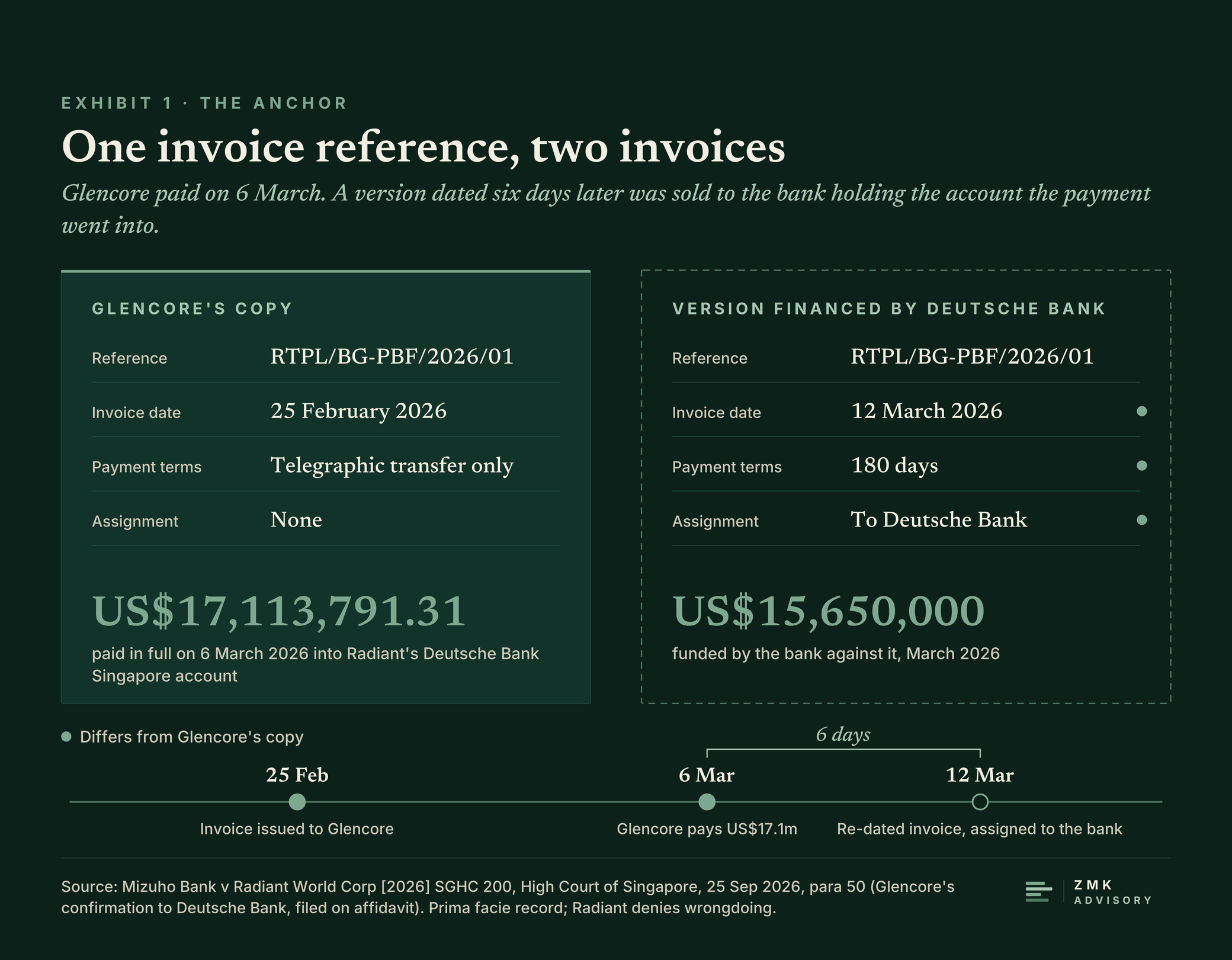
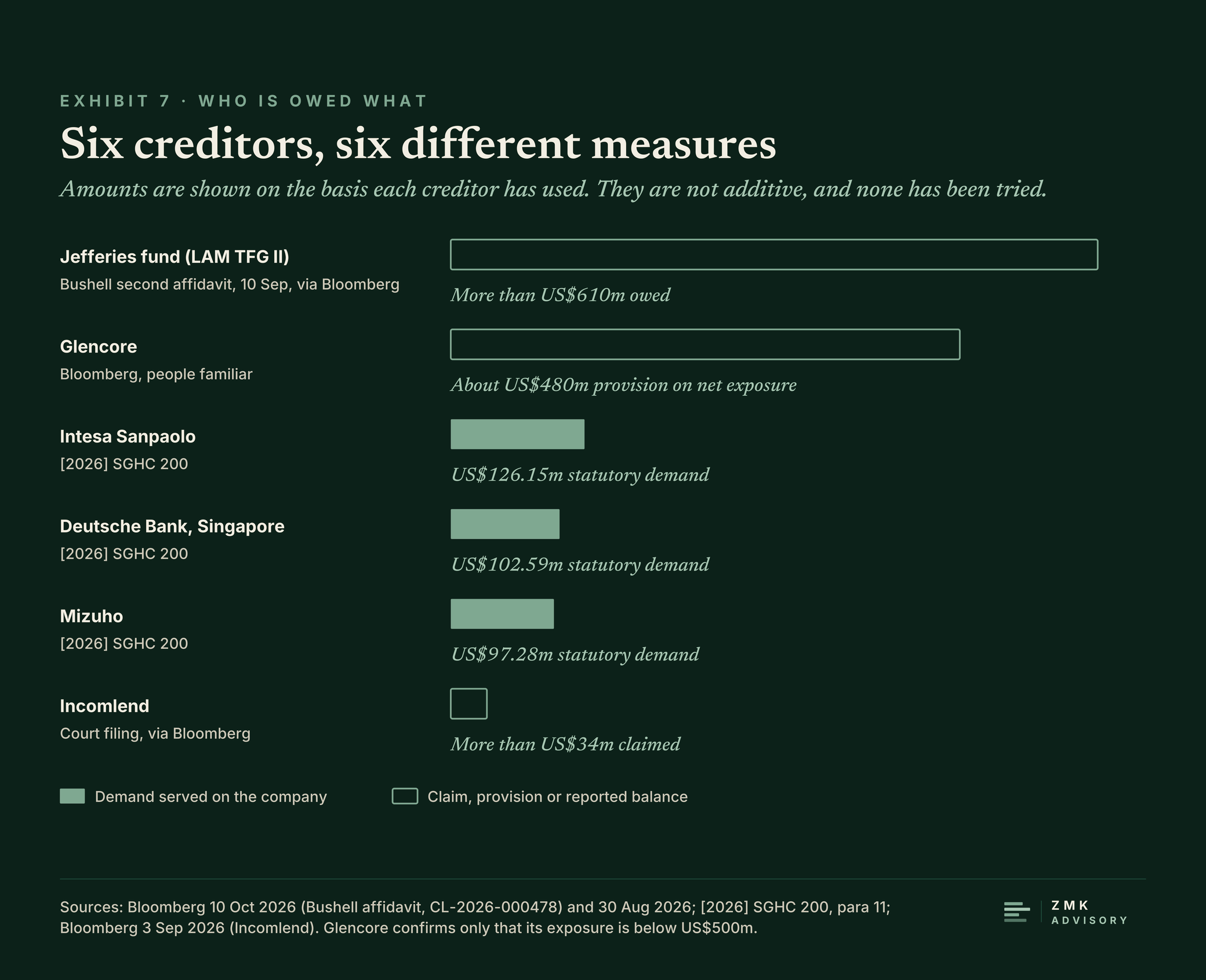
One invoice is the small number. A fund run by Jefferies’ Point Bonita unit financed US$3.8 billion of Glencore-named invoices for Radiant World and its sister trader Sapphire Minmetals from 2021.2 Its solicitor, Christopher Bushell, says in his second affidavit in the London proceedings, dated 10 September,3 that the fund has evidence of falsified documents behind at least 50 receivables with a nominal value of nearly US$900 million. The fund is still owed more than US$610 million, of which more than US$550 million is linked to purported sales to Glencore and Vitol. Other lenders, among them Mizuho, Deutsche Bank and Intesa Sanpaolo, allege about US$500 million more in separate proceedings.4 Radiant reported US$9.6 billion of revenue in the year to September 2025 and says it moves more than 80 million tonnes of iron ore a year.5 Glencore, for years its most important counterparty, took a provision of about US$480 million, according to people familiar with the matter cited by Bloomberg.6
Radiant denies all wrongdoing and is suing Glencore for more than US$2 billion. Glencore calls that claim meritless and says it holds confirmed evidence that Radiant and associated companies sent lenders falsified invoices, contracts and emails attributed to Glencore staff.7 None of that has been tried.
What the published record already shows is narrower and more useful. Every lender in this case bought the same idea: that a receivable carrying a major trader’s name carries that trader’s credit. The idea was only ever as strong as the channel through which the buyer’s confirmation arrived, and in most of these deals that channel ran through the borrower.
A short position in 2021
In the week of 10 May 2021, the benchmark 62% Fe iron ore index had the most volatile week in its history. It posted its biggest-ever daily gain, US$18.31, on 10 May, peaked at US$237.57 a tonne on 12 May, and then suffered its biggest-ever one-day fall, US$28.78, on 14 May.8
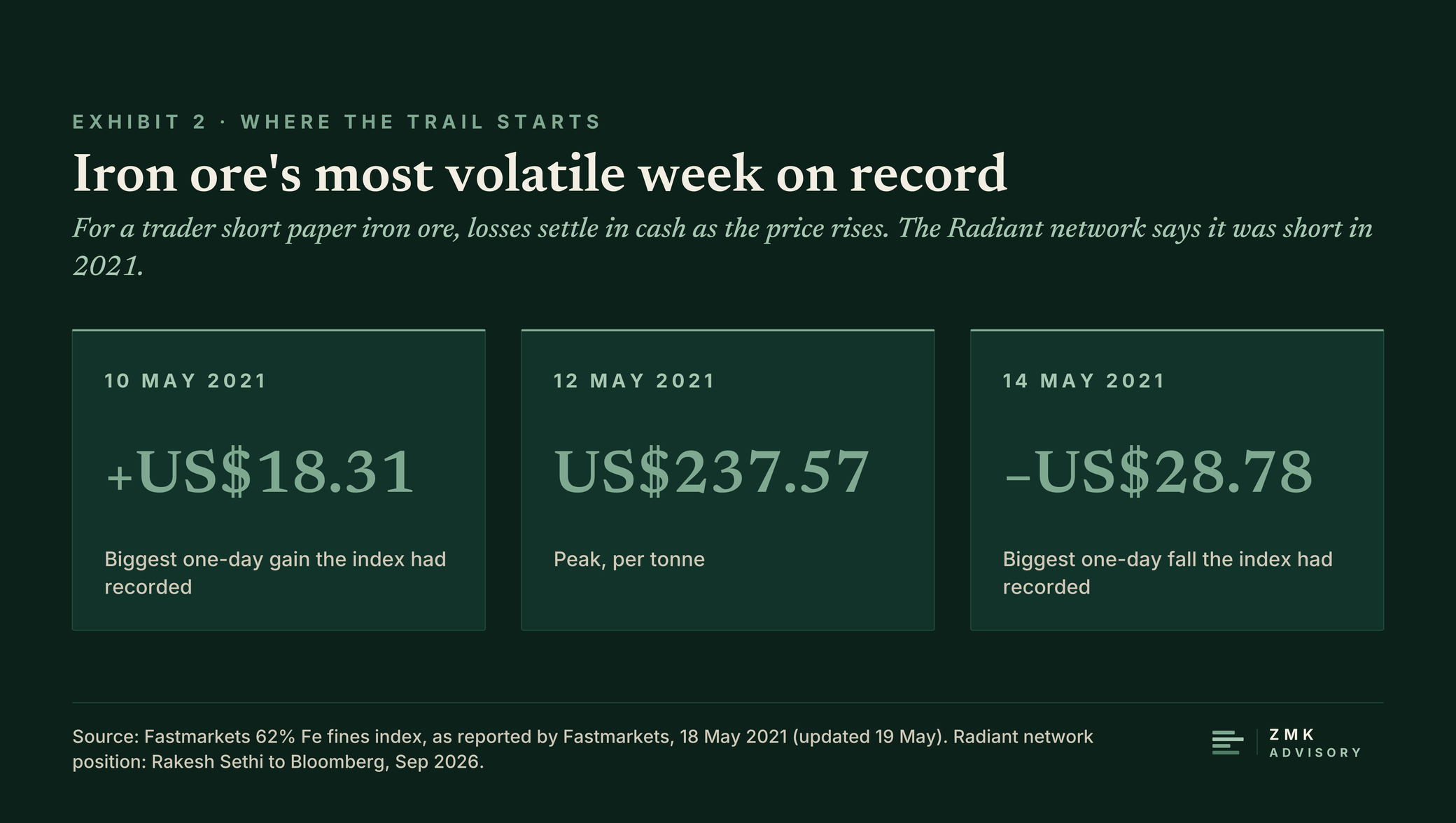
Sapphire’s chairman, Rakesh Sethi, has said the Radiant network held short derivatives positions and took losses on them as prices spiked in 2021.9 Radiant’s Singapore claim and Nahar’s affidavit, as reported by the Financial Times, describe how those positions were built. From 2017 the companies traded over-the-counter iron ore derivatives with Glencore as counterparty, with no cash margin, and losses were rolled forward rather than settled. Glencore’s exposure to any single entity was capped at about US$500 million, so other traders were brought in.10
That design matters. On an exchange, a losing short pays cash every day the price rises, and the pain arrives in instalments. Without margin, nothing is paid until the position is closed, and the loss accumulates quietly on the counterparty’s book. On Radiant’s account, the close came in July 2021, when Glencore crystallised the loss and demanded repayment of US$1.1 billion.10 The timing was brutal. The IMF’s monthly iron ore price averaged US$214 a tonne in July 2021 and US$114 in September, 47 per cent lower on our calculation, and US$90 by November.11 A short closed out in July locked in its loss just before the market moved its way. Whether Glencore was entitled to close out when it did is for the Singapore court.
Radiant’s claim, as reported by Bloomberg, says that in exchange for repayment of that US$1.1 billion, Glencore agreed to keep trading with the group and help it raise financing, including from Jefferies, and that Glencore directed the instruments, volumes and prices of its derivatives trades.12 By late 2025 the relationship had gone further still. In November and December, according to filings in the Mizuho case reported by the FT, Glencore signed agreements drawn up by Linklaters for warrants convertible into equity in Radiant;10 Radiant’s letter to Glencore puts the stake at 4.995 per cent.13 Within three months Glencore’s own records were flagging invoices it did not recognise, and by August it had cut Radiant off. Glencore rejects Radiant’s account of the relationship.
Deutsche Bank’s receivables purchase agreement with Radiant, then trading as Royalline, is dated 19 October 2021.1 The Jefferies fund began lending to the group the same year with US$35 million,14 and went on to buy US$2.54 billion of invoices from Radiant and US$1.3 billion from Sapphire.10 Whether a derivatives debt and a receivables-finance machine were connected is a question for trial. The record places them in the same twelve months.
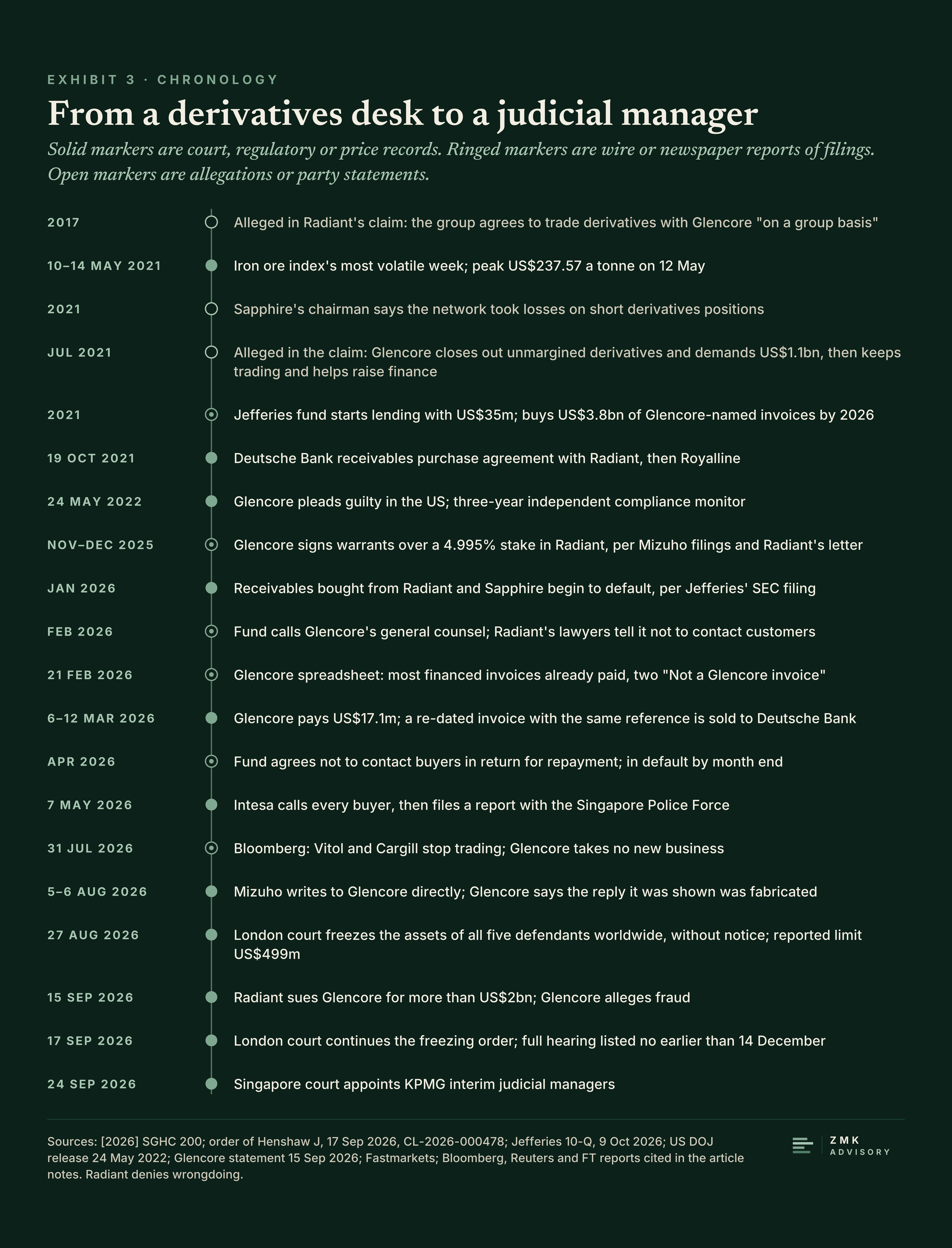
Radiant’s claim also alleges that Glencore “directed those channels so that the true commercial arrangements would not be reflected in its audited records”, and ties that to US Justice Department oversight.15 The oversight itself is a matter of record. In May 2022 Glencore entities pleaded guilty in the US to bribery and market-manipulation conspiracies; the resolutions totalled more than US$1.1 billion and imposed an independent compliance monitor for three years.16
The plumbing
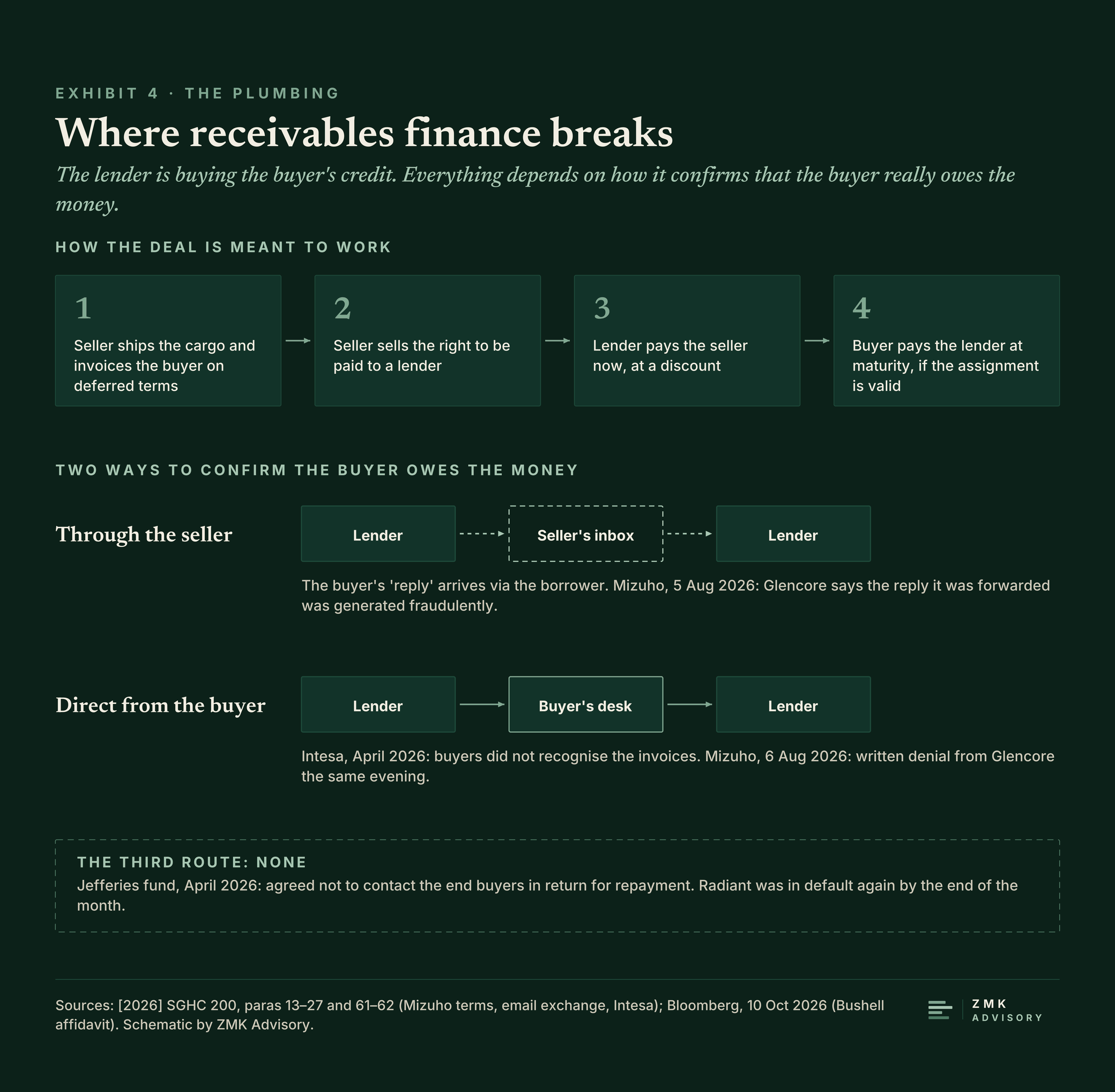
Receivables finance is the ordinary plumbing of physical commodities. A trader sells a cargo on deferred terms and then sells the right to be paid to a lender at a discount. The lender is underwriting the buyer rather than the seller. A mid-sized house can fund a large book this way, borrowing the credit of whoever sits on the other side of its invoices. When that buyer is Glencore or Vitol, the paper looks close to risk-free.
Mizuho’s agreement with Radiant, dated 11 June 2026, shows what a careful bank asked for. Each offer had to come with the invoice, the supply contract, evidence of performance such as bills of lading, and a signed notice of assignment addressed to Glencore, plus evidence that the notice had been delivered and acknowledged back by email. Every item on the list came from the seller. The buyer’s acknowledgment, the one document that turns seller risk into buyer risk, travelled through the seller’s own inbox. On 18 June Mizuho paid US$95.5 million for five Glencore receivables.1
Glencore says the assignment step never happened in law. Its general counsel, Shaun Teichner, wrote to Jefferies on 29 June that none of the invoices the fund claimed to own carried notice of assignment, and that the underlying contracts barred assignment without Glencore’s consent. He also asked the fund to stop suggesting it might claim on credit insurance written over Glencore.2 If the assignment point holds, the risk Jefferies priced as Glencore credit was Radiant credit from day one, and insurance bought against Glencore’s default may have nothing to respond to.
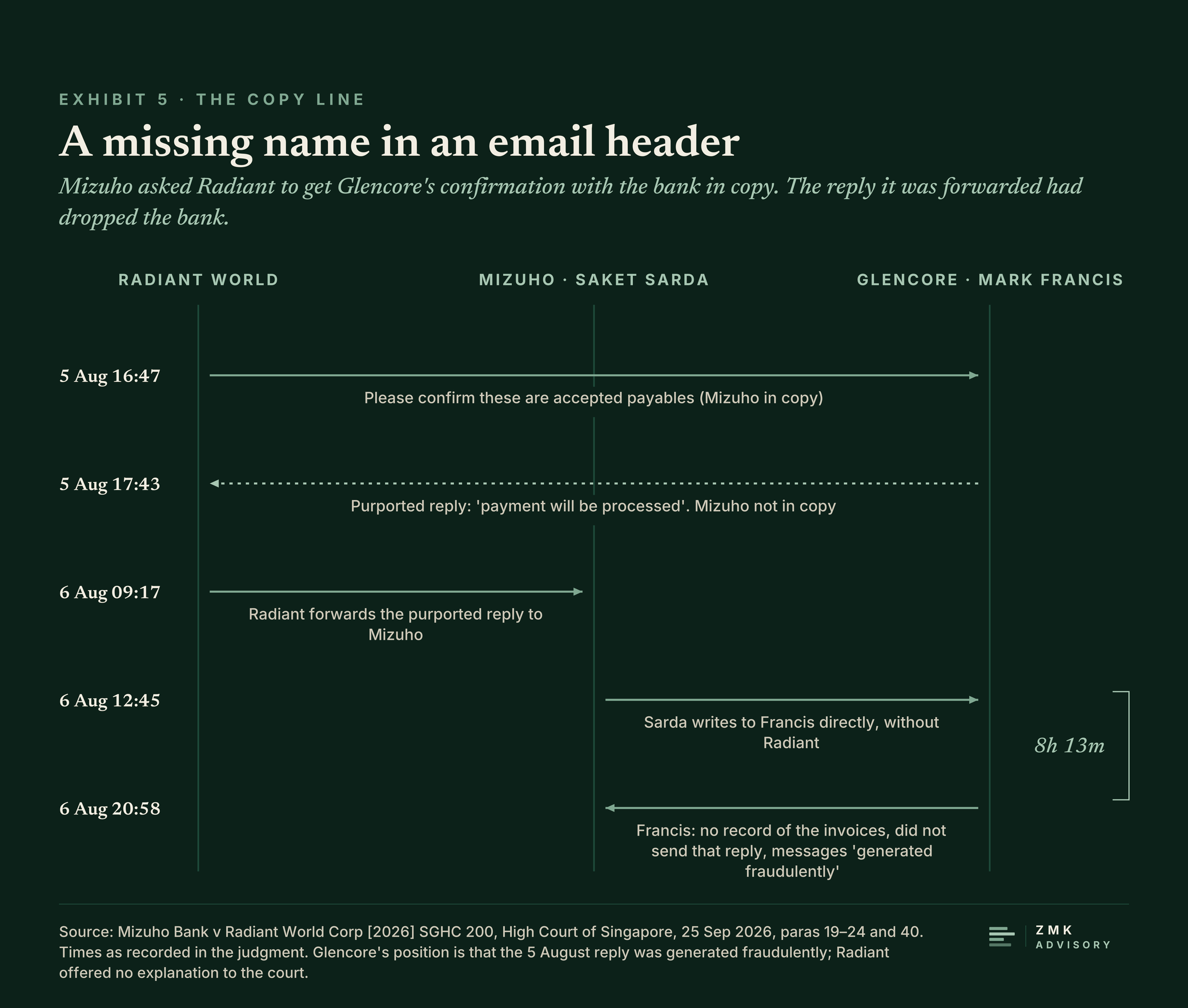
Then came the copy line. On 5 August, at Mizuho’s request, Radiant emailed Glencore’s iron ore operations manager, Mark Francis, with Mizuho’s Saket Sarda in copy, asking him to confirm the receivables. The next morning Radiant forwarded what it said was Francis’s reply, confirming payment would be made. The reply had dropped Mizuho from the copy line. Sarda wondered why, and wrote to Francis directly. That evening Francis answered that Glencore had no record of the invoices, that he had neither received Radiant’s email nor written the reply, and that Glencore’s analysis was that the messages had been “generated fraudulently”. Five days later he added that Glencore’s invoices under the same contract numbers had all been paid between 30 April and 3 June, before Mizuho bought on 18 June, and that Glencore had never been notified of any assignment.1 One banker’s curiosity about a missing name in an email header drew a written denial from Glencore just over eight hours later.
Jefferies tried to make the same call, and was told to stay away. According to Bushell’s affidavit, the fund rang Glencore’s general counsel directly in February and also approached Vitol and Gunvor, now Centalion. That month a law firm acting for Radiant wrote that the fund must refrain from contacting any of Radiant’s customers directly. In March Sethi wrote that he was “shocked” the fund had approached Glencore and that it should “be on the sidelines”. In early April the fund signed a forbearance agreement: no contact with the end buyers, in return for repayment by September. Two payments arrived. By the end of April Radiant was in default again. Sethi told Bloomberg the fraud claim is wrong and that every transaction was carried out on Glencore’s instructions.4
The one check that exposed the problem at Intesa and at Mizuho was, at the largest creditor, switched off by contract.
Jefferies had seen a version of this structure fail once already. Its Point Bonita unit ran a trade-finance portfolio of about US$3 billion supported by US$1.9 billion of investor equity, and had about US$715 million in receivables of the auto-parts group First Brands, due almost entirely from retailers such as Walmart and AutoZone. First Brands acted as servicer and directed those blue-chip buyers’ payments to the fund, until it stopped doing so on 15 September 2025.17 The obligors were impeccable. The seller controlled the cash and the paperwork.
The two cases are linked by more than design. As investors pulled money after First Brands, Point Bonita stopped rolling over Radiant’s facilities, according to people familiar with the matter cited by the FT.14 Jefferies told the SEC on 9 October that receivables bought from Radiant and Sapphire, due from traders including Glencore, Vitol and Gunvor, “had been paid in full since 2021”, and that “starting in January 2026, purchased receivables began to enter into default”.18 Five clean years, then default within months of the funding stopping. On our reading, that is the question to put to any book: were the receivables paid by the buyers, or by the next round of financing? The courts will decide which it was here.
The numbers they put before the court
Two narratives compete: a trader that fed fabricated paperwork to banks, or a junior partner cut loose by its senior partner once lenders asked questions. A creditor does not need to pick one to answer the first question that matters, which is what Radiant’s own numbers show.
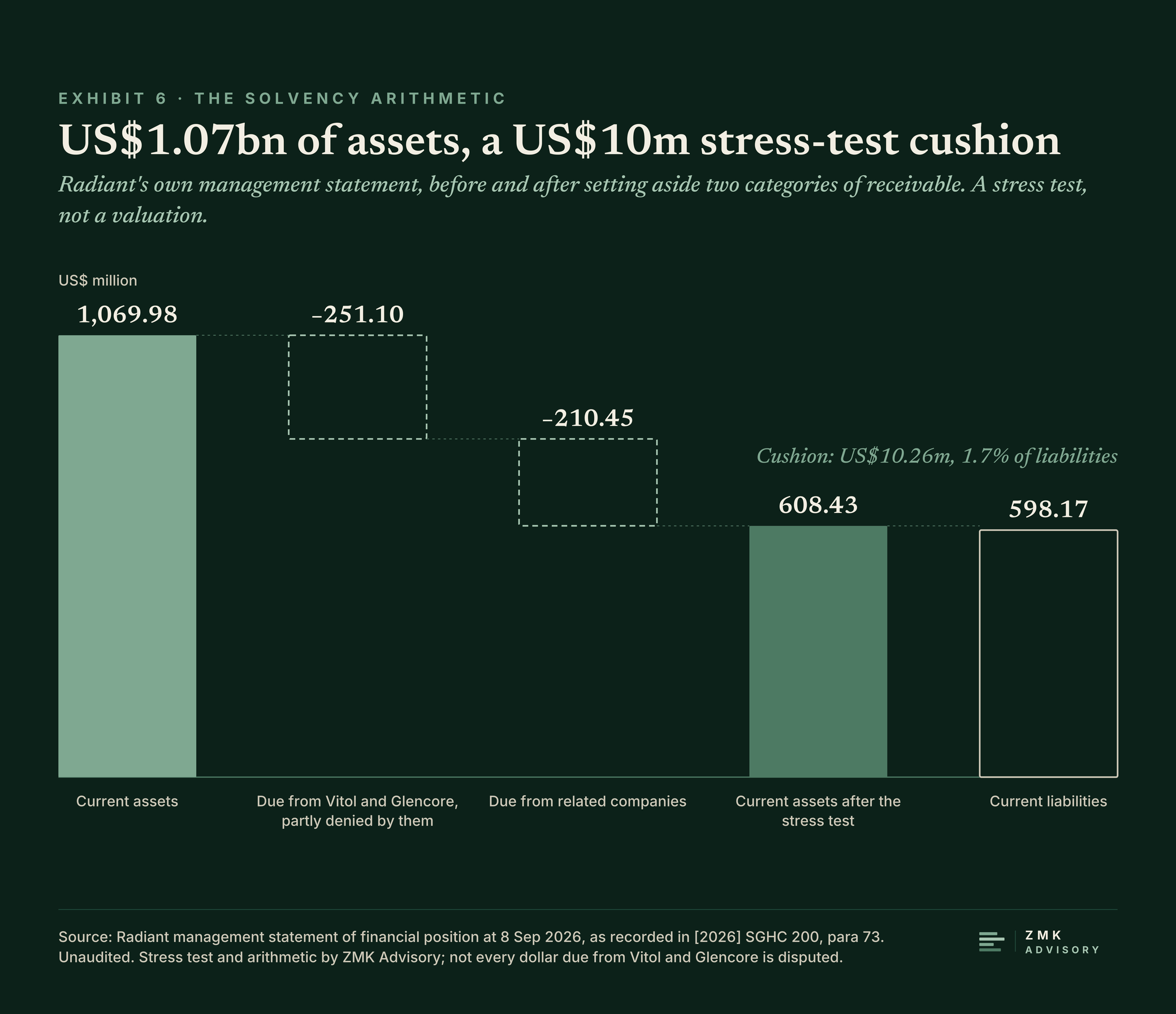
Radiant put a management statement of its financial position at 8 September 2026 before the Singapore court. It showed current assets of US$1,069.98 million against current liabilities of US$598.17 million. Trade receivables made up US$1,006.99 million of those assets. Within them, US$251.1 million was due from Vitol and Glencore, both of which say certain of the purported receivables do not exist, and US$210.45 million was due from three related companies: Aspira, Quanterra and Sapphire Minmetals. Justice Tan placed little weight on the statement.1
On our calculation that is a current ratio of 1.79, with receivables at 94 per cent of current assets. The two flagged categories together come to US$461.55 million, or 46 per cent of receivables. As a stress test only, setting them aside leaves current assets of US$608.43 million against liabilities of US$598.17 million. That is a cushion of US$10.26 million, or 1.7 per cent of liabilities, before anyone asks about the remaining US$545.44 million. The test is crude in both directions: not every dollar owed by Vitol and Glencore is disputed, but the court also refused to count the US$2 billion claim against Glencore as an asset, calling its outcome “pure speculation”.1
The cash line is blunter. On 31 July Radiant said on its website that it remained “well-capitalised, with a strong liquidity position” and that all its facilities were unchanged.19 Seven weeks later, lawyers for the Jefferies fund told the London court that Radiant’s audited accounts for the year to 30 September 2025 showed cash above US$200 million, while a witness statement for Radiant gave its cash as US$10,000. Justice Simon Bryan, granting the worldwide freezing order on 27 August, recorded the fund’s case that debit notes had been used to paper over the cracks and that “the well has now run dry”.20
On 17 September Justice Andrew Henshaw continued that order against all five defendants until a full hearing, to be listed no earlier than 14 December. The defendants have split: the two Radiant companies say they will defend the claim; Sapphire, Sethi and Nahar say they will contest the English court’s jurisdiction. What they disclose about their assets in the meantime will stay private, because the judge exempted that evidence from the Commercial Court’s new public-filing rules.3
Glencore’s own position nets down the same way. Radiant’s letter to Glencore of 27 August says Glencore’s termination notice put the two Radiant companies’ debt to Glencore at US$951 million and Glencore’s debt to them at US$471 million. Glencore has said only that its exposure is below its US$500 million materiality threshold, after provisions already booked.13 The difference between the two balances is US$480 million, the provision Bloomberg reported.6 Set against Group Adjusted EBITDA of US$10.1 billion in the first half of 2026, the loss is a bruise for Glencore.21
Radiant’s own count shows who got out. A spreadsheet attached to Nahar’s affidavit of 16 September lists US$870 million owed by Radiant World Corporation alone to six receivables financiers, led by the Jefferies fund and Intesa. Of 19 other facilities, letter-of-credit and repo lines among them, only one still showed money outstanding: US$18 million under a KBC letter of credit, which Nahar said was being settled and KBC says leaves it with no exposure.22 On our reading, the lenders who held the documents or the cargo were repaid. The lenders who held a buyer’s name on an invoice were not.
Three more facts in the record have had little coverage.
The first belongs to Intesa Sanpaolo, the closest thing this story has to a hero. In April 2026 Radiant told the bank that a buyer had raised payment concerns over invoices assigned to Intesa, and offered to buy them back. Intesa found the explanation odd, because the buyer was a large global enterprise that had just posted strong profits. So it rang every buyer under its facility. The answers, the bank told the court, were substantially unanimous: the buyers did not recognise the invoices. On 7 May Intesa filed a report with the Singapore Police Force.1 That was 85 days before Bloomberg reported, on 31 July, that Vitol and Cargill had stopped trading with Radiant and that Glencore was taking no new business. Intesa says its €200 million exposure is now largely covered by provisions.23 The police’s Commercial Affairs Department confirmed in August that it was looking into Radiant.24 Intesa’s check cost a round of phone calls.
The second sits in Deutsche Bank’s own records, which held Glencore’s 6 March payment before the bank funded the re-dated invoice. Vitol told the same bank it first saw the six invoices purportedly addressed to it when Deutsche Bank sent them over on 1 August, and contracts bearing the name and signature of its trader Jay Ng had been neither signed nor authorised by him.1
The third is how slowly the knowledge travelled. On 4 February Ross Berger, who ran Point Bonita, emailed Francis that the fund was “15-days past due on $42.5MM of the $334.4MM of Glencore International AG invoices we own”. He sent four follow-ups before Francis replied that the fund’s relationship was with Radiant, “but it is not with Glencore on this topic”. On 21 February Francis sent Nahar, not the fund, a spreadsheet setting the fund’s invoice data beside Glencore’s records. Most of the invoices related to cargoes already shipped and paid, some as early as July 2025. Two read “Not a Glencore invoice; vsl not found, contract not found”. By 1 July Jefferies’ general counsel, Mike Sharp, was writing to Glencore of “a deadly serious issue”. Some weeks after the July emails, a person familiar with the fund’s position still said it believed the underlying trades were valid. Glencore says it told the fund from the start that it had no record of any assignment, and later helped expose what it calls a fraudulent scheme.2
Concentration cuts both ways. Sethi says Sapphire alone traded 30 million tonnes of iron ore with Glencore last year;9 against the 95.4 million tonnes Glencore reports selling in 2025, that would be 31 per cent on our calculation.25 A person familiar with Glencore’s position told the FT that Radiant averaged less than 10 per cent of its iron ore volume over the past decade.13 Radiant held a majority stake in Sapphire until 2015, according to Hong Kong company records.14
What changes on Monday
The litigation will run for years. Its next London deadline is 22 October, when the defendants’ evidence and any jurisdiction challenges fall due. The risk lesson is available now, and it is narrow enough to test against any book.
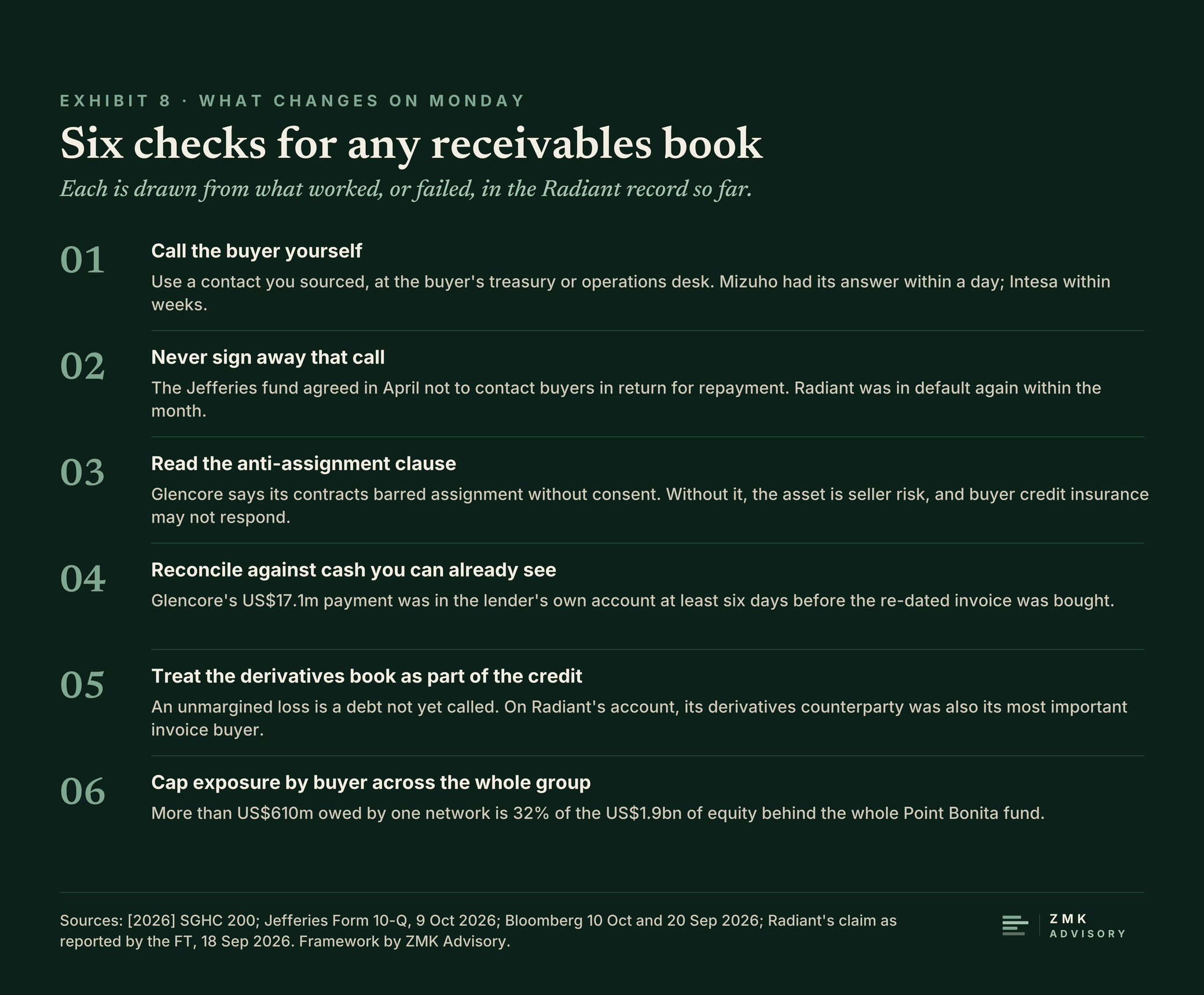
Confirm the buyer out of band, through a contact the lender sourced itself, never through a reply forwarded by the seller. Mizuho found the problem within a day that way; Intesa within weeks. And never sign that right away, as the Jefferies fund did in April.
Read the anti-assignment clause before pricing buyer risk. Without the buyer’s consent, the asset is seller risk at seller pricing, and credit insurance written on the buyer may not respond.
Reconcile financed invoices against the cash you can already see. On Glencore’s evidence, its payment had been in Deutsche Bank’s own account for at least six days before the re-dated invoice was bought.
Treat the seller’s derivatives book as part of the credit. An unmargined loss is a debt not yet called, and receivables finance is the fastest cash a physical trader can raise. On Radiant’s own account, its derivatives counterparty and its most important invoice obligor were the same company.
Cap exposure by obligor across the seller’s whole group. More than US$610 million owed by one network is 32 per cent of the US$1.9 billion of equity Jefferies reports behind the whole Point Bonita portfolio, on our calculation.18 That is a concentration problem before it is a fraud problem.
Trading houses carry a lesson too. Their names are collateral in other people’s books, and the record shows how long knowledge of unrecognised invoices can sit in private correspondence. Months separate Glencore’s spreadsheet from the point, some weeks after the July emails, when the fund still said it believed the trades were valid.
On 6 March, US$17.1 million settled an iron ore cargo. On Glencore’s evidence, an invoice with the same reference, dated 12 March, was then financed by the bank where that payment had landed. For any lender, trader or investor carrying counterparty exposure in metals and energy, the useful question about Radiant World is how much of their own book would survive one direct call to the buyer. That is the question ZMK Advisory puts to the clients it advises on counterparty, derivatives and trade-finance risk.
Status of proceedings. Every proceeding referred to here is open. The Singapore findings are interim and prima facie, made on an application to appoint interim judicial managers in HC/OA 946/2026 (granted 24 September; grounds published 25 September); the judicial management application itself has not been decided. Radiant’s claim against three Glencore entities (HC/OC 836/2026, filed 15 September with Sapphire as co-claimant) has not been tried. In London, LAM Trade Finance Group II’s claim (CL-2026-000478, Commercial Court, issued 27 August 2026) is at an early stage. Bryan J granted a worldwide freezing order without notice on 27 August, with permission to serve Nahar and Sethi out of the jurisdiction. On 17 September Henshaw J continued it until an adjourned return date not before 14 December 2026 (three days plus a day of pre-reading), with costs reserved. Under his timetable the defendants’ evidence and any CPR Part 11 jurisdiction challenges are due by 22 October, the Radiant companies’ defences by 9 November, LAM’s evidence in answer by 19 November and the defendants’ reply by 3 December. Sapphire, Nahar and Sethi have said they will contest jurisdiction; Radiant World Corporation and Radiant World Holding have said they will defend; all reserve the right to seek discharge of the order without showing a change of circumstances. LAM’s Singapore freezing application (HC/OA 986/2026) has a case conference on 14 October; Incomlend’s claim (HC/OC 747/2026) and the Hong Kong order are also at an early stage, and Radiant has denied wrongdoing in all of them. The Singapore Police Force’s Commercial Affairs Department has confirmed it is looking into Radiant. Bloomberg has reported that the US Department of Justice and the Commodity Futures Trading Commission examined Radiant’s transactions, and Nahar’s affidavit, as reported by the FT, acknowledges investigations involving the Singapore police, the Justice Department and the UK Financial Conduct Authority. No charges have been brought, and investigations do not always lead to charges. Nothing in this article asserts that any party has acted unlawfully. It reports what the parties allege and what the courts have recorded. The First Brands matter is included as a structural precedent for the receivables-finance design; the only link with Radiant World drawn here is the shared lender.
Our calculations. Current ratio 1,069.98 / 598.17 = 1.79. Receivables share 1,006.99 / 1,069.98 = 94.1%. Flagged receivables 251.10 + 210.45 = 461.55, which is 45.8% of 1,006.99. Stress-test assets 1,069.98 − 461.55 = 608.43; cushion 608.43 − 598.17 = 10.26, which is 1.7% of 598.17. Residual receivables 1,006.99 − 461.55 = 545.44. Net Glencore balance 951 − 471 = 480. IMF iron ore price July to September 2021: 113.72 / 214.34 − 1 = −46.9%; November 90.13. Jefferies fund exposure 610 / 1,900 = 32.1%. Point Bonita purchases 2.54 + 1.30 = 3.84bn. Intesa police report (7 May 2026) to Bloomberg report (31 July 2026) = 85 days. London freezing order (27 August) to earliest adjourned return date (14 December) = 109 days. Glencore payment (6 March) to date of re-dated invoice (12 March) = 6 days. Sapphire volume 30 / 95.4 = 31.4%. All in US dollars as reported; no currency translation.
Comparability. The US$1,069.98m and US$598.17m figures come from an unaudited management statement prepared by Radiant for litigation, dated 8 September 2026, to which the court gave little weight. The US$200m cash figure is from audited accounts at 30 September 2025 and the US$10,000 figure from a Radiant witness statement, both as characterised by LAM’s counsel; neither is quoted from the underlying document, and they are eleven months apart. The stress test is illustrative and labelled as such in the body. The IMF series is a monthly average, not the Fastmarkets daily index used in Exhibit 2, and the close-out date and price of the alleged 2021 positions are not public; the comparison shows market direction only, not a loss calculation. The 95.4 Mt figure is Glencore’s 2025 iron ore marketing volume sold; the 30 Mt figure is Sethi’s claim and the sub-10% figure a decade average from a person familiar with Glencore’s position, so the two are not directly comparable. The US$1.9bn equity figure is Jefferies’ statement of Point Bonita’s invested equity at the time of the First Brands bankruptcy in September 2025, repeated unchanged in its August 2026 quarterly filing; redemptions since then are likely to have reduced it, which would raise the 32% share, but no later figure is disclosed. The EBITDA comparison is for scale only: a provision and a half-year earnings measure are different quantities. The Deutsche Bank purchase took place between 12 and 31 March; the judgment does not give the exact funding date of the re-dated Glencore invoice.
Reported, not confirmed. The US$480m provision is reported by Bloomberg from people familiar with the matter; Glencore has confirmed only that the exposure is below US$500m after provisions, and its published accounts do not name Radiant. The US$951m and US$471m balances are Glencore’s termination-notice figures as described in Radiant’s letter of 27 August, as reported by the FT. The 2021 derivatives terms (no cash margin, losses rolled forward, a single-entity cap of about US$500m) and the US$1.1bn close-out are allegations in Radiant’s claim and Nahar’s affidavit as reported by the FT; Radiant’s earlier letter put the figure at almost US$1.2bn, and Bloomberg describes the US$1.1bn as a debt to be repaid under the alleged 2021 arrangement. Radiant’s lender spreadsheet covers Radiant World Corporation only, not Sapphire or other related companies, so its figures are not comparable with the fund’s network-wide claim; per-lender amounts from it appear only on aggregator sites and are not used. Measures of the Jefferies fund’s exposure differ by date and scope: about US$526m claimed from Glencore in July emails, almost US$500m reported by the FT on 5 September, more than US$610m (including Vitol-named paper) in Bushell’s affidavit. Exhibit 7 uses the affidavit figure. The 50 receivables, US$900m nominal value, US$610m and US$550m outstanding, the February no-contact letter, Sethi’s March correspondence and the April forbearance terms are Bloomberg’s account of the second affidavit of Christopher Bushell, dated 10 September 2026, which the order of 17 September confirms was before the London court; the affidavit itself has not yet been obtained. The US$499m limit of the London freezing order is as reported by the FT and Bloomberg; Singapore reporting gives a US$499.2m limit for the parallel Singapore injunction; the London order’s terms sit in an appendix not included in the office copy obtained. The decision to stop rolling Radiant’s facilities after First Brands, and Radiant’s majority stake in Sapphire until 2015, are FT reports citing people familiar with the matter and Hong Kong company records respectively. Sethi’s denial is as given to Bloomberg. The 21 February spreadsheet, the Teichner emails and the credit-insurance request are Bloomberg’s account of attachments to legal documents.
Deliberately omitted. WhatsApp messages attributed to named Glencore executives, which Radiant has put in evidence and the FT has reported, are omitted, as are Radiant’s further allegations about named executives, about the routing of documents through Glencore’s Delhi office, about proposed payments of US$69m and US$120m, about the timing of executive appointments and about Glencore’s role in introducing other counterparties. They are untested, they concern individuals against whom no finding has been made, and the argument does not depend on them. Personal assets of individual defendants are omitted as irrelevant to the risk argument. Figures from aggregator and retail-investor sites are excluded.
Interests. ZMK Advisory’s principal led Rio Tinto’s Simandou country strategy team from April 2023 to July 2025 and holds a small long position in Rio Tinto equity awarded during that employment. The cargo in the Deutsche Bank transaction was loaded under load-port certificates issued by Robe River, part of the Rio Tinto group, and Rio Tinto Commercial held a watching brief at the Singapore hearing.
- 1 Mizuho Bank, Ltd v Radiant World Corp Pte Ltd [2026] SGHC 200, General Division of the High Court of Singapore, HC/OA 946/2026 (SUM 2669/2026), grounds of decision of Kristy Tan J, 25 September 2026 (decision granted 24 September, para 3). https://www.elitigation.sg/gd/s/2026_SGHC_200. Primary judicial record. Source for the Deutsche Bank true-invoice sequence (paras 43–53, incl. the US$17,113,791.31 payment of 6 March and the 12 March invoice), the October 2021 DBSG agreement (para 43), Nahar’s evidence (para 56), Mizuho’s document requirements and US$95.5m purchase (paras 13–17), the 5–6 August email exchange and Glencore’s 11 August response on prior payment and assignment (paras 19–27, 40), Vitol’s evidence (paras 46–51), Intesa’s verification and police report (paras 61–62), the management statement and the weight given to it (para 73) and the treatment of the US$2bn claim (para 74).
- 2 Bloomberg News, “Inside Jefferies’ months-long tussle with Glencore over Radiant World”, 20 September 2026, Bloomberg wire via The Edge Malaysia. https://theedgemalaysia.com/node/818629. Bloomberg’s account of emails attached to legal documents. Full text also republished by the Australian Financial Review. Source for the US$3.8bn of Glencore invoices financed since 2021, the Teichner letter of 29 June, the 21 February spreadsheet, the credit-insurance request, Berger’s 4 February email and follow-ups, Francis’s reply, Sharp’s 1 July email, the August cut-off and Glencore’s statement on its dealings with LAM. Also source for the position, some weeks after the July emails, of a person familiar with the fund that it still believed the underlying trades were valid.
- 3 Order of Henshaw J, LAM Trade Finance Group II LLC v Radiant World Corporation Pte Ltd and others, Claim No. CL-2026-000478, High Court of Justice, Business and Property Courts of England and Wales, King’s Bench Division, Commercial Court, dated 17 September 2026; sealed copy entered on the CE-File public file on 8 October 2026; office copy obtained by ZMK Advisory on 12 October 2026 via CE-File Public Case Search (search CL-2026-000478), https://efile.cefile-app.com/login (four pages; Appendix 1, setting out the freezing order’s terms, not included). Primary judicial record. Source for the 27 August without-notice freezing order and service order of Bryan J, the 16 September acknowledgments of service, the second affidavit of Christopher Bushell dated 10 September 2026, the continuation of the order, the adjourned return date and timetable, reserved costs and the Practice Direction 51ZH exemption for asset-disclosure evidence.
- 4 Bloomberg News (Upmanyu Trivedi, Jack Farchy and Archie Hunter), “Jefferies Says Found Fraud in $900 Million of Radiant Deals”, 10 October 2026, updated 11 October. https://www.bloomberg.com/news/articles/2026-10-10/jefferies-says-it-found-fraud-in-900-million-of-radiant-deals. Bloomberg’s account of the September affidavit of Christopher Bushell, solicitor for LAM Trade Finance Group II, in the London freezing-order proceedings. Source for the 50 receivables and nearly US$900m nominal value, the US$610m and US$550m outstanding, the US$500m alleged by other lenders, the February no-contact letter, Sethi’s March correspondence, the April forbearance and default, and Sethi’s denial.
- 5 Reuters, “What is Radiant World and why is it in the news?”, 2 October 2026, Reuters wire via Business Recorder. https://www.brecorder.com/news/40442502/what-is-radiant-world-and-why-is-it-in-the-news. Source for FY2025 revenue (from corporate filings) and the 80 Mt annual volume (from the company’s website).
- 6 Bloomberg News, “Glencore took $480 million provision on Radiant World exposure”, 30 August 2026, Bloomberg wire via Mining.com. https://www.mining.com/web/glencore-took-480-million-provision-on-radiant-world-exposure/. Source for the US$480m provision and the US$951m / US$471m balances first reported by the FT.
- 7 Glencore plc, “Update on past business activities involving Radiant World”, company statement, 15 September 2026. https://www.glencore.com/media-and-insights/news/update-on-past-business-activities-involving-radiant-world-. Primary company disclosure. Source for Glencore’s fraud allegation, its “meritless” response, its review and the below-US$500m threshold.
- 8 Fastmarkets, “Iron ore’s most volatile week: How we got here and what comes next”, 18 May 2021 (updated 19 May 2021). https://fastmarkets.com/insights/iron-ores-most-volatile-week-how-we-got-here-and-what-comes-next. Price reporting agency publishing its own 62% Fe index. Source for the 10 May gain, 12 May peak and 14 May fall.
- 9 Bloomberg News, interview with Rakesh Sethi, 4 September 2026, Bloomberg wire via The Edge Malaysia. https://theedgemalaysia.com/node/816948. Source for the 2021 short-derivatives losses, the 30 Mt Sapphire volume and the 95.4 Mt Glencore figure.
- 10 Financial Times (Ortenca Aliaj, Camilla Hodgson and Robert Smith), report on the Radiant World and Glencore relationship, 18 September 2026. https://www.ft.com/content/350df9ff-fa41-4984-a1ee-248d8335b213. FT’s account of Radiant’s claim, Nahar’s affidavit and evidence filed in the Mizuho proceedings. Source for the 2017 derivatives arrangement (no cash margin, losses rolled forward, single-entity cap of about US$500m), the July 2021 close-out and US$1.1bn demand, the Linklaters warrant agreements signed in November and December 2025, and Point Bonita’s US$2.54bn of Radiant and US$1.3bn of Sapphire invoice purchases.
- 11 International Monetary Fund, Primary Commodity Prices, “Global price of Iron Ore”, US$ per tonne, monthly average, via Federal Reserve Bank of St. Louis, FRED series PIORECRUSDM, accessed 13 October 2026. https://fred.stlouisfed.org/series/PIORECRUSDM. Primary statistical series. Source for July 2021 (214.34), September 2021 (113.72) and November 2021 (90.13).
- 12 Bloomberg News, “Radiant World Says Glencore Helped When Jefferies Probed Its Trades”, 16 September 2026, Bloomberg wire via Swissinfo. https://www.swissinfo.ch/eng/radiant-world-says-glencore-helped-when-jefferies-probed-its-trades/92071584. Bloomberg’s account of Radiant’s statement of claim, which it says it has not verified. Source for the 2017 group-basis derivatives arrangement, the alleged 2021 arrangement and US$1.1bn debt, and the alleged control of derivatives trading.
- 13 Financial Times (Ortenca Aliaj, Camilla Hodgson, Robert Smith and Owen Walker), “Glencore threatened with $1.4bn lawsuit from embattled trader Radiant”, 29 August 2026. https://www.ft.com/content/359d4ea5-59b6-425f-ac66-c9836cec04f9. Source for the US$951m and US$471m balances as Glencore’s termination-notice figures described in Radiant’s letter of 27 August, Glencore’s below-US$500m statement after provisions, the 4.995% warrant, and the decade-average share of less than 10% from a person familiar with Glencore’s position.
- 14 Financial Times (Ortenca Aliaj and Robert Smith), “Jefferies fund caught with $500mn exposure to second alleged invoice fraud”, 5 September 2026. https://www.ft.com/content/6bde3e74-9a7c-4528-9b9c-42a14eec0414. Source for Point Bonita’s initial US$35m of financing in 2021, its decision to stop rolling Radiant’s facilities after First Brands redemptions (people familiar), and Radiant’s majority stake in Sapphire until 2015 (Hong Kong company records).
- 15 Financial Times (Ortenca Aliaj and Camilla Hodgson), “Iron ore trader Radiant alleges Glencore hid their ties from audited records”, 16 September 2026. https://www.ft.com/content/69b514eb-d627-4d46-9218-0842706c7115. Free republication via Swissinfo: https://www.swissinfo.ch/eng/swiss-industry/iron-ore-trader-radiant-alleges-glencore-hid-their-ties-from-audited-records/92065826. FT’s account of Radiant’s statement of claim in HC/OC 836/2026. Source for the “true commercial arrangements” allegation, its link to US Justice Department oversight and Sapphire’s role as co-claimant.
- 16 US Department of Justice, Office of Public Affairs, “Glencore Entered Guilty Pleas to Foreign Bribery and Market Manipulation Schemes”, press release, 24 May 2022. https://www.justice.gov/opa/pr/glencore-entered-guilty-pleas-foreign-bribery-and-market-manipulation-schemes. Primary government record. Source for the two pleas, the more than US$1.1bn total and the three-year independent compliance monitor.
- 17 Jefferies Financial Group Inc., Form 8-K, Exhibit 99.1, press release on Point Bonita and First Brands, 8 October 2025, SEC EDGAR (CIK 96223). https://www.sec.gov/Archives/edgar/data/96223/000114036125037595/ef20056799_ex99-1.htm. Primary regulatory filing. Source for the roughly US$3bn Point Bonita portfolio, the US$715m First Brands receivables, the named obligors, the servicer role and the 15 September 2025 stop.
- 18 Jefferies Financial Group Inc., Form 10-Q for the quarter ended 31 August 2026, filed 9 October 2026, SEC EDGAR (CIK 96223). https://www.sec.gov/Archives/edgar/data/96223/000009622326000033/jef-20260831.htm. Primary regulatory filing. Source for the Point Bonita portfolio of about US$3bn supported by US$1.9bn of invested equity (US$113m, or 5.9%, owned by LAM), the receivables purchased from Radiant and Sapphire and due from Glencore, Vitol and Gunvor, “paid in full since 2021”, defaults from January 2026, the fund’s allegation of fraud and its English proceedings for deceit, conspiracy, breach of contract and restitution.
- 19 Radiant World, “Radiant World Response to Media Report”, company website, 31 July 2026. https://radiant-world.com/uncategorized/radiant-world-response-to-media-report/. Primary company statement. Source for “well-capitalised, with a strong liquidity position” and “all facilities unchanged”.
- 20 Wire report (agency not named on the page), “Jefferies-linked fund says Radiant World may hold just US$10,000 in cash”, London, 17 September 2026, via The Edge Malaysia. https://theedgemalaysia.com/node/818451. Source for LAM’s position that the receivables did not exist or were not validly assigned, the US$200m / US$10,000 cash comparison as put by LAM’s lawyers at the 17 September hearing, and the remarks of Bryan J when he made the freezing order.
- 21 Glencore plc, 2026 Half-Year Report, 5 August 2026. https://www.glencore.com/.rest/api/v1/documents/static/98cf0f2a-ede7-4ced-9539-061198c3b6be/GLEN-2026-Half-Year-Report.pdf. Primary company filing. Source for H1 2026 Group Adjusted EBITDA of US$10.1bn.
- 22 Bloomberg and Reuters, “Radiant World table shows six lenders with huge exposure”, 23 September 2026, via The Star (Malaysia). https://www.thestar.com.my/business/business-news/2026/09/23/radiant-worldtable-shows-six-lenders-with-huge-exposure. Account of an undated spreadsheet attached to Nahar’s affidavit signed on 16 September 2026, covering Radiant World Corporation Pte only. Source for US$870m owed to six receivables financiers, the 19 other facilities, the US$18m KBC letter of credit, Nahar’s statement that it was being settled and KBC’s statement that it has no exposure.
- 23 Reuters, “Vitol, Cargill, Glencore cut ties with Radiant World”, 31 July 2026, Reuters wire via Mining.com. https://www.mining.com/web/vitol-cargill-glencore-cut-ties-with-radiant-world/. Source for the 31 July report and Intesa’s statement that its €200m exposure is largely covered by provisions.
- 24 Financial Times (Owen Walker), “Singapore police look into iron ore trader Radiant World”, 20 August 2026. https://www.ft.com/content/91e95fcd-00ac-45d0-a4cf-a28a941f8a2c. Source for the Commercial Affairs Department’s confirmation and for Bloomberg’s report of US Justice Department and CFTC interest.
- 25 Glencore plc, 2025 Annual Report, 10 March 2026, table “Selected marketing volumes sold”, p. 50. https://www.glencore.com/.rest/api/v1/documents/static/9b103e11-72e7-40bf-ae7c-eabe57361522/GLEN-2025-Annual-Report.pdf. Primary company filing. Source for 2025 iron ore marketing volume sold of 95.4 Mt (2024: 74.6 Mt).
Not investment research. This is commentary and analysis. It is not a recommendation and not an inducement to buy, sell or hold any security or commodity.