The €300 Million Confession
The synergy case Saipem and Subsea7 published in July 2025, and the theory of harm the European Commission published in July 2026, are built from the same industrial facts.
The €300m synergy Saipem and Subsea7 put to investors rests on the same facts as the Commission’s case against the merger, and no remedy yet proposed reconciles the two.
- 01The synergy depends on fewer overlapping bids and a tighter fleet.In merger control, that is the removal of a bidder and the rationalisation of capacity.
- 02Completion has moved from the second half of 2026 into 2027.The Commission stopped the clock on 25 August. On ZMK’s calculation, a 16 December decision moves to around the second week of January 2027.
- 03SURF prices had already risen before the merger.Subsea margins at Subsea7 and TechnipFMC rose by about 520 and 320 basis points year on year, with backlog at or near record levels.
- 04ExxonMobil, Petrobras and TotalEnergies filed against the deal in Brazil.The Commission’s preliminary finding is that customers may not be able to resist price increases.
- 05No remedy adds the vessels the market lacks.Behavioural commitments add no hulls, and any divestment comes from the same fleet as the savings. Buyers tendering for 2028 work should price bidder-count risk now.
The synergy case and the Commission’s theory of harm rest on the same facts.
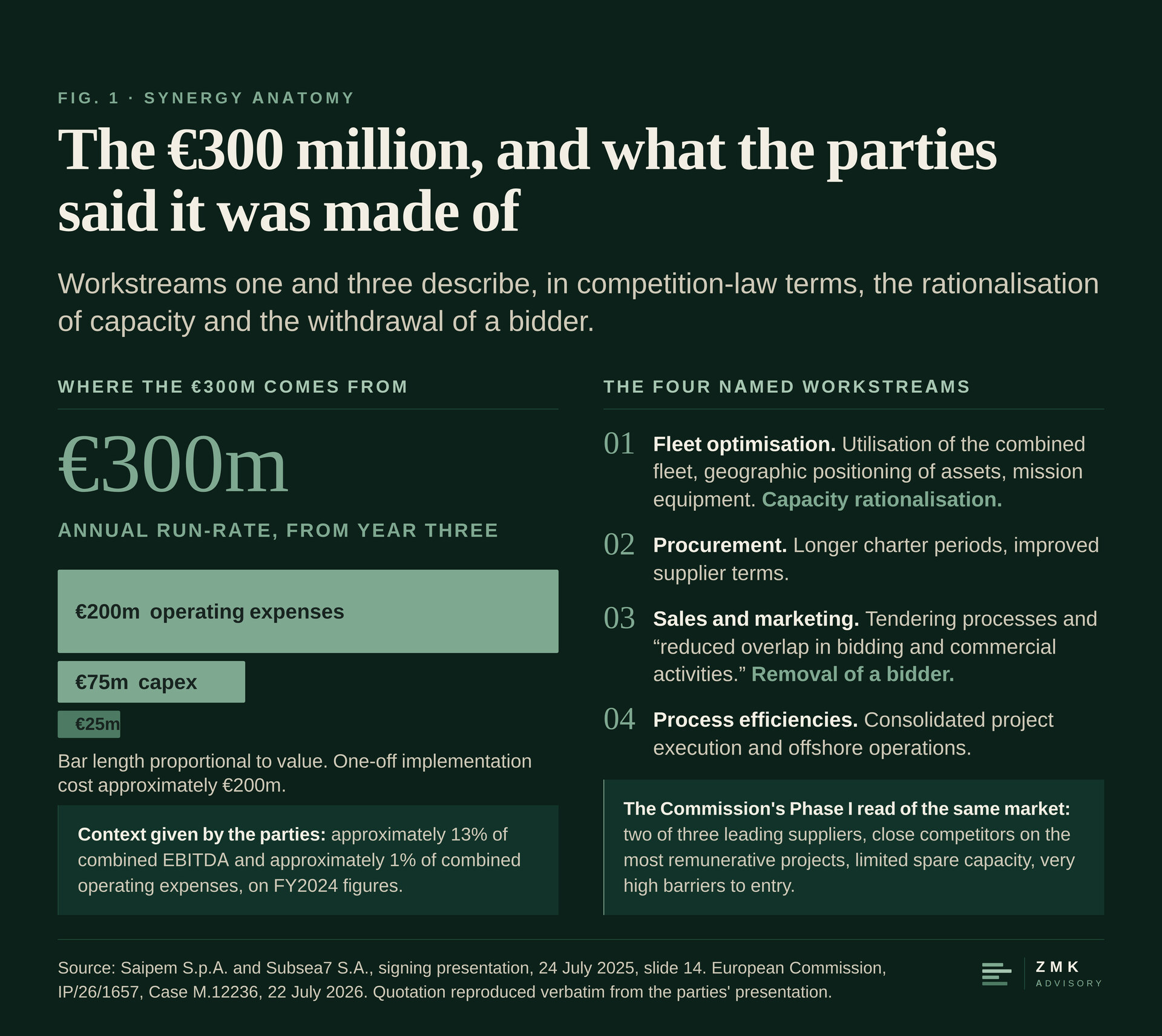
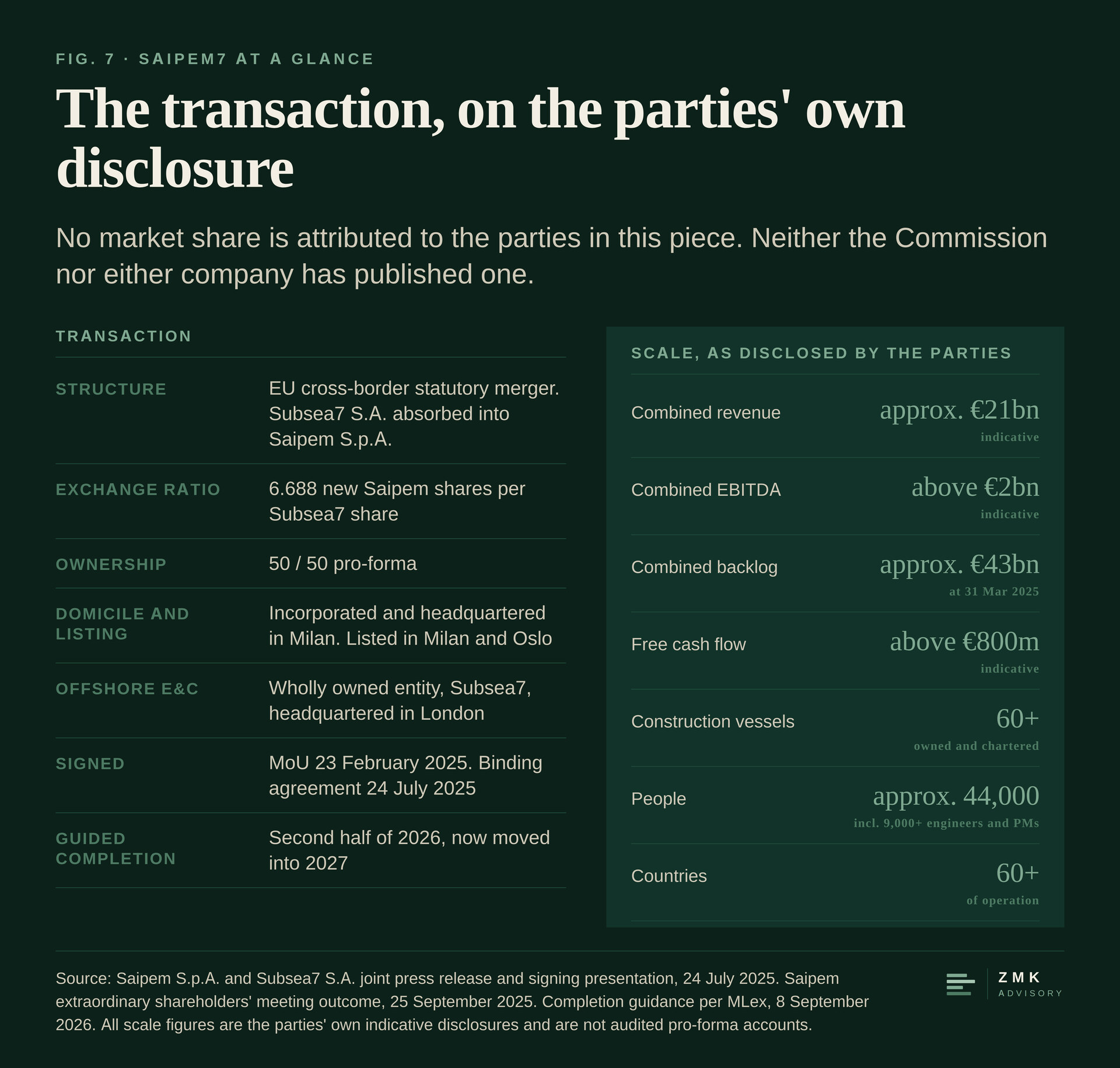
€300 million a year. That was the run-rate synergy Saipem and Subsea7 put in front of investors on 24 July 2025, the day they signed the binding agreement to merge into a single company to be called Saipem7.1 On the parties’ own FY2024 arithmetic the figure represents approximately 13 per cent of combined EBITDA and approximately 1 per cent of combined operating expenses, delivered at a one-off implementation cost of approximately €200 million and reaching full run-rate in year three.2
The composition of the number matters more than its size. The parties identified four sources. Fleet optimisation came first, defined as improved utilisation of the combined vessel fleet, better geographic positioning of assets and rationalised mission equipment. Procurement came second, through longer charter periods and improved supplier terms. Consolidation of project execution came fourth. Third on the list was sales and marketing, and the parties described it in seven words: “reduced overlap in bidding and commercial activities.”2
Twelve months later, on 22 July 2026, the European Commission opened an in-depth Phase II investigation into the same transaction under Article 6(1)(c) of the EU Merger Regulation.3 Its preliminary findings were that the two companies are two of the three leading suppliers of subsea umbilicals, risers and flowlines in the world; that they compete closely with each other, particularly on the most complex and most remunerative projects; that only one comparable competitor would remain, with other rivals considerably smaller and limited in their ability to compete across the board; that spare capacity is limited and barriers to entry and expansion very high, explained partly by the investment required in highly sophisticated vessels; and that customers, despite being large and sophisticated, “may not be able to resist price increases.”3
A synergy programme resting on fewer overlapping bids and a more tightly optimised fleet describes, in the vocabulary of merger control, the removal of a bidder and the rationalisation of capacity. The parties disclosed it because disclosure was required of them and because it is the ordinary industrial logic of consolidation. The consequence is that the value case and the theory of harm rest on the same underlying facts. That is why the file has proved harder than the market priced it, and why a completion both companies had guided to for the second half of 2026 has now moved into 2027.
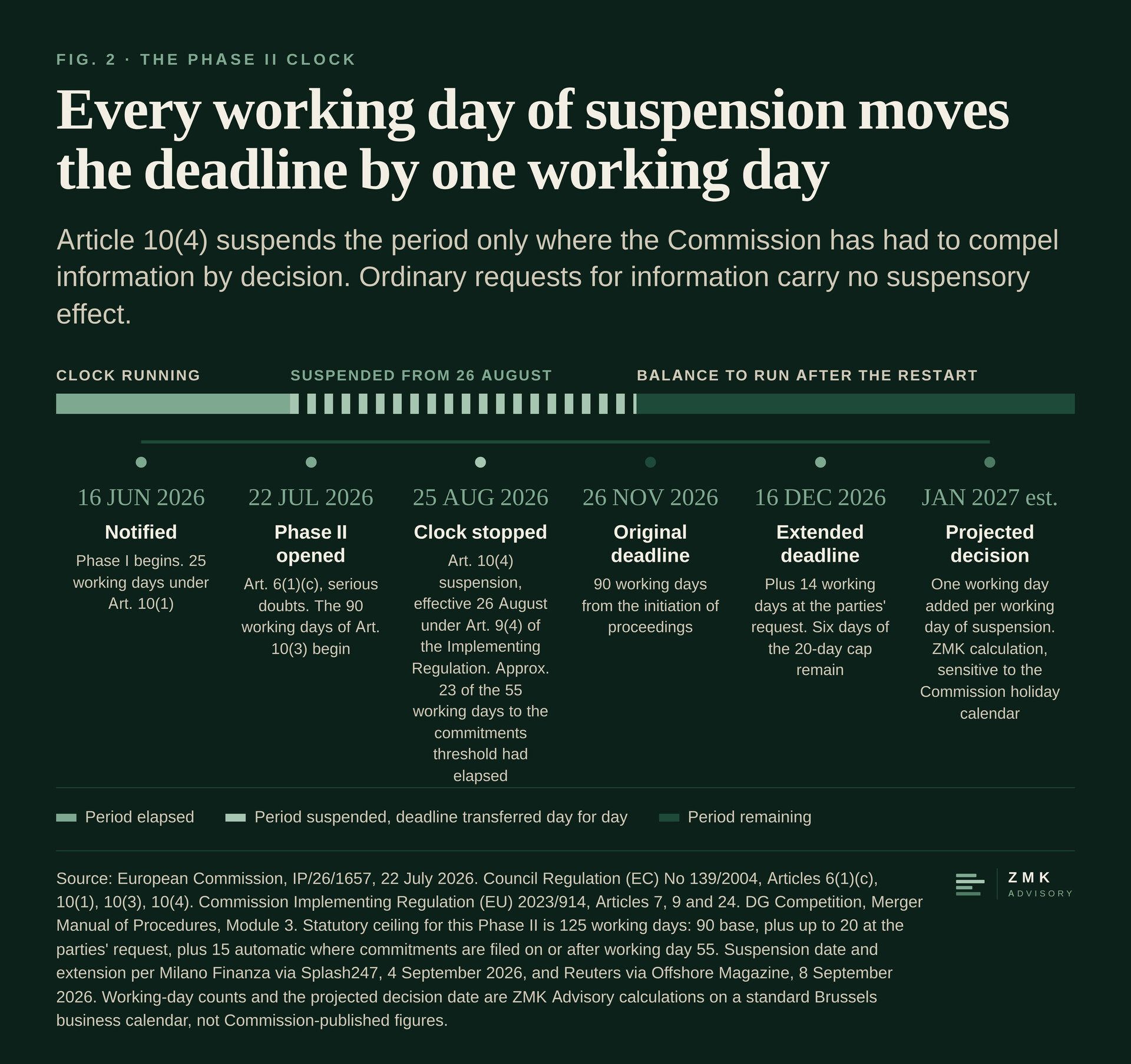
The suspended clock moves completion into 2027.
The transaction was notified to the Commission on 16 June 2026.3 Phase I ran and produced serious doubts. Proceedings were initiated on 22 July, and under Article 10(3) of the Merger Regulation4 the Commission then had 90 working days from the date of initiation, not from the date of notification, to reach a decision. That produced a statutory deadline of 26 November 2026.3
The same provision allows the notifying parties to request an extension, once only, no later than 15 working days after initiation, with total extensions capped at 20 working days.4 The parties requested 14, moving the deadline to 16 December and leaving six working days of that allowance unused.5 A further 15 working days attaches automatically if commitments are offered on or after the 55th working day from initiation, which sets the absolute statutory ceiling for this Phase II at 125 working days before any suspension is applied.6 A remedy filed late in the process therefore lengthens the process again.
On 25 August the Commission stopped the clock.7
The mechanism is narrower than the phrase “pending further information” suggests. Under Article 10(4) of the Merger Regulation, Phase II periods are suspended only where, owing to circumstances for which one of the undertakings is responsible, the Commission has had to compel information by formal decision under Article 11(3) or order an inspection under Article 13.4 Article 9 of the Implementing Regulation sets out the grounds, which include the supply of incomplete or incorrect information in response to a simple request, failure to submit to an inspection, and failure to inform the Commission of material changes to the facts contained in the notification.8 An ordinary request for information under Article 11(2) does not stop the clock.6 The Commission’s own guidance describes suspensions as reserved for “a handful of very complex in-depth investigations.”9
The Commission has not published the grounds engaged in this case, and the trade press reporting is limited to a source stating that the pause concerns a substantial information request rather than remedy discussions.10 Which limb of Article 9 was used is therefore not on the public record, and should not be assumed.
What can be established is duration. A suspension expires only when the complete and correct information is received, or when the Commission decides the information is no longer necessary.8 The precedents are long. In Oracle/PeopleSoft the periods were suspended on 14 April 2004 and the timetable resumed on 7 October, close to six months.11 In Orange/VOO the Commission adopted an Article 11(3) decision on 26 October 2022 and the notifying party complied on 30 January 2023, a suspension of approximately three months.12
Article 9(4) of the Implementing Regulation provides that suspension begins on the working day following the event that causes it, so a decision taken on 25 August stops the clock from 26 August.8 On that basis, and applying the Brussels working-day calendar which excludes Saturdays, Sundays and Commission holidays,6 the suspension had run for approximately 12 working days by 10 September 2026. On a ZMK Advisory calculation, and allowing for the Commission’s year-end closure, that alone displaces a 16 December decision to around the second week of January 2027. The count is sensitive by a day or so to the Commission’s own holiday schedule and to the exact date of the Article 11(3) decision, which has not been published. The figure is our calculation and not a Commission-published date, and the Commission publishes provisional deadlines, extensions and suspensions on the case register for M.12236, which remains the authoritative source.13 The direction, however, is not in dispute. The second-half-of-2026 completion both companies have guided to since February 2025 is no longer available.10
Ten of the sixteen competition authorities reviewing this transaction have already cleared it, Turkey among them in July.7 Brazil’s CADE granted unconditional clearance in June.14 The United Kingdom’s Competition and Markets Authority cleared the deal at Phase 1 in November 2025.15 The United States waiting period under the Hart-Scott-Rodino Act expired at the end of July.16 The two that have not are the two that will determine what the vessel fleet looks like.
The repricing preceded the merger.
The concern about SURF pricing is frequently discussed as a forecast of what Saipem7 might do. The available evidence describes something that has already happened.
Westwood forecasts global offshore field development capex of US$137 billion in 2026, an increase of 30 per cent on the US$105.2 billion recorded in 2025. Thirty-eight offshore field final investment decisions were taken in the first half of 2026, an increase of 90 per cent on the first half of 2025, committing US$66.4 billion of capex, more than three times the prior-year figure. Full-year subsea EPC awards are forecast at US$17 billion, underpinned by 283 subsea tree units. Demand for SURF in 2026 is forecast at approximately 4,000 kilometres, an increase of 32 per cent year on year.17
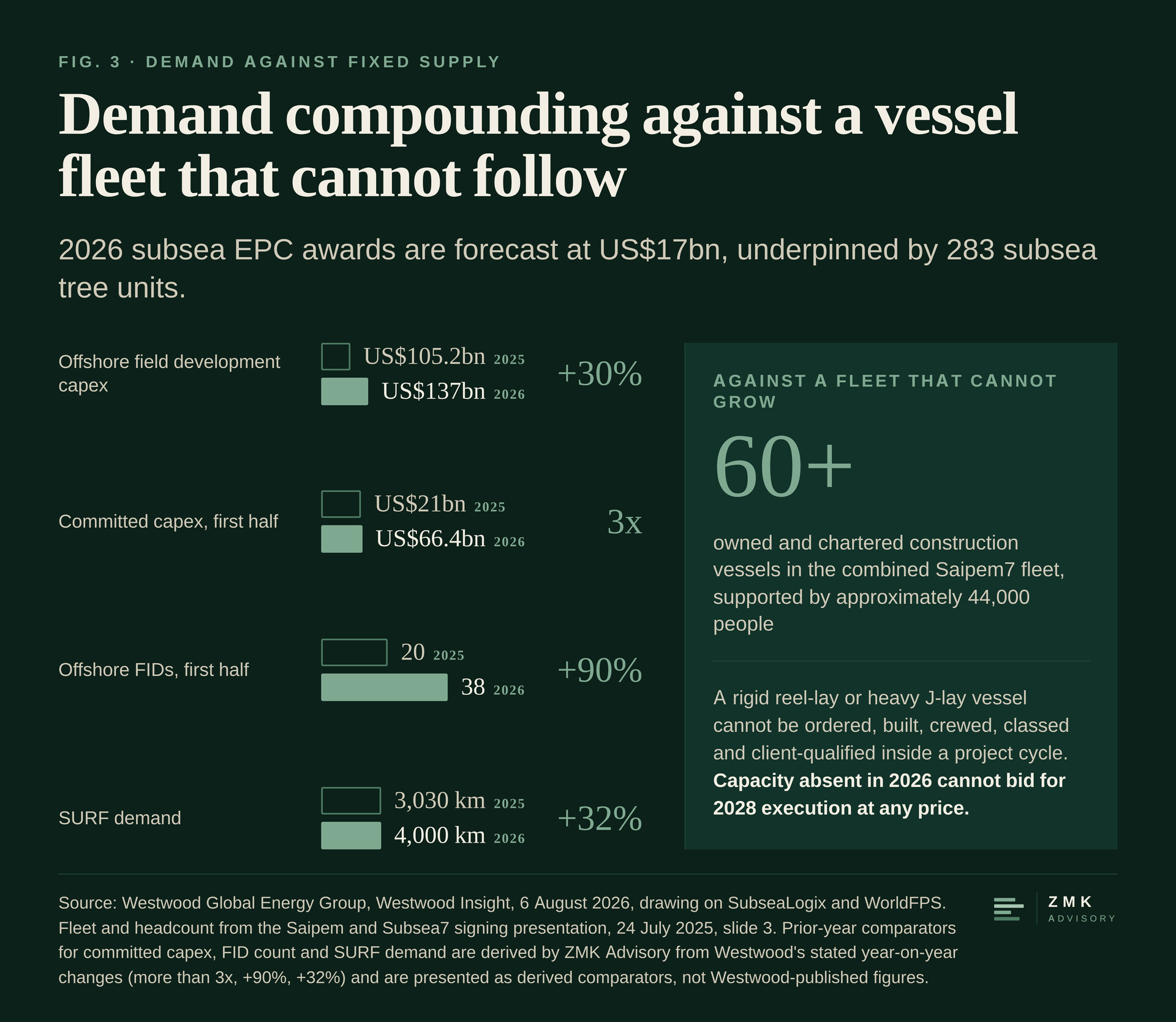
Against that demand, the three companies the Commission identifies as the market leaders reported second-quarter results within eight days of one another at the end of July 2026.
Subsea7 reported adjusted EBITDA of $471 million on revenue of $1.9 billion, a margin of 24 per cent against 21 per cent a year earlier, and raised full-year margin guidance from approximately 23 per cent to approximately 24 per cent. Backlog stood at $13.6 billion, with the Subsea and Conventional book at an all-time high of $11.8 billion.18 Within that division the adjusted EBITDA margin was 26.5 per cent, an increase of approximately 520 basis points year on year.19
TechnipFMC, the third leader and the only comparable competitor the Commission expects to remain, reported Subsea adjusted EBITDA of $577.2 million at a margin of 23.2 per cent, up 320 basis points year on year, on Subsea backlog of $15.8 billion.20 Its subsea opportunities list has passed $30 billion and has grown for eight consecutive quarters.21
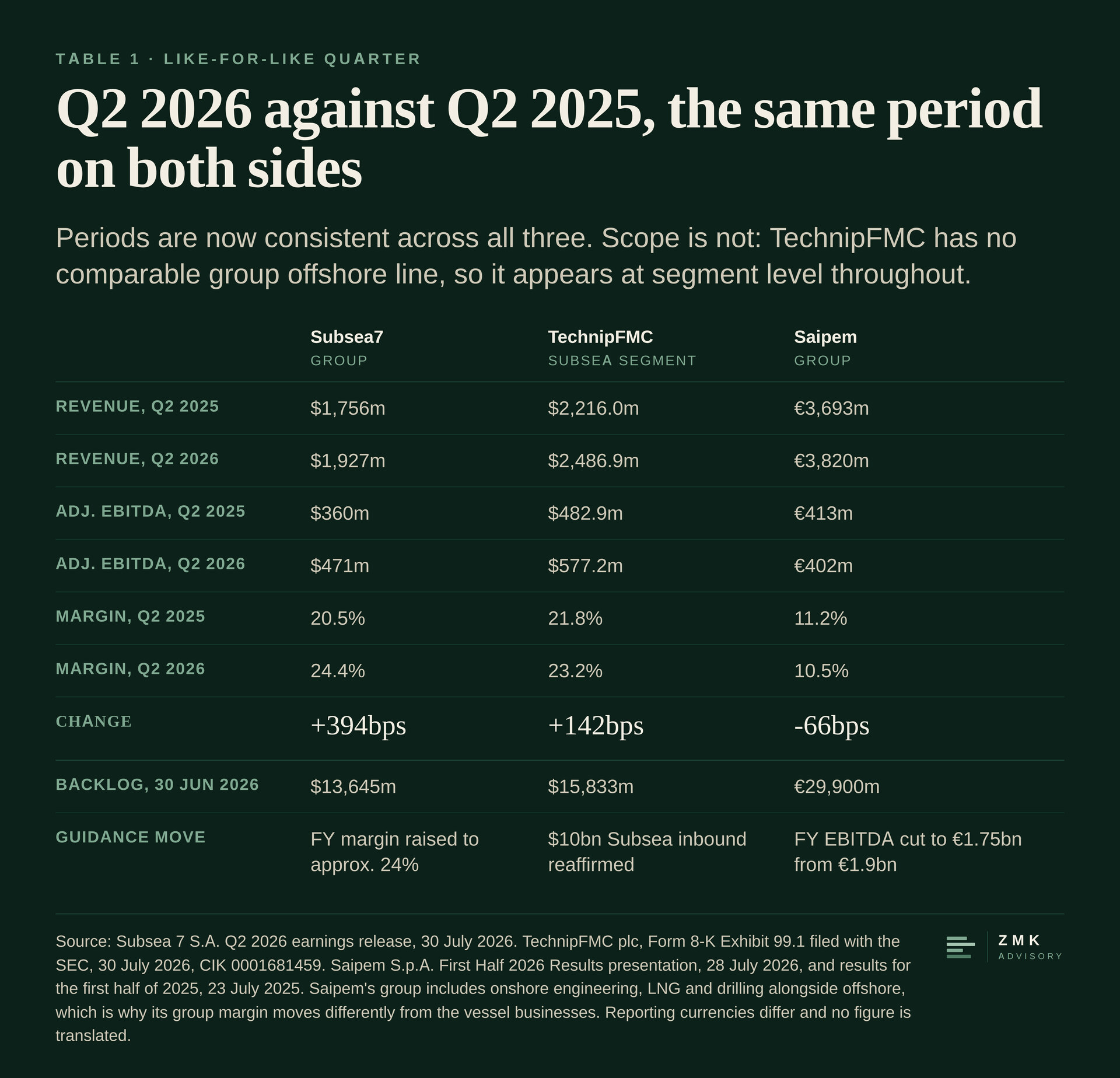
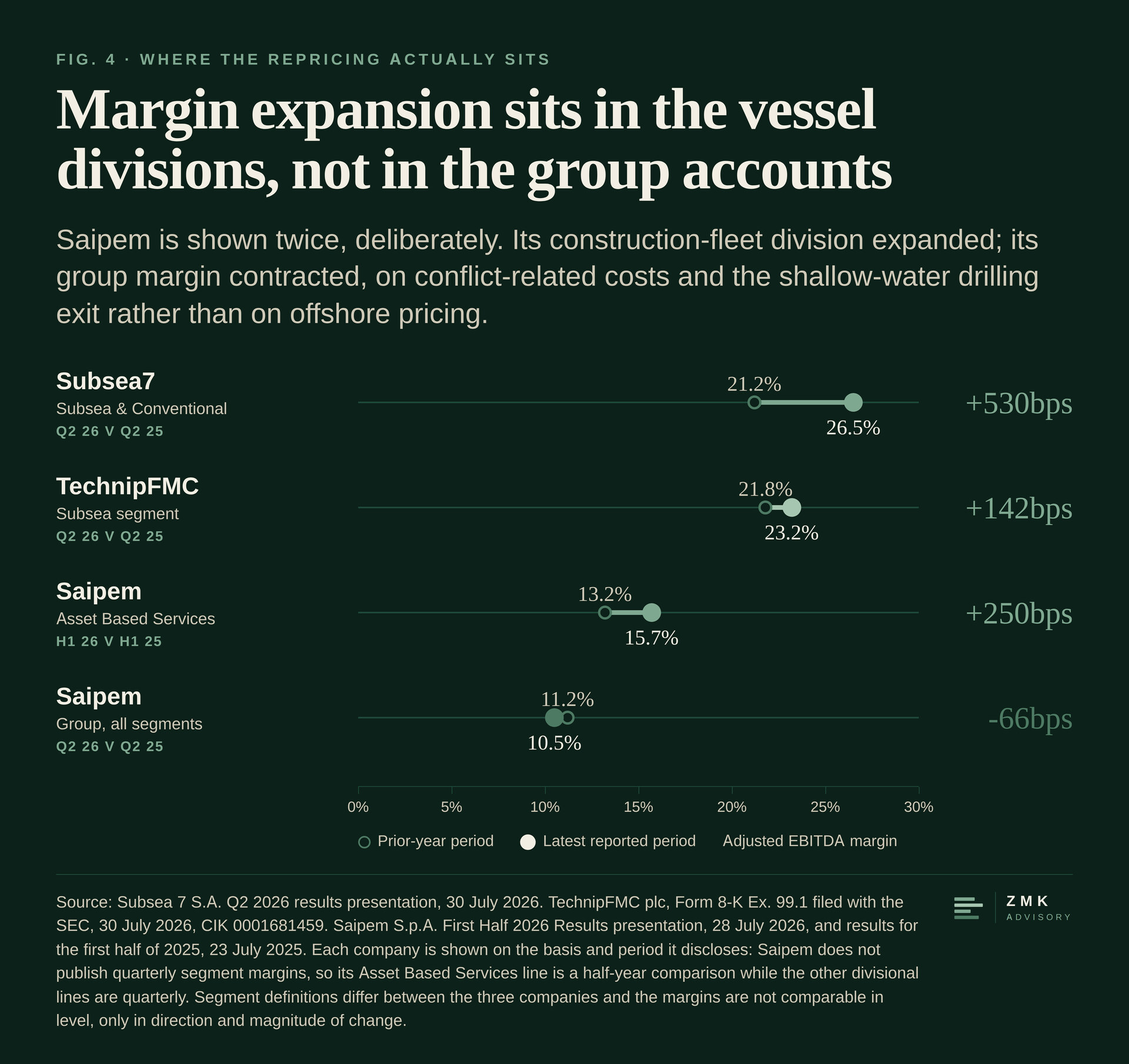
Saipem is the exception, and the exception is instructive. On a like-for-like quarter its group adjusted EBITDA fell 2.8 per cent to €402 million on revenue of €3.82 billion, a margin of 10.5 per cent against 11.2 per cent in the same quarter of 2025.22 That missed analyst consensus and prompted a cut in full-year guidance to €1.75 billion from €1.9 billion.23 But Saipem’s group accounts blend offshore construction with onshore engineering, LNG and drilling, and the guidance cut was attributed to roughly €70 million of conflict-related costs already incurred and to the disposal of the shallow-water drilling business, not to offshore pricing.22 Its Asset Based Services division, the one that owns and runs the construction fleet, moved the other way: a first-half margin of 15.7 per cent against 13.2 per cent, which the company attributes to a better project mix and a higher utilisation rate of the construction fleet.22
That divergence is the finding, not a complication of it. Where a company’s results are driven by vessels, margin expanded. Where they are diluted by everything that is not vessels, it did not.
Three balance sheets, at or near record backlog, with margins expanding in the same period in which the European Commission opened an investigation into whether the sector was at risk of becoming more expensive. One of the three raised guidance in the same quarter.
The mechanism is physical rather than commercial. In high-end offshore EPCI, price is set by the availability of a small number of specialised vessels rather than by the number of contractors submitting bids. The combined Saipem7 fleet would comprise more than 60 owned and chartered construction vessels, supported by approximately 44,000 people including more than 9,000 engineers and project managers.2 A rigid reel-lay or heavy J-lay vessel cannot be added inside a project cycle. Capacity that does not exist in 2026 cannot bid for work executing in 2028.
Global fleet counts also overstate what is available in any particular basin. Saipem told investors in April 2026 that its Middle East construction and drilling fleet is largely dedicated to the region, so that executing work in the Gulf requires no additional vessels to enter it and no units to transit the Strait of Hormuz for work elsewhere.24 That is presented as an operational strength, and it is one. It also means the units supporting an €11.5 billion regional backlog are not contestable capacity for a project offshore West Africa or Western Australia.
The honest reading is uncomfortable in both directions. The merger does not create pricing power in SURF, because pricing power in SURF is already visible in three sets of quarterly margins. What the merger does is remove the residual competitive discipline operating inside a market that is already tight, through a programme whose first named workstream is fleet optimisation.
The largest buyers filed against the deal.
The most consequential evidence in this file was submitted by the buyers.
When Brazil’s CADE reviewed the transaction, ExxonMobil, Petrobras and TotalEnergies all filed against it, joined by TechnipFMC as a competitor. Exxon argued the deal would concentrate SURF contracting and reduce customer choice. Petrobras argued that it relies on the parties for its core business.25 Reuters reported the objecting majors’ concern that the combined firm would be positioned to impose additional costs, delay projects and push clients toward exclusive long-term contracts.14 The Brazilian producers’ association, ABEP, told CADE that “a total prohibition of the operation would be the appropriate competitive solution,” arguing that in a structurally constrained market no remedy, including the divestment of vessels, would be sufficient.26
CADE’s General Superintendence cleared the transaction unconditionally on 23 June 2026.14 ABEP appealed to the CADE Tribunal within three weeks.27 The Australian Competition and Consumer Commission escalated to a Phase 2 assessment on 3 July, its commissioner stating that the acquisition “could substantially lessen competition” in subsea infrastructure critical to Australian offshore oil and gas projects.28 The European Commission opened Phase II on 22 July.3
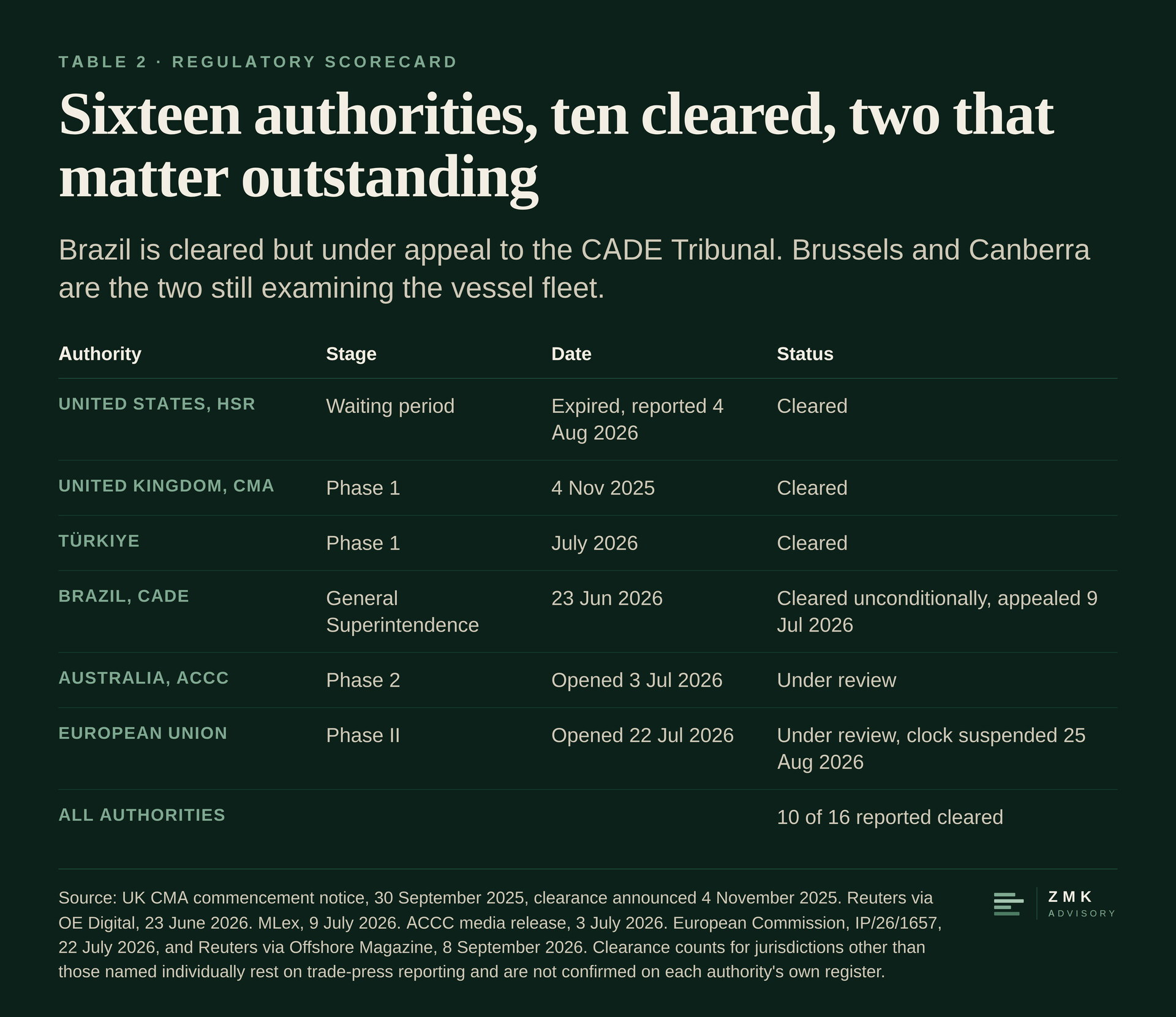
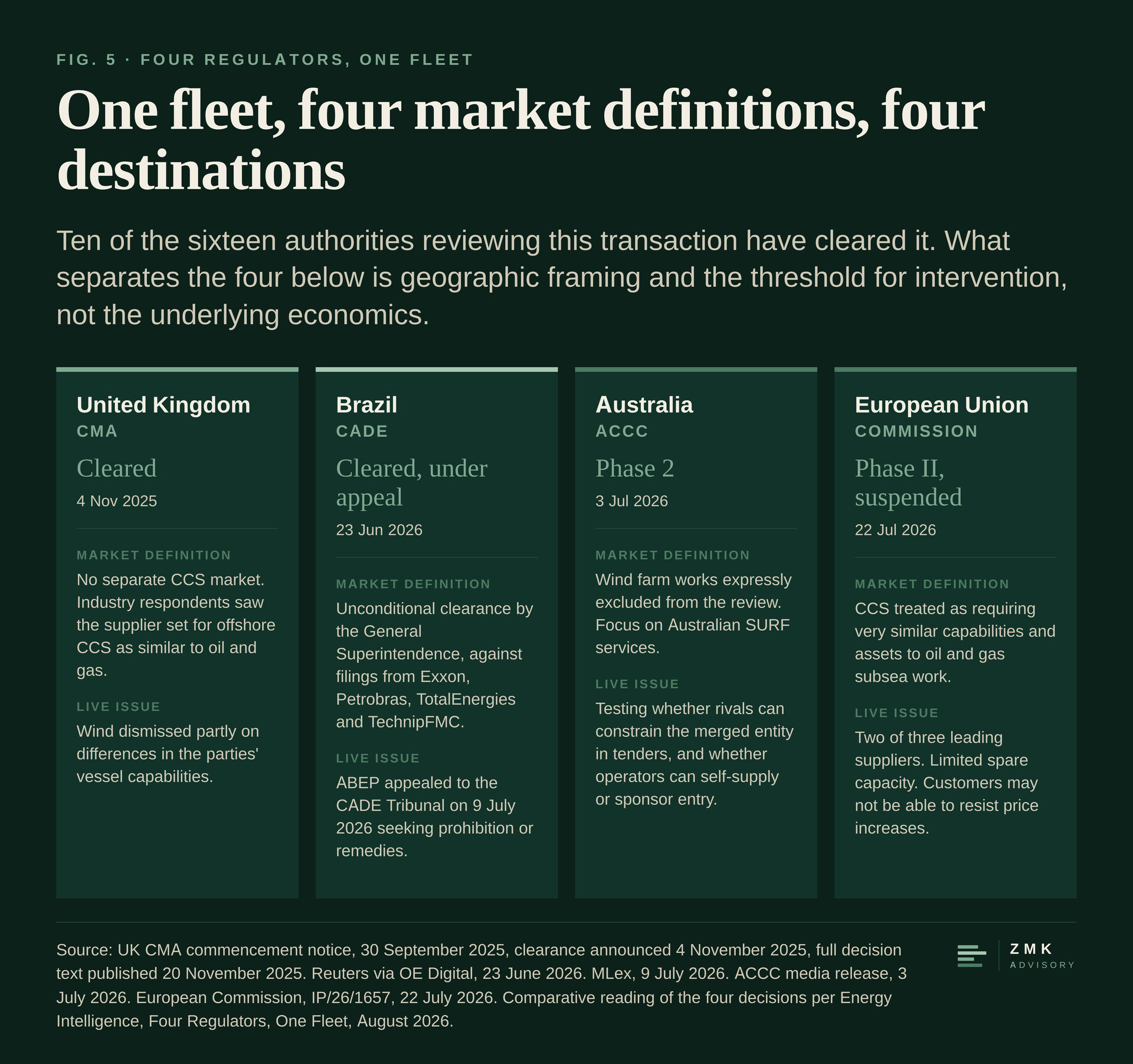
Three authorities reached three positions on one transaction inside five weeks. The variable is market definition: whether SURF constitutes a distinct product market or forms part of a broader offshore engineering market, and whether the relevant geographic frame is global or basin by basin. Australia’s assessment carries an additional feature, since the transaction is among the first energy-services tests of the mandatory formal merger regime that took effect there on 1 January 2026, with no domestic precedent for the ACCC to be bound by.28
Two elements of the Commission’s reasoning have received less attention than they warrant. The first is that it explicitly linked SURF capability to carbon capture and storage, finding that very similar assets and capabilities appear necessary to compete for CCS work today and in future.3 European decarbonisation infrastructure therefore sits inside the same vessel bottleneck as oil and gas tiebacks. The second is the buyer-power finding. Some of the largest listed energy companies in the world have effectively told regulators, in writing, that they cannot resist price increases from their own contractors. If that finding survives Phase II it is close to dispositive on the SURF theory of harm, and it is difficult to rebut with the standard countervailing-power arguments.
No remedy adds the vessels the market lacks, so buyers should act before Brussels decides.
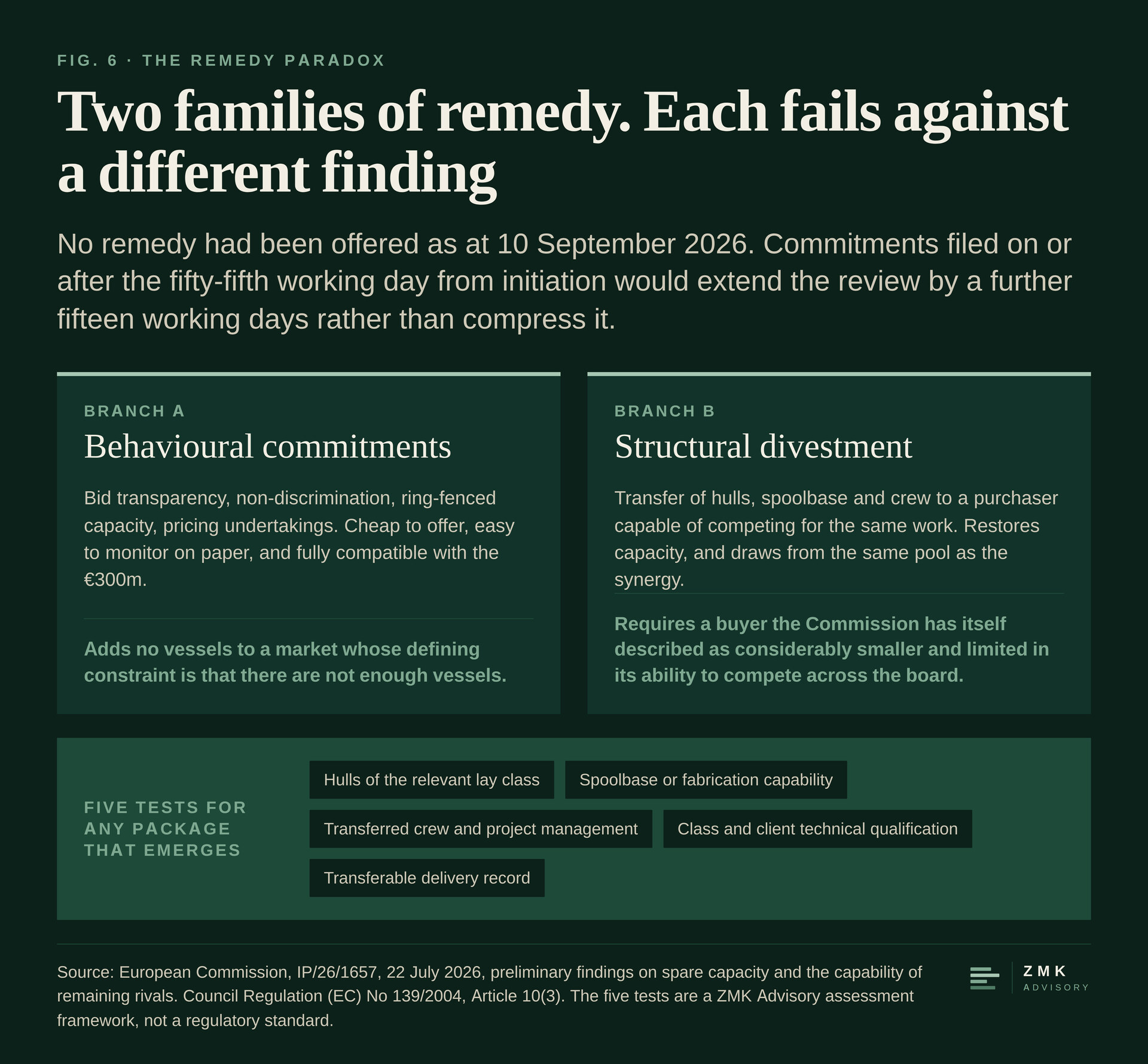
Two families of remedy are available. Behavioural commitments, whether bid transparency, non-discrimination or capacity ring-fencing, add no vessels to a market whose defining constraint is that there are not enough vessels. Structural divestment does add contestable capacity, but it requires a purchaser, and the Commission’s own preliminary finding is that the remaining competitors are considerably smaller and limited in their ability to compete across the board.3 That does not make divestment impossible; it changes what divestment can realistically achieve. A remedy cannot manufacture a third full-suite SURF competitor, because a package capable of that would need vessels, spoolbase capacity, crew, technical qualification and a client-transferable delivery record, which is most of what distinguishes a tier-one contractor from a mid-tier one. What a remedy can do is move specific assets, individual reel-lay or heavy-lay hulls, or a regional spoolbase, to a mid-tier contractor or a financially backed platform, restoring contestability in particular scopes or particular basins rather than across the market. That is the more probable shape of any package here, and it carries its own consequence: every hull and every base that leaves the combined fleet is drawn from the same pool as the fleet-optimisation savings that form the first pillar of the €300 million.2
The remedy is also drawn from the same pool as the €300 million. Fleet optimisation and reduced bidding overlap are the two synergy workstreams most exposed to a structural or behavioural fix, and they sit first and third on the parties’ own list.2
For operators, the decision cannot wait for Brussels. Capacity for 2028 execution is being allocated in tender rounds running now, under a market structure that will not have a settled name until 2027 at the earliest. Three practices distinguish the buyers who manage this well. The first is analysing concentration at the level of the vessel class the scope actually requires, in the basin where the work sits, rather than accepting a global market definition that may not describe the project. The second is writing tenders that price bidder-count risk explicitly, rather than assuming a three-bidder field persists to award. The third is opening capacity conversations early, on the understanding that in an asset-constrained market the scarce commodity being contracted is not a contractor but a hull with an available window.
The €300 million was always a defensible industrial number, and it remains one. What has changed is that a regulator has now read the same disclosure and drawn the opposite conclusion from it, and no remedy yet proposed reconciles the two readings.
ZMK Advisory provides macro-strategy and risk analysis across metals, mining, oil and gas.
Technical notes
T1. What SURF is, and why the vessel class rather than the contractor is the unit of analysis. SURF denotes subsea umbilicals, risers and flowlines: the pipes and cables installed on or near the seabed that connect subsea wells to production facilities above the surface.3 Installation capability is a function of lay technology, principally rigid reel-lay, J-lay and S-lay for rigid pipe, plus flexible-lay and heavy-lift capability, and each technology is embodied in a small population of specific hulls. The parties’ own market-positioning disclosure segments their combined fleet by exactly these categories.2 Concentration measured across “offshore contractors” and concentration measured across, for example, heavy J-lay vessels capable of ultra-deepwater work are different numbers, and only the second is relevant to a specific tender.
T2. Phase II timing architecture. Article 10(3) EUMR sets 90 working days from initiation of proceedings under Article 6(1)(c), extended to 105 working days where commitments are offered under Article 8(2) second subparagraph on or after the 55th working day from initiation. Extensions may be granted once on the notifying parties’ request, made within 15 working days of initiation, or at any time by the Commission with the parties’ agreement, subject to a combined cap of 20 working days. The maximum Phase II duration is therefore 110 working days, or 125 where commitments are submitted on or after day 55.6 Working days exclude Saturdays, Sundays and Commission holidays under Article 24 of the Implementing Regulation.8
T3. Suspension architecture. Article 10(4) EUMR suspends the Phase II period only where, owing to circumstances for which one of the undertakings involved is responsible, the Commission has had to require information by decision under Article 11(3) or order an inspection under Article 13. Article 9 of Implementing Regulation (EU) 2023/914 enumerates the grounds and the running periods, and provides that suspension begins on the working day following the event and expires at the end of the day on which the reason is removed.8 A simple request for information under Article 11(2) does not suspend the period.6
T4. Comparability of the financial figures used. The three companies do not report on a common basis, and this piece compares only like against like. Every margin comparison in Section III is the same period against the same period of the prior year. Subsea7 and TechnipFMC disclose quarterly segment margins; Saipem does not, so its Asset Based Services comparison is half-year while its group comparison is quarterly, and each is labelled as such wherever it appears. Subsea7 and TechnipFMC report in US dollars, Saipem in euro, and no figure is translated. Saipem’s group adjusted EBITDA includes onshore E&C, sustainable infrastructures and drilling offshore, so its group margin is not comparable in level to Subsea7’s or TechnipFMC’s subsea margins, and no such comparison is drawn: the figures are used for direction and magnitude of change within each company only. Correction: Saipem’s group margin is compared quarter against quarter. An earlier comparison of its half-year figures against the others’ quarterly figures showed expansion where a like-for-like quarter shows contraction, and has been withdrawn. One further comparability point: all three margins are struck on adjusted EBITDA, which sits above depreciation, so differences in fleet capital intensity and in newbuild or upgrade spend do not flow through to the margin line. Vessel downtime does affect it, through utilisation and revenue, which is why Saipem’s own attribution of its Asset Based Services margin expansion to a higher construction-fleet utilisation rate is the relevant disclosure rather than an incidental one.22 Backlog definitions also differ, and TechnipFMC states expressly that backlog does not capture all revenue potential for Subsea Services.20 Saipem quotes net cash on a pre-IFRS 16 basis.22 Subsea7 reports both including and excluding lease liabilities.18 Figures are not aggregated into a market total.
T5. Why no market share appears in this article. Neither the European Commission nor either party has published a market share for the parties in SURF. The Commission’s language is qualitative: two of three leading suppliers, high market and capacity shares.3 ABEP’s submission to CADE asserted ranges from 40 to 50 per cent up to 70 to 80 per cent, but that is an advocate’s figure produced in an adversarial process by a party seeking prohibition, and it is recorded here as an advocacy position rather than as evidence.26 Any percentage attributed to the parties in current commentary should be traced to a named source before use.
T6. Sources excluded by design. Commercial market-research vendors publish 2026 SURF market values ranging from approximately US$3.3 billion to approximately US$62.9 billion, a spread of roughly twenty times, which indicates that the underlying scope definitions are not comparable. None is used here. Where SURF market activity is quantified in this piece it is expressed in installed kilometres and subsea tree units, which are physically verifiable, sourced to Westwood.17 Retail-investor aggregator commentary and sell-side ratings notes are likewise excluded from the evidentiary basis.
- 1 Saipem S.p.A. and Subsea7 S.A., "Saipem and Subsea7 announce signing of the Merger Agreement," joint press release, Milan and Luxembourg, 24 July 2025. Establishes the binding agreement, the 6.688 exchange ratio, the 50/50 pro-forma split, the Saipem7 name, indicative combined revenue of approximately €21bn, EBITDA in excess of €2bn and backlog of approximately €43bn, and the €300m synergy figure. https://www.saipem.com/en/media/press-releases/2025-07-24/saipem-and-subsea7-announce-signing-merger-agreement
- 2 Saipem S.p.A. and Subsea7 S.A., "Combination of Saipem and Subsea7: Creating a Global Leader in Energy Services," signing presentation, 24 July 2025. Slide 14 is the primary source for the synergy decomposition (approximately €200m opex, €75m capex, €25m process efficiencies), the approximately €200m one-off implementation cost, the year-three run-rate, the 13 per cent of combined EBITDA and 1 per cent of combined opex ratios, and the four named synergy workstreams including the phrase quoted in Section I. Slide 15 sets out the combined fleet by lay technology and the "more than 60 owned and chartered construction vessels" figure. Slide 3 gives the approximately 44,000 headcount and more than 9,000 engineers and project managers. Slide 8 is the parties' own market-positioning matrix across SURF, conventional, trunklines, offshore wind, floaters and drilling. https://www.subsea7.com/content/dam/subsea7-corporate2018/gated/merger-presentation/presentation_merger_agreement_combination_of_saipem_and_subsea7_24_july_2025_final.pdf
- 3 European Commission, "Commission opens in-depth investigation into proposed merger between Saipem and Subsea7," press release IP/26/1657, Case M.12236, 22 July 2026. Primary source for the notification date of 16 June 2026, the Phase II opening, the 26 November 2026 deadline, the definition of SURF, the CCS capability linkage, the five preliminary findings quoted and paraphrased in Section I, the statement that coordinated effects will be examined, and the extension of the inquiry to trunkline services, decommissioning, and vertical and conglomerate effects. https://ec.europa.eu/commission/presscorner/detail/nl/ip_26_1657
- 4 Council Regulation (EC) No 139/2004 of 20 January 2004 on the control of concentrations between undertakings (the EU Merger Regulation), Articles 6(1)(c), 8, 10(3) and 10(4), Official Journal L 24, 29 January 2004. Establishes that the 90 working days runs from initiation of proceedings rather than from notification; the increase to 105 working days where commitments are offered under Article 8(2) second subparagraph on or after the 55th working day; the single extension available on the notifying parties' request within 15 working days of initiation; the 20 working-day cap on total extensions; and the Article 10(4) conditions for suspension. https://eur-lex.europa.eu/legal-content/EN/TXT/PDF/?uri=CELEX%3A32004R0139
- 5 Splash247, "EU hits pause on Saipem-Subsea7 merger review," 4 September 2026, reporting Milano Finanza. Source for the 14 working-day extension moving the deadline from 26 November to 16 December 2026, and for the suspension taking effect from 25 August 2026. https://splash247.com/eu-hits-pause-on-saipem-subsea7-merger-review/
- 6 European Commission, DG Competition, Merger Manual of Procedures, Module 3: Types of Procedures, paragraphs 88 to 102. Confirms that Article 10(3) periods are calculated from the working day following the Article 6(1)(c) decision; that total extensions may not exceed 20 working days; that maximum Phase II duration is 110 working days, or 125 where commitments are submitted on or after day 55; that suspension results directly from the adoption of an Article 11(3) or Article 13 decision and that a simple request for information does not suspend; that "working days" excludes Saturdays, Sundays and Commission holidays under Article 24 of the Implementing Regulation; and that provisional deadlines, extensions and suspensions are published on DG Competition's website. https://competition-policy.ec.europa.eu/document/download/c6785486-fc46-4b8a-bbfa-d02d0b66df09_en
- 7 Offshore Magazine, "European Commission suspends in-depth review of Saipem–Subsea7 merger," 8 September 2026, reporting Reuters wire. Corroborates the 25 August effective date, states the suspension has no fixed duration and that the timetable restarts only when the Commission deems the outstanding information complete, and records clearance by 10 of the 16 authorities reviewing the deal. https://www.offshore-mag.com/business-briefs/company-news/news/55403333/european-commission-suspends-in-depth-review-of-saipemsubsea7-merger
- 8 Commission Implementing Regulation (EU) 2023/914 of 20 April 2023 implementing Council Regulation (EC) No 139/2004, Articles 7, 8, 9 and 24, Official Journal L 119, 5 May 2023. Article 9(1) and 9(2) enumerate the grounds on which time limits are suspended where the Commission has to adopt an Article 11(3) or Article 13(4) decision, including incomplete or incorrect information supplied in response to a simple request and failure to inform the Commission of material changes to the notified facts. Article 9(3) sets the running period to receipt of complete and correct information or to the point at which the Commission determines the information is no longer necessary. Article 9(4) provides that suspension begins on the working day following the event and expires at the end of the day the reason is removed. https://eur-lex.europa.eu/eli/reg_impl/2023/914/oj/eng
- 9 Jakob Dewispelaere, "Requests for Information in Merger Cases: Regulatory Overreach?", Competition Policy International, 2020. Cited for the Commission's own characterisation of the frequency with which suspensions are used, and for the distinction between an Article 11(2) simple request and an Article 11(3) decision. https://www.competitionpolicyinternational.com/wp-content/uploads/2020/08/06-Requests-for-Information-in-Merger-Cases-Regulatory-Overreach-Jakob-Dewispelaere.pdf
- 10 MLex, Nicholas Hirst and Jean Comte, "Saipem and Subsea7 see EU review derail merger timeline," 8 September 2026. Source for the assessment that end-2026 completion is no longer achievable, for the parallel Australian remedy deadline, and for the characterisation of the suspension notice on the Commission's register. https://www.mlex.com/mlex/mergers-acquisitions/articles/2522200
- 11 Commission Decision of 26 October 2004 declaring a concentration compatible with the common market, Case COMP/M.3216 Oracle/PeopleSoft, procedural history. Precedent for the duration of an Article 10 suspension: periods suspended from 14 April 2004 following the absence of a reply to an Article 11 request, timetable resumed 7 October 2004. https://www.legislation.gov.uk/eudn/2005/621/division/3/data.xht
- 12 Summary of Commission Decision, Case M.10663 Orange/VOO, Official Journal C 1523, 2023, procedural history at recitals 6 and 7. Precedent for both mechanisms discussed in Section II: a 10 working-day extension granted at the notifying party's request under Article 10(3), and an Article 11(3) decision adopted 26 October 2022 with compliance on 30 January 2023, the suspension expiring at the end of that day. https://eur-lex.europa.eu/legal-content/EN/TXT/HTML/?uri=OJ%3AC_202301523
- 13 European Commission, public case register, Case M.12236 SAIPEM / SUBSEA7. The authoritative record of the provisional legal deadline and of any published extension or suspension. https://competition-cases.ec.europa.eu/cases/M.12236
- 14 Reuters, "Brazil antitrust agency approves Subsea7-Saipem merger without restrictions," 23 June 2026, wire via OE Digital. Establishes unconditional clearance by CADE's General Superintendence on 23 June 2026, the identity of the objecting parties, and the objectors' stated concerns regarding additional costs, project delay and exclusive long-term contracts. https://www.oedigital.com/amp/news/540582-brazil-clears-subsea7-saipem-merger-without-conditions
- 15 UK Competition and Markets Authority, "Anticipated merger between Subsea7 S.A. and Saipem S.p.A.", notice under section 96(2A) of the Enterprise Act 2002, 30 September 2025. Establishes that the UK merger notice was accepted on 30 September 2025, that the initial period commenced 1 October 2025 and that the Phase 1 decision deadline was 25 November 2025. https://assets.publishing.service.gov.uk/media/68da63b0dadf7616351e4b6f/Commencement_notice.pdf
- 16 MarineLink, "Saipem, Subsea7 Clear Key US Regulatory Merger Hurdle," 4 August 2026. Establishes expiry of all applicable waiting periods under the Hart-Scott-Rodino Antitrust Improvements Act of 1976. https://www.marinelink.com/news/saipem-subsea-clear-key-us-regulatory-541726
- 17 Westwood Global Energy Group, "Westwood Insight: Offshore Field Development Capex to Reach US$137bn in 2026," 6 August 2026. Source for 2026 offshore field development capex of US$137bn against US$105.2bn in 2025; 38 offshore FIDs in 1H 2026 versus 1H 2025; US$66.4bn of committed 1H capex; US$17bn full-year subsea EPC awards; 283 subsea tree units; and SURF demand of approximately 4,000km, up 32 per cent year on year. https://www.westwoodenergy.com/news/westwood-insight/westwood-insight-offshore-field-development-capex-to-reach-us137bn-in-2026
- 18 Subsea 7 S.A., "Subsea 7 S.A. Announces Second Quarter and Half Year 2026 Results," earnings release, 30 July 2026 (Oslo Børs: SUBC; ISIN LU0075646355). Source for Q2 revenue of $1,927m, adjusted EBITDA of $471m at a 24 per cent margin against 21 per cent, backlog of $13,645m at 30 June 2026, order intake of $2.1bn, book-to-bill of 1.1x, the raised full-year margin guidance, and the net cash position on both lease bases. https://www.subsea7.com/content/dam/subsea7-corporate2018/Results_Reports_Presentations/Results/2026/q2/2q26-earnings-release.pdf.downloadasset.pdf
- 19 Subsea 7 S.A., Second Quarter 2026 results presentation, 30 July 2026. Source for the Subsea and Conventional divisional adjusted EBITDA of $410m at a 26.5 per cent margin, the approximately 520 basis point year-on-year expansion, and the $11.8bn all-time-high divisional backlog. https://www.subsea7.com/content/dam/subsea7-corporate2018/Results_Reports_Presentations/Results/2026/q2/2q26-presentation.pdf.downloadasset.pdf
- 20 TechnipFMC plc, Form 8-K, Exhibit 99.1, "TechnipFMC Announces Second-Quarter 2026 Results," filed with the US Securities and Exchange Commission, 30 July 2026 (CIK 0001681459; NYSE: FTI). Source for Subsea revenue of $2,486.9m, Subsea adjusted EBITDA of $577.2m at a 23.2 per cent margin, Subsea inbound of $2,507.1m, Subsea backlog of $15,833.2m, the backlog scheduling by year, and the disclosure that backlog does not capture all revenue potential for Subsea Services. https://www.sec.gov/Archives/edgar/data/1681459/000168145926000040/technipfmc2026630-8kerex.htm
- 21 TechnipFMC plc, Second Quarter 2026 earnings presentation, 30 July 2026. Source for the subsea opportunities list exceeding $30bn on a project-value midpoint basis and for the eighth consecutive quarter of growth in that list, and for the reaffirmed $10bn 2026 Subsea inbound target. https://www.technipfmc.com/media/tssckphf/technipfmc-2q26-earnings-presentation.pdf
- 22 Saipem S.p.A., "First Half 2026 Results," investor presentation, 28 July 2026 (Borsa Italiana: SPM). Source for H1 revenue of €7.35bn, adjusted EBITDA of €836m at an 11.4 per cent margin, order intake of €5.7bn in the half plus €2.3bn in July, backlog of €29.9bn at 30 June 2026, free cash flow of €388m post lease repayments, net cash of €1.08bn pre-IFRS 16, and the revised FY2026 EBITDA guidance of €1.75bn. https://www.saipem.com/sites/default/files/2026-07/Saipem_1H_2026_Results_Presentation_FINAL.pdf
- 23 Reuters via Investing.com, "Saipem drops after Q2 miss, 2026 EBITDA cut on Middle East costs," 28 July 2026. Corroborates: Q2 2026 adjusted EBITDA of €402m, down 2.8 per cent year-on-year, against LSEG consensus of €464m; Q2 revenue of €3.82bn, up 3.4 per cent; the full-year guidance cut to €1.75bn from €1.9bn, attributed to costs already incurred in the first half, anticipated additional second-half expenses, and the deconsolidation of the shallow-water drilling unit. https://www.investing.com/news/stock-market-news/saipem-cuts-2026-earnings-outlook-on-middle-east-crisis-costs-93CH-4814880
- 24 Saipem S.p.A., "First Quarter 2026 Results Conference Call," official transcript, April 2026. Source for the Middle East backlog of €11.5bn at the end of Q1 2026 and for management's statement that the regional construction and jack-up fleet is largely dedicated to the Gulf, requiring no additional vessels to enter the region and no transit of the Strait of Hormuz to execute work elsewhere. https://www.saipem.com/sites/default/files/2026-04/Saipem%20First%20Quarter%202026%20results_3.pdf
- 25 Reuters, "Oil firms ask Brazil antitrust watchdog to intervene in Subsea7–Saipem merger," September 2025. Source for the substance of the Petrobras, ExxonMobil and TechnipFMC filings to CADE, including Exxon's argument on SURF contractor concentration and customer choice and Petrobras's statement of reliance on the parties for its core business. https://finance.yahoo.com/news/oil-firms-ask-brazil-antitrust-194359772.html
- 26 MarketScreener, "Brazil split over Saipem-Subsea7 merger," 23 May 2026, summarising third-party submissions in the CADE proceeding. Source for the ABEP submission quoted in Section IV, for ABEP's argument that no remedy including vessel divestment would suffice in a structurally constrained market, and for the divergent positions of ExxonMobil, TechnipFMC and Petrobras on the availability of behavioural and structural remedies. https://www.marketscreener.com/news/brazil-split-over-saipem-subsea7-merger-ce7f5adfdb81f526
- 27 MLex, Flavia Fortes, "Brazil oil producers appeal CADE's approval of Subsea7-Saipem merger," 9 July 2026. Source for the ABEP appeal to the CADE Tribunal seeking prohibition or the imposition of structural and behavioural remedies. https://www.mlex.com/mlex/dealrisk/articles/2499366
- 28 Australian Competition and Consumer Commission, "Saipem Subsea7 merger requires Phase 2 review," media release, 3 July 2026. Source for the Phase 2 escalation on 3 July 2026, the quoted statement by Commissioner Dr Philip Williams, the 21 July 2026 submissions deadline, and the ACCC's framing of the competition question around subsea infrastructure critical to Australian offshore oil and gas projects. https://www.accc.gov.au/media-release/saipem-subsea7-merger-requires-phase-2-review
Status of the proceeding. Case M.12236 is live. The European Commission’s Phase II findings described here are preliminary by definition and the Commission has reached no conclusion. The Australian review is also open, and the Brazilian clearance is under appeal. Nothing in this note asserts that any party has acted unlawfully, made a false statement, or failed to comply with any obligation.
ZMK’s own arithmetic. Several figures in this note are derived rather than disclosed. The suspension had run approximately 12 working days to 10 September 2026, counted from 26 August on the Article 9(4) basis that suspension begins the working day after the causing event, on a standard Brussels business calendar. The resulting displacement of the 16 December deadline to around the second week of January 2027 follows from that count and is sensitive to the Commission’s own holiday schedule and to the unpublished date of the Article 11(3) decision. The approximately 23 of 55 working days elapsed to the commitments threshold, and the 125-working-day statutory ceiling, are computed from Articles 10(3) and 10(4) as described in the technical notes. The basis-point changes in Section III are computed from margins each company disclosed. The prior-year comparators in Fig. 3 are derived from Westwood’s stated year-on-year changes and are not Westwood-published figures. None of these is a forecast.
Comparability. Every margin comparison is the same period against the same period of the prior year. Saipem does not disclose quarterly segment margins, so its Asset Based Services line is a half-year comparison while the other divisional lines are quarterly, and each is labelled on the face of the figure. Reporting currencies differ and no figure is translated. Backlogs are not aggregated into a market total. No market share is attributed to the parties anywhere in this note, because neither the Commission nor either company has published one.
Exhibits. The seven figures and two tables are original work by ZMK Advisory. Each carries its own source line on its face and reproduces no third-party material. The photographs are licensed as stated in their captions and have been graded; modification is indicated as the licences require.
Interests. ZMK Advisory holds no position, long or short, direct or derivative, in any company named in this note. It has not been engaged by any party to the transaction discussed, by any of the companies named, by any competitor or customer of theirs, or by any lender or adviser to the transaction.