Seven Trades
Seven trades cleared the window that timestamps the world’s iron ore benchmark in 2022. Beijing has spent four years and three supply embargoes fighting for control of it, and has won something other than a lower price.
Beijing’s four-year campaign against the iron ore benchmark has won it the reference: the governance, the currency and the jurisdiction of the number. It has not won a lower price, and the lever that will move the price is Simandou.
- 01A six-billion-tonne derivatives market settles on a thin timestamped window.Seven trades cleared the Platts Market on Close window in 2022 and eleven in 2023. SGX traded about 5.8 billion tonnes of IODEX futures in 2025, on ZMK’s arithmetic.
- 02Four years of embargo produced one quantified concession: a 1.8 per cent rebate.That is about $1.52 a tonne, or roughly $1.2bn a year across the three Australian majors on ZMK’s arithmetic. China’s import bill fell $9.4bn in 2025 on the market alone.
- 03The objection is the currency, not the method.The 2020 study’s claim that the index is biased upward has never been tested in public. Its complaint that the index is “denominated in US dollars” is the one policy has followed.
- 04China has won the reference, not the price.A new assessor changes who reads the cargoes and in what currency. It does not change the ore, the freight or the grade, and declining grades are what moved the specification to 61 per cent.
- 05The lever that moves the price is Simandou.Up to 120 million tonnes a year of high-grade ore, with Baowu controlling the northern blocks since January 2026. Beijing has since capitalised a successor body at three times CMRG’s size, aimed at base metals.
Field Note Audio
Questions on the analysis, answered on the record.
A six-billion-tonne derivatives market settles on a window that saw seven trades in 2022.
In 2022, S&P Global Commodity Insights published 956 lines of iron ore Market on Close commentary, up 110 per cent on the year before. Inside that window, the structured session that produces the 17:30 Singapore timestamp the seaborne iron ore trade settles against, the year’s activity came to 140 offers, three bids, and seven concluded trades.1
2023 was better on the bid side and barely better on execution. Forty bids, 91 offers, eleven trades (S&P Global, Asian iron ore spot activity picks up in 2023, 9 April 2024).
That is not the whole evidential base, nor does Platts pretend it is. The IODEX also draws on transactions, bids and offers reported bilaterally through the day, and in 2023 S&P observed 949 seaborne spot deals and a further 3,060 portside transactions. Nor is any of this concealed: the counts above are S&P’s own published figures, in S&P’s own annual reviews.
Concentration in that base is high by a second, independent measure. Wood Mackenzie puts the share of both spot trade and the index taken by three brands, Pilbara Blend Fines, Mining Area C Fines and Newman High Grade Fines, at between 80 and 95 per cent over the twelve months to August 2026 (Wood Mackenzie). A benchmark for a 1.26 billion tonne trade is being set, in practice, off three Australian products.
The point is not that the assessment is unsupported. It is what sits on top of it. Singapore Exchange reported iron ore derivatives volume of 5.8 billion tonnes in 2024, up 32 per cent, and characterised that in its own market statistics as “about 3.7 times the underlying seaborne iron ore market.”2 In 2025 SGX traded 57.8 million IODEX futures lots, which, at 100 tonnes to the lot, is about 5.8 billion tonnes in that contract alone.3 Those contracts cash-settle to the monthly average of the Platts IODEX.
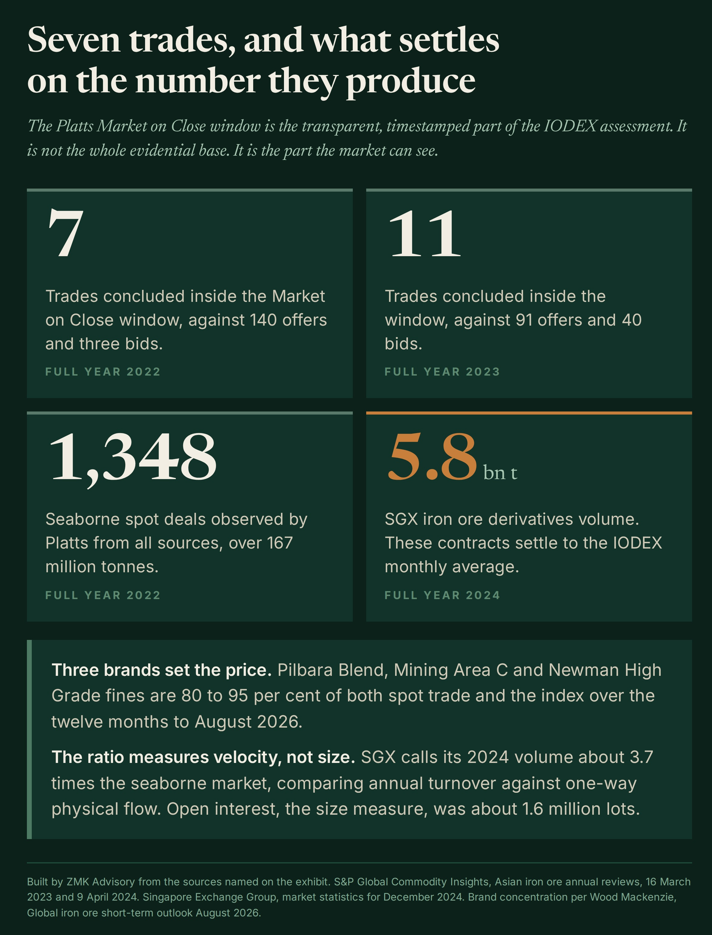
Read that structure honestly, and it does not say the assessment is unimportant. It says the opposite. A very large financial market takes its final cash flow from a number whose transparent input is measured in tens of trades a year. That is leverage on a thin input, and it is the same structural objection that produced the post-LIBOR benchmark regimes. It is a real fragility, and it is the best argument available to Beijing.
It is also not the argument Beijing has been making, and it is not what four years of pressure have actually delivered.
Four years of embargo bought a 1.8 per cent rebate. The market cut China’s import bill by $9.4 billion.
China Mineral Resources Group was registered on 19 July 2022 in Xiong’an New Area with 20 billion yuan of capital, about $3 billion. Yao Lin moved directly from the chairmanship of Chinalco to chair it. Guo Bin, a vice-president of Baowu, became general manager. Ten days later, the China Iron and Steel Association established an Iron Ore Working Committee, said CMRG would “play the leading role”, and made CMRG’s new chairman a vice chairman of CISA itself.4 Beijing published no mission statement for the entity. The mandate is legible in the appointments.
The instrument has been embargo. From September 2025, CMRG told mills and traders to stop buying BHP’s Jimblebar fines, then widened the instruction to dollar-denominated BHP cargoes generally (Reuters, 30 September 2025). Fortescue’s Super Special Fines and Fortune Fines were restricted from 15 July 2026, Super Special Fines being 43 per cent of Fortescue’s second-quarter shipments; its weekly shipments to China fell 70 per cent week on week to 1.17 million tonnes in late July, the lowest since February 2020, with cargoes diverted to India and Vietnam (Reuters, 31 July 2026). On 8 September 2026, with contract talks at what was described as a critical point, CMRG told mills to hold off buying Rio Tinto’s Pilbara Blend (Bloomberg).
The campaign has in fact run on two tracks, and the distinction matters. With the majors, CMRG has pressed for better contractual terms and a different index. With smaller and non-Australian suppliers, it has gone further and taken the sales function itself: exclusive China sales agency over Hancock Prospecting’s Roy Hill, a 10 million tonne supply agreement with Anglo American’s Kumba signed in August 2026, and discussions with Brazil’s CSN Mineração over an agency mandate on the same model (Wood Mackenzie; the Kumba agreement separately reported by Reuters, 14 August 2026). The index fight is the visible track. The agency track is the one spreading faster, and it does not require anybody to agree about methodology at all.
Seven months of embargo produced the BHP settlement in April 2026. Jimblebar fines now price off a weighted basket of four indices, of which the yuan-denominated COREX 61 per cent portside index carries 26 per cent, with Argus seaborne, Mysteel seaborne and Mysteel portside making up the balance. No Platts assessment appears in it. Two commercial terms were disclosed alongside it: a 1.8 per cent rebate per vessel on term contracts, and a freight-linked discount on certain large vessels whose value has not been published.5
There is now a better measure than the rebate, because the formula has run long enough to be observed. Wood Mackenzie’s reading of BHP’s first full quarter under the four-index Jimblebar formula and the yuan settlement mechanism is that realised prices fell 2 per cent quarter on quarter to $83.58 a wet tonne while benchmark prices rose 1.7 per cent, which it calls “a plausible early sign of the new pricing mechanism smoothing (and slightly discounting) BHP’s China-linked revenue relative to pure seaborne indices” (Wood Mackenzie). That is a wedge of roughly 3.7 percentage points opening between what the benchmark did and what BHP received. It is also, in the same assessment, a drag that is “visible but modest”: across the full year BHP’s realised price still rose 3 per cent, to $84.56 a wet tonne, with the negotiations “mainly limiting upside relative to spot benchmarks”.
Size the disclosed rebate against that. A 1.8 per cent rebate on $84.56 is $1.52 a tonne. Extended across the 815.6 million tonnes BHP, Rio Tinto and Fortescue shipped in their most recent reported periods on a 100 per cent joint venture basis, it is roughly $1.2 billion a year. That is ZMK Advisory’s own arithmetic and a scale indication only: the three reporting periods are not coterminous, the rebate is a term on one BHP product line with no equivalent disclosed for Rio Tinto or Fortescue, the three miners realise on differing bases and at materially different prices, and the freight-linked limb of the concession is unquantified, so the figure is not a ceiling. Shipment volumes are BHP Western Australia Iron Ore FY2026 sales of 288.1Mt, Rio Tinto Pilbara calendar 2025 shipments of 326.2Mt and Fortescue FY2026 shipments of 201.3Mt.
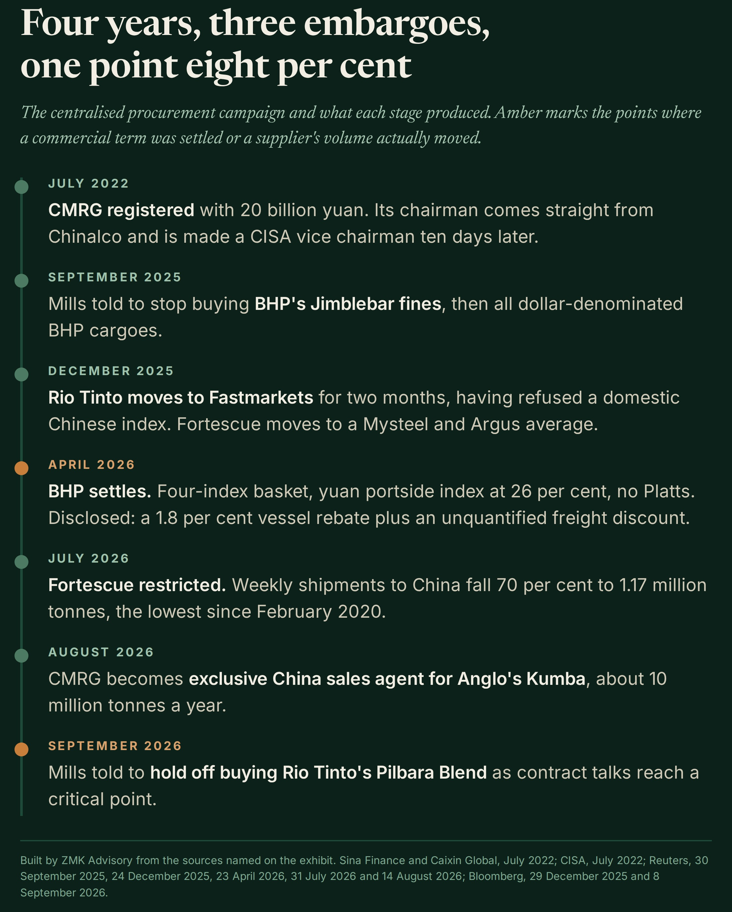
$1.2 billion is real money, and it is an incomplete measure of a concession whose second limb is undisclosed. Set against it: China’s iron ore import bill fell $9.4 billion in 2025, to $123.05 billion from $132.43 billion, on volume that rose 1.8 per cent to a record 1.26 billion tonnes (General Administration of Customs, major imports by quantity and value, December 2025). That saving is seven times the rebate arithmetic above, and none of it came from the index. It came from the market.
Beijing’s objection to the benchmark is its currency, not its method.
On 14 September 2026 the International Consortium of Investigative Journalists published “China Capital”, 4.8 million records from the Industrial and Commercial Bank of China covering 2005 to 2024, worked by journalists across 24 countries. Reporting from that cache by the Australian Financial Review, ICIJ’s Australian partner, describes a 2020 People’s Bank of China study on the internationalisation of the renminbi which criticises the iron ore benchmark in these terms: “Platts is an inquiry index denominated in US dollars... Due to its own mechanism defects, the Platts tends to rise [rather] than to fall, which squeezes the profit of domestic steel mills and is unfavourable to the development of the domestic steel industry.”6
There are two claims in that sentence and they are not equally serious.
The first is a claim of estimator bias: that the method produces a number systematically above the market it measures. It is worth being precise about what would and would not test it. The price path does not. IODEX 62 per cent Fe set its record at $233.10 a dry tonne on 12 May 2021 and averaged $109.44 in 2024 and $102.37 in 2025 (S&P Global annual reviews); on the 61 per cent basis adopted in January, the CFR China benchmark averaged $95.6 a tonne in August 2026, down 2 per cent on July (Wood Mackenzie). A benchmark can carry an upward bias against the true clearing price and still fall by half when the underlying market falls by half. Testing the claim requires comparing the IODEX against an independent assessment of the same cargoes over the same period, and ZMK has not run that test. What can be said is that six years after the document was written, no such comparison has been published by the PBOC, by CISA, or by anyone else. The most consequential technical allegation in the dispute remains an assertion.
The second claim is the one that has driven everything since, and it is not technical. “Denominated in US dollars.” The document it sits inside is a study of renminbi internationalisation, not a methodology review.
The subsequent record is consistent with that emphasis. CMRG’s September 2025 instruction to mills named dollar-denominated cargoes specifically. CISA’s public position in August 2026, as reported by the Global Times on 5 August, was that “dollar-denominated benchmarks have largely reflected transactions involving a limited number of international miners”, and that wider use of yuan-based indices “could also curb speculation, allow prices to better reflect supply and demand”. Caixin described the BHP settlement as the first of the four major miners to accept yuan-based pricing in a long-term contract with CMRG, with 51 per cent of Jimblebar sales referencing the yuan-denominated Beijing portside index.
ZMK has seen no evidence that the 2020 study directed what followed, and the sequence is equally consistent with separate institutions reaching the same conclusion independently. But the emphasis is unmistakable, and it has been reported almost everywhere as a fight about methodology. On the available record it is a fight about denomination, and denomination is a perfectly rational thing for the buyer of 1.26 billion tonnes a year to want.
China has won control of the reference, not of the price.
The obvious objection to everything above is that if the index were unimportant, BHP would not have absorbed seven months of suspended purchases before conceding it, and the market would not have moved 70 per cent of seaborne fines spot trade onto floating-price terms, up from 56 per cent, in a single year (S&P Global, Asian iron ore 2025 review, 26 February 2026). Sophisticated parties behave as though the reference matters. They are right, and the evidence that they are right is sharper than critics of the index might expect.
Consider the specification change. Platts opened consultation on the IODEX quality basis in April 2025, proposed a move from 62 to 61 per cent Fe on 10 June and launched a 62/61 basis spread the same day, and confirmed the change on 1 July for effect from 2 January 2026, citing degradation in the quality of the Australian fines informing the assessment.7 SGX then adjusted its contracts from 1 September 2025, and calculated the adjustment from the average of Platts’ own daily 62/61 basis spread over 1 July to 29 August. The derivatives complex could not reprice until the assessment told it what the repricing was worth, and then used the assessment’s own arithmetic to do it.
Nor was this one administrator’s quirk. Fastmarkets and Argus launched 61 per cent references for the same reason, and Wood Mackenzie rebuilt its own value-in-use cost curves onto both a 61 and a 62 per cent basis to match, noting that “for many years, global iron ore pricing revolved around a 62% Fe benchmark” and that the change followed declining mined grades. Three price reporting agencies and an independent research house moved the same way, because the ore moved.
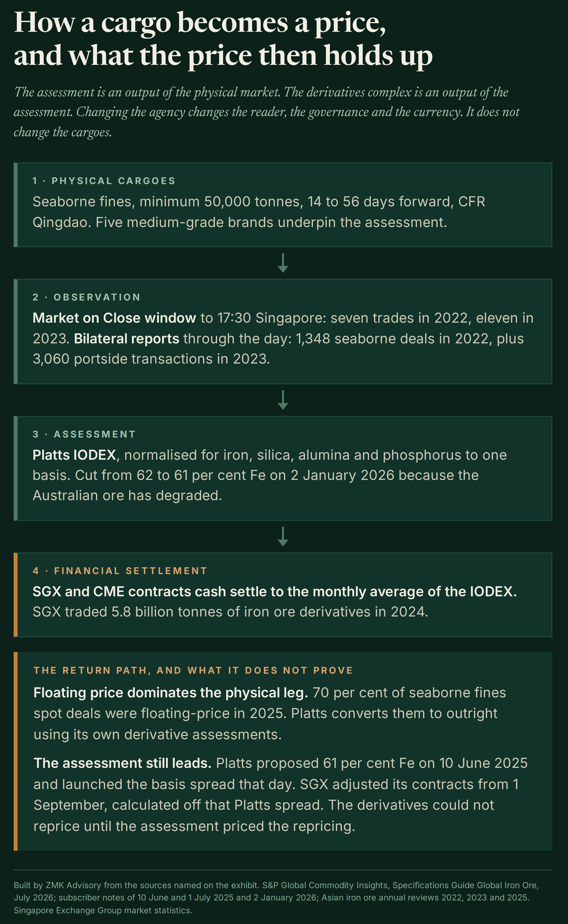
That is the case for the index mattering, made properly. It is also the case for what China has actually won, which is not a price.
An assessment is an output of the physical market, not an input to it. It reads cargoes, normalises them, and prints a number. Change the agency, and you change who reads the cargoes, under whose governance, on whose audit trail, with whose complaints process, in whose currency and in whose jurisdiction. Those are substantial things to acquire, and acquiring them from a US-listed administrator operating under externally assured IOSCO principles is a deliberate act with consequences that will take years to show up. What changing the agency does not do is change the cargoes. The ore, the freight, the grade and the mill margin are unchanged by the identity of the assessor, which is why the import bill moved $9.4 billion on supply and demand while the index fight moved $1.52 a tonne.
The degradation behind the specification change makes the point on its own. Rio Tinto’s Pilbara Blend Fines was specified at 60.8 per cent Fe for the third quarter of 2025, with first cargoes discharging in a 60.6 to 61.6 per cent range, and its premium over Mining Area C Fines collapsed from $2.15 a tonne to zero by mid-August (S&P Global, Q3 2025 iron ore trade review). No index published that. The orebody did.
And the orebody is being drawn down. Wood Mackenzie’s depletion analysis finds that only three of six major producers replaced what they mined between 2016 and 2025, with cumulative reserve replacement of 73 per cent at Rio Tinto, 66 per cent at Fortescue and 28 per cent at Vale. That puts Rio Tinto’s Pilbara reserve life at 8.5 years, the tightest among the majors, and is the mechanism nobody in the index argument is discussing. Australian ore is getting worse because the Pilbara has been mined faster than it has been replaced for a decade, and the benchmark specification followed.
Simandou, not the index, is the lever that will move the price.
While the index fight ran, the thing that actually moves an iron ore price arrived.
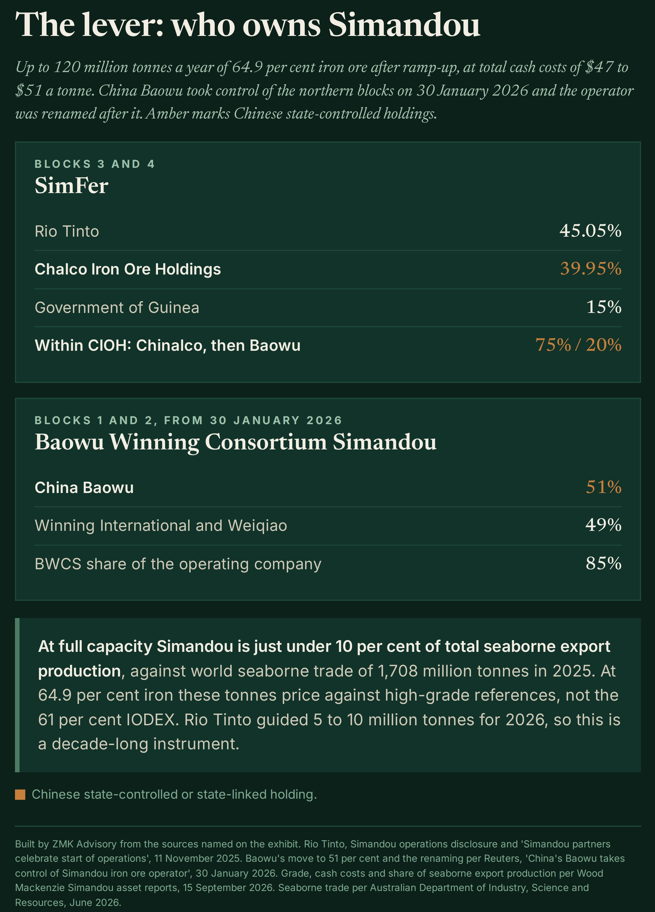
Simandou began operations on 11 November 2025 and shipped its first cargo in December. Rio Tinto describes combined capacity across the four blocks of up to 120 million tonnes a year following commissioning and ramp-up, at grades of 65 to 66 per cent Fe, with the SimFer mine ramping to about 60 million tonnes over 30 months. The ownership is the point, and it changed this year. On the southern blocks, Chalco Iron Ore Holdings, 75 per cent held by Chinalco with Baowu holding a further 20 per cent, owns 47 per cent of Simfer Jersey alongside Rio Tinto’s 53 per cent, and Simfer Jersey holds 85 per cent of the operating entity with the Guinean state holding the balance. On the northern blocks, China Baowu completed the purchase of a further 2 per cent on 30 January 2026, taking it from 49 to 51 per cent and giving it control of the operator, which was renamed Baowu Winning Consortium Simandou.8 The world’s largest steelmaker does not hold a minority position in half of Simandou. It controls it, and the vehicle carries its name.
Rio guided 5 to 10 million tonnes for 2026, so this is a decade-long instrument rather than a 2026 one, and Wood Mackenzie’s asset analysis puts the deposit at just under 10 per cent of total seaborne export production at full capacity, delivered at 64.9 per cent iron and total cash costs of $47 to $51 a tonne. High-grade tonnes at that scale, at that position on the cost curve, controlled by the mills that will consume them, are a different order of thing from a 1.8 per cent rebate.
Concede what cuts the other way, because it is substantial. China’s crude steel output fell 4.4 per cent in 2025 to 960.8 million tonnes and was down a further 3.1 per cent in the first seven months of 2026 (World Steel Association). The domestic leg of Beijing’s own supply strategy has gone backwards: CISA’s 2022 Cornerstone Plan set a target of 370 million tonnes of domestic iron ore output by 2025, a hundred million tonnes above the 2020 base, and output instead declined, with concentrate reaching roughly 294 million tonnes in 2025 on a Mysteel survey covering 94 per cent of producers. The direction is the finding. The plan required a third more domestic ore, and the country produced less. Meanwhile, ore imports rose 5.5 per cent in the first eight months of 2026. Falling steel production alongside rising ore imports is not a picture of a buyer in command of its own consumption.
Which is the argument. A buyer’s pricing power is the power to walk away, and that is made of alternative supply, of inventory and of demand elasticity. China now has the first of those under construction in Guinea and has been losing ground on the third for two years. What it has bought in the meantime is the reference: the governance, the audit trail, the settlement currency and the jurisdiction of the number, which is worth having and is not the same as the number itself.
For the miners, the risk worth modelling is not which agency prints the assessment. It is 120 million tonnes a year of high-grade ore whose owners also own the mills, a customer in its second consecutive year of falling steel output, and a benchmark specification already cut once because the ore behind it is deteriorating. Those three move realised prices by multiples of 1.8 per cent. The reference question is the part of this story that is easiest to report and the cheapest to lose.
For everyone else, the tell is what Beijing built next. Guangyan International Investment was established in December 2024 with registered capital of 60 billion yuan, three times CMRG’s, to coordinate China’s overseas mineral investments, and Wood Mackenzie records that it draws explicitly on CMRG’s experience in negotiating iron ore pricing. The target this time is base metals. Whatever was learned in the iron ore campaign, Beijing has capitalised it at three times the size and pointed it at copper.
The distinction between what is contractually visible and what is structurally decisive is the whole of the work.
- 1 The Platts Market on Close process collects bids, offers and confirmed trades in a structured window to a 17:30 Singapore timestamp. It is the transparent component of an assessment that also draws on activity reported bilaterally through the day, and the argument concerns the thinness of the timestamped window, not of the total observation base. The 2022 counts of 140 offers, three bids and seven trades, and the 956 lines of MOC commentary, are S&P Global’s own published figures. S&P Global Commodity Insights, “Iron ore prices take a hit on weak demand amid surge in Platts observed spot activity: 2022 review,” 16 March 2023. https://www.spglobal.com/commodityinsights/en/market-insights/latest-news/metals/031623-iron-ore-prices-take-a-hit-on-weak-demand-amid-surge-in-platts-observed-spot-activity-2022-review
- 2 Singapore Exchange Group, “SGX Group reports market statistics for December 2024,” 9 January 2025. The 3.7 times figure is SGX’s own characterisation and compares annual traded turnover against annual one-way physical flow. Turnover counts every change of hands, so the ratio measures velocity rather than outstanding exposure; the size measure is open interest, which SGX reported at about 1.6 million lots at end-2024. The comparison is reproduced as SGX states it, with that limitation. https://links.sgx.com/1.0.0/corporate-announcements/AA0XRZ0VCVGKKF1W/830049_20250109_SGX_Group_reports_market_statistics_for_December_2024.pdf
- 3 SGX Monthly Statistics Report, December 2025, calendar year to date: IODEX iron ore futures 57,789,977 lots. The conversion at the contract size of 100 metric tonnes per lot is ZMK Advisory’s arithmetic, not an SGX statement. It covers futures only. A further 7,558,307 options lots traded in the same period and are deliberately excluded, because option exposure is delta-weighted and converting option lots at full notional would overstate it. The exchange’s 65 per cent Fe, low-alumina and lump premium contracts are also excluded. https://links.sgx.com/1.0.0/corporate-announcements/H3L2VGGP9YCWRZI2/871660_SGX%20Monthly%20Statistics%20Report%20Update_Dec%202025.pdf
- 4 CMRG’s registration date, capital and founding appointments are from the corporate registry filing as reported by Sina Finance, 19 July 2022, and Caixin Global, “China debuts $3 billion state iron ore giant,” 20 July 2022. The CISA Iron Ore Working Committee, the “leading role” formulation and the appointment of CMRG’s chairman as a CISA vice chairman are from CISA’s own account of remarks by He Wenbo on 29 July 2022. https://www.caixinglobal.com/2022-07-20/china-debuts-3-billion-state-iron-ore-giant-101915236.html
- 5 Two accounts of the same settlement, consistent with each other on different measures. Reuters reports the four-index weighted basket with COREX 61 per cent portside at 26 per cent, a 1.8 per cent rebate per iron ore vessel on term contracts “on top of a freight-linked discount for certain large ships,” and a contract running to the end of BHP’s 2027 financial year. Caixin reports the same deal as 51 per cent referenced to the yuan-denominated Beijing Iron Ore Port Spot Price Index against 49 per cent to Mysteel and Argus. Reuters, “BHP adopts new Chinese iron ore price index in deal to end dispute,” 23 April 2026; Caixin Global, “BHP shifts to yuan-based pricing in deal with China state buyer,” 22 April 2026. https://www.mining.com/web/bhp-adopts-new-chinese-iron-ore-price-index-in-deal-to-end-dispute/ https://www.caixinglobal.com/2026-04-22/bhp-shifts-to-yuan-based-pricing-in-deal-with-china-state-buyer-102436831.html
- 6 ZMK Advisory has not had sight of the underlying document. The quotation and its attribution to a 2020 People’s Bank of China study on renminbi internationalisation contained in the ICBC cache are reproduced as published by the Australian Financial Review, ICIJ’s Australian partner on the “China Capital” investigation, September 2026. That report is behind subscription and is cited to the originating publication. The scale of the cache is per ICIJ, “About the China Capital investigation,” 14 September 2026: 4.8 million records covering 2005 to 2024, worked by journalists in 24 countries. https://www.icij.org/investigations/china-capital/about-china-capital-investigation-icbc/
- 7 S&P Global Commodity Insights subscriber notes: the proposal and launch of the 62/61 per cent Fe IODEX basis spread, 10 June 2025; the confirmation of the change, 1 July 2025; and the effective date note, 2 January 2026. The specification moved from 62% Fe / 4% silica / 2.25% alumina to 61% Fe / 4.5% silica / 2.5% alumina, and the assessment was renamed IODEX CFR China, with a transitional basis spread running to 31 December 2027. SGX’s own contract adjustment, effective for contracts expiring January 2026 onward, was calculated from the average of the Platts daily 62/61 basis spread from 1 July to 29 August 2025. https://www.spglobal.com/energy/en/pricing-benchmarks/our-methodology/subscriber-notes/070125-platts-to-update-iodex-quality-specifications-to-reflect-61-fe-effective-jan-2-2026
- 8 Southern blocks per Rio Tinto, Simandou operations disclosure and “Simandou partners celebrate start of operations,” 11 November 2025: Simfer Jersey is 53 per cent Rio Tinto and 47 per cent Chalco Iron Ore Holdings and holds 85 per cent of the operating entity, with the Government of Guinea holding 15 per cent; CIOH is 75 per cent Chinalco, 20 per cent Baowu, 2.5 per cent CRCC and 2.5 per cent CHEC. On a look-through basis this is Rio Tinto 45.05 per cent, CIOH 39.95 per cent and the Government of Guinea 15 per cent. Northern blocks per Reuters, “China’s Baowu takes control of Simandou iron ore operator,” 30 January 2026: Baowu lifted its holding from 49 to 51 per cent, the transaction having been approved by Guinea on 30 May 2024 and completed on 30 January 2026, and the Singapore-registered parent and its Guinean unit were renamed Baowu Winning Consortium Simandou, which holds 85 per cent of the Blocks 1 and 2 operating company. The 120 million tonne figure is combined nameplate following ramp-up and is not a current or dated production figure; Rio Tinto guided 5 to 10 million tonnes for 2026. https://www.riotinto.com/en/operations/africa/simandou https://www.mining.com/web/chinas-baowu-takes-control-of-simandou-iron-ore-operator/
Note on sources. Every numbered source carries a live link to the document it cites. Two Reuters reports, in notes 5 and 8, are linked through their syndicated copies on mining.com. Material that is subscription-gated or paywalled is attributed in the text by institution, document title and date instead, without a numbered note: this applies to the other Reuters reports, the Bloomberg report and the Wood Mackenzie research. ZMK Advisory’s own arithmetic is labelled where it appears and set out under Derived figures.
Derived figures. Two figures are ZMK Advisory’s own arithmetic rather than a reported or disclosed number, and both are labelled as such where they appear: the conversion of 2025 SGX lot volumes into tonnes (note 3), and the $1.52 a tonne and approximately $1.2 billion a year rebate calculation in Section II, whose working, basis and four limitations are set out in the text. Shipment volumes for that calculation are from BHP results for the year ended 30 June 2026 (18 August 2026), Rio Tinto fourth quarter 2025 production results (21 January 2026) and Fortescue FY26 full year results (20 August 2026).
Imagery. The image shown when this note is shared is a generated image, not a photograph of any named vessel, terminal or operator. The four exhibits are built by ZMK Advisory from the sources named on each exhibit.
Interests. ZMK Advisory holds no position, long or short, direct or derivative, in BHP, Rio Tinto, Fortescue, Anglo American, Vale, S&P Global, Fastmarkets, Argus Media or Singapore Exchange, and has no engagement by any company named in this note, its parent, any lender, or any party to a live transaction.
Not investment research. This is commentary and analysis. It is not a recommendation and not an inducement to buy, sell or hold any security or commodity.