Simandou: The Fiscal Return Behind Guinea’s $200 Billion Bet
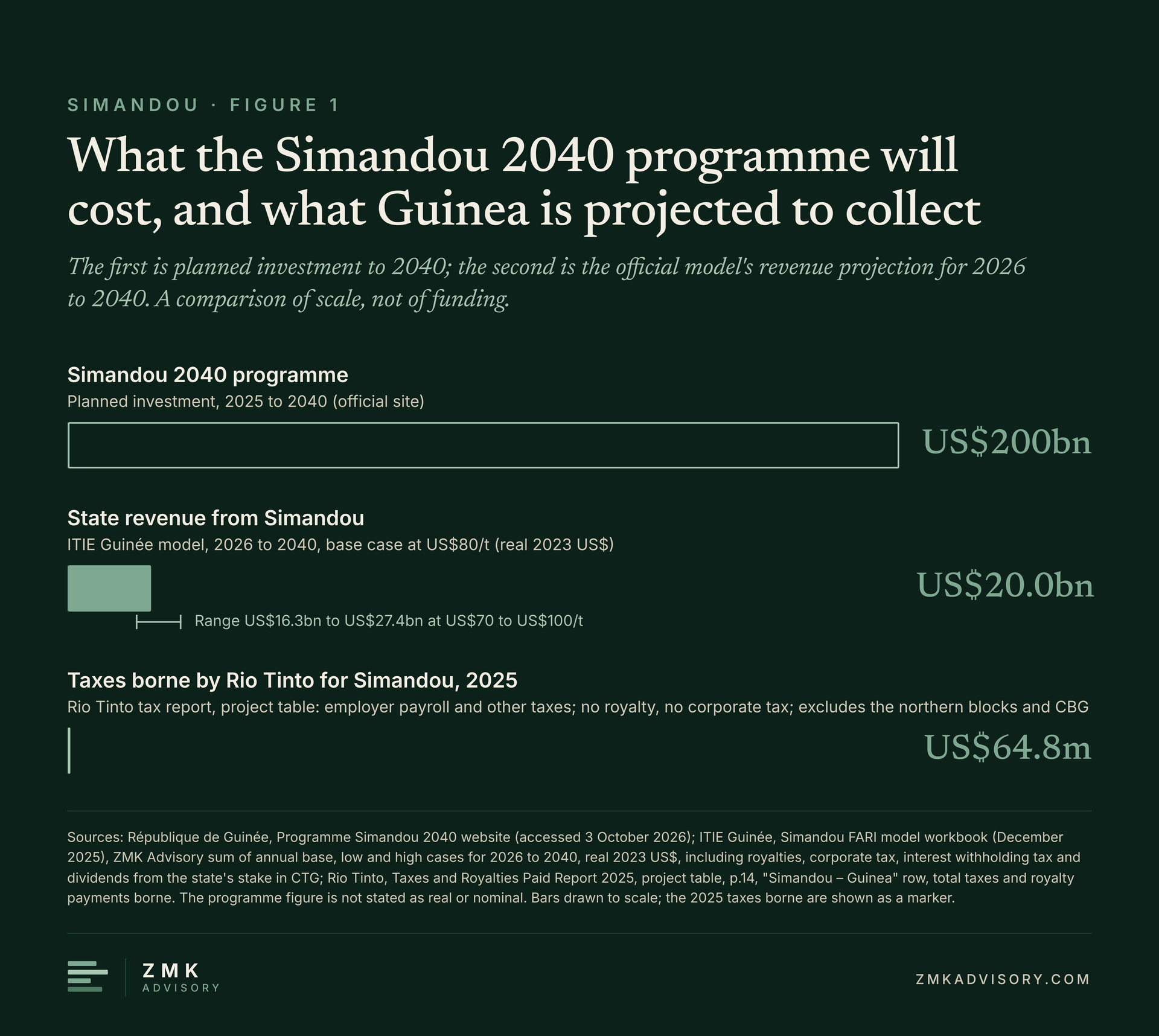
Guinea’s development programme is costed at US$200 billion over fifteen years. Guinea’s official EITI fiscal model puts the state’s modelled revenue from Simandou at about US$20 billion over a broadly overlapping period.
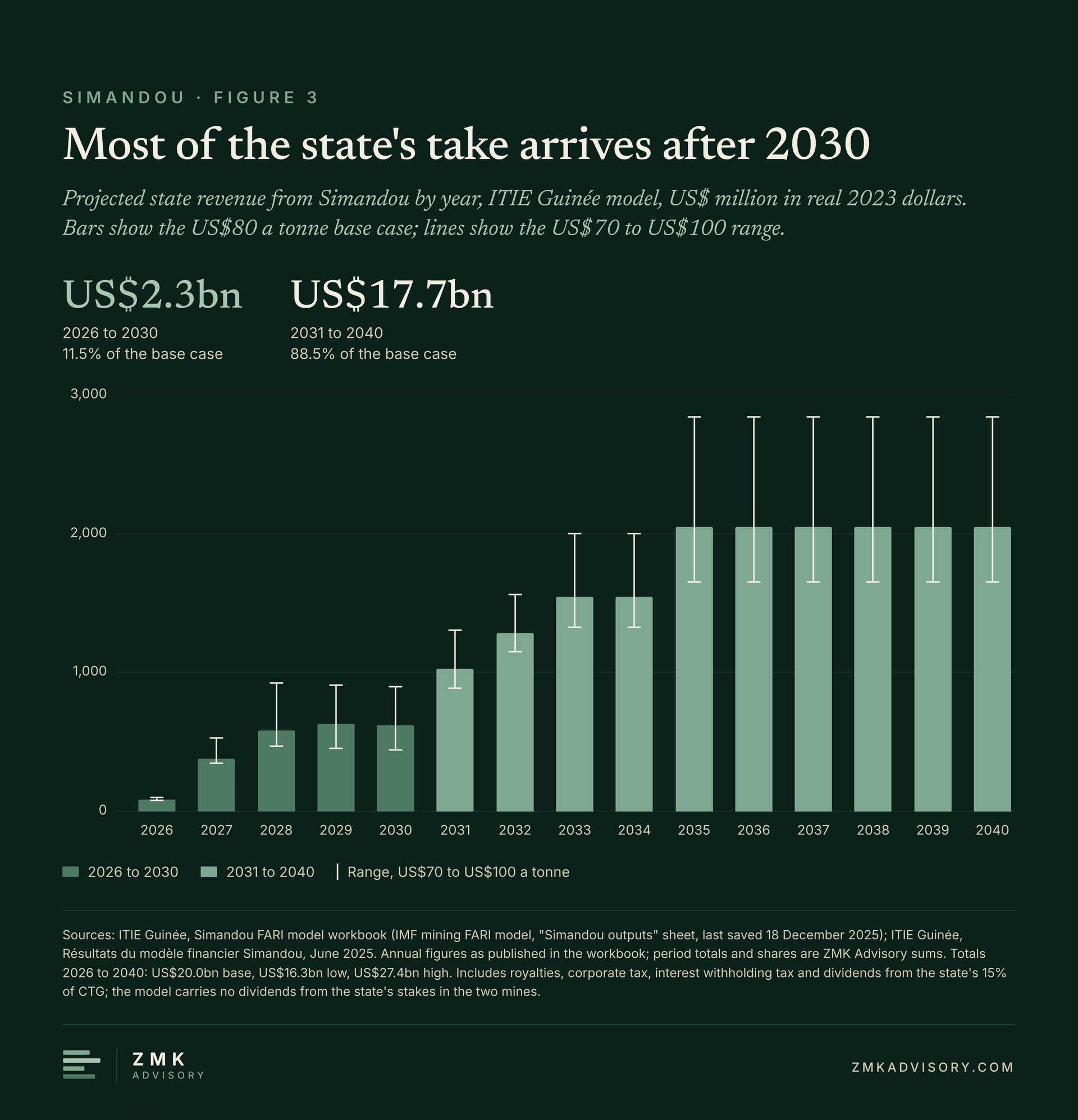
On the official model, Guinea’s receipts from Simandou are about one-tenth of the programme named after it, and most arrive after 2030.
- US$200 billionthe headline cost of the Simandou 2040 national development programme over fifteen years, 2025 to 2040
- US$20 billionstate revenue from Simandou over 2026 to 2040 in the official ITIE Guinée model, base case at US$80 a tonne, in real 2023 dollars, on our calculation
- 88.5 per centthe share of those base-case receipts that falls after 2030, on our calculation
- 18 per centthe fall in the fifteen-year total, to US$16.3 billion, if iron ore is US$70 a tonne rather than US$80, on our calculation
- US$64.8 milliontaxes borne in Guinea in respect of Simandou in 2025, Rio Tinto reports, with no royalties and no corporate income tax
- 4fiscal regimes apply to Simandou, and the conventions behind two of them, the northern blocks and the railway and port, are unpublished
The two numbers measure different things: the first is the investment envelope for the broader Simandou 2040 national development programme; the second is projected government revenue from the Simandou mining and infrastructure complex.
This article sets out where each number comes from and what sits between them.
Two numbers, one horizon
US$200 billion. That is the figure on the official website of Simandou 2040, Guinea’s national development programme: “$200 billion over 15 years to transform Guinea”, in three phases of US$65 billion, US$75 billion and US$60 billion running from 2025 to 2040, across 122 projects and 36 reforms. The same site states that the Simandou mine, railway and port account for “$20 billion” of the first phase.1 That distinction matters.
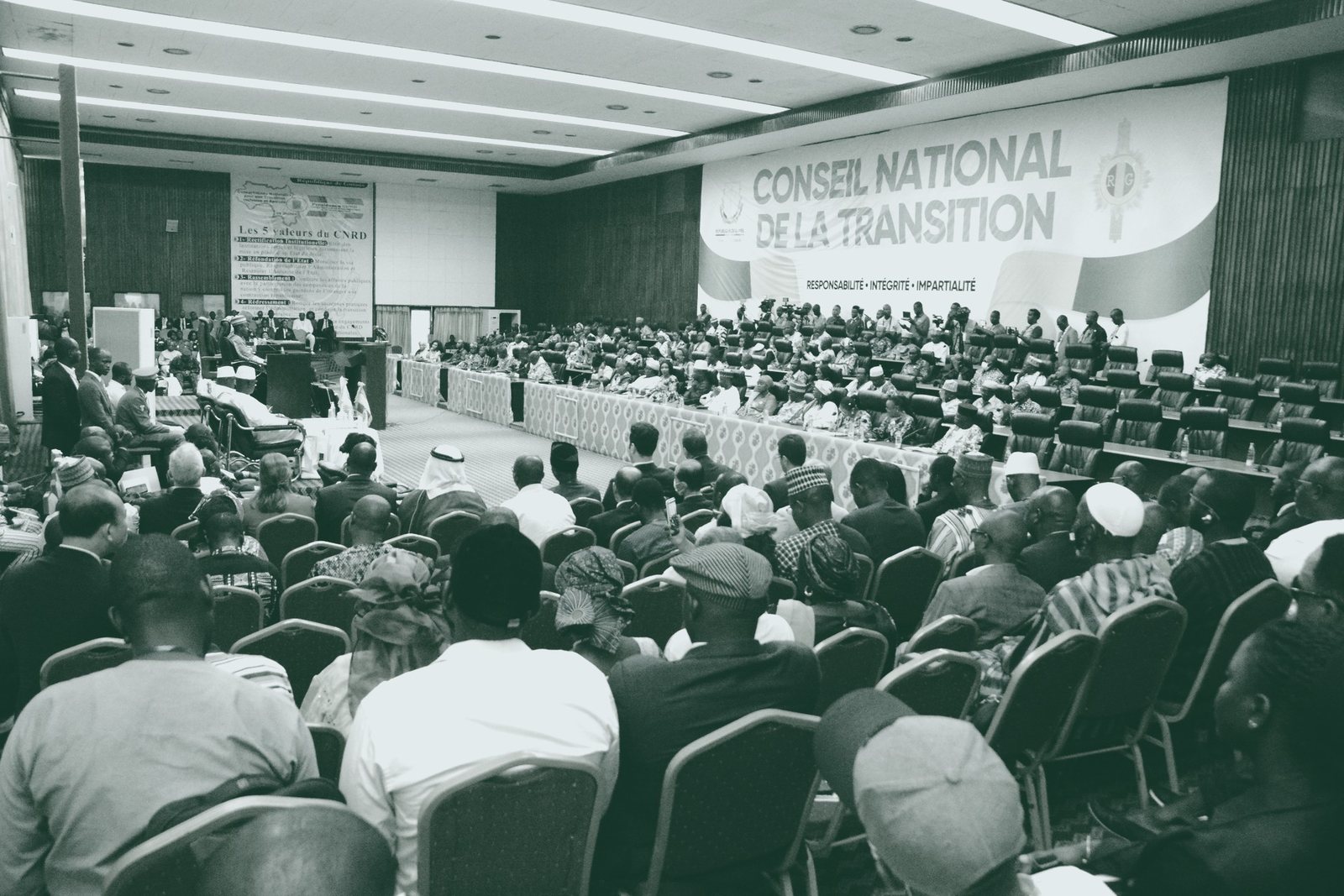
The number has a traceable history. Its earliest public appearance cited for this article is a speech by Djiba Diakité, Minister-Director of the Presidential Cabinet and chair of the Simandou Strategic Committee, in May 2025. He presented it as provisional, an estimate “à ce stade” (at this stage) of “aux alentours de 200 milliards de dollars US”, (around about $200B US) adding “nous allons affiner ces chiffres”. (We are going to fine-tune those numbers) He also said that “à peine 30%” (barely 30%) was to be financed by the state.2 On 5 March 2026, the National Transitional Council adopted a 2026-2040 planning law and a 2026-2030 programming law for the programme, with total investment estimated, in Ecofin’s report of the adoption, at “more than $200 billion”.3 In the same chamber that day, the Minister of Economy, Finance and Budget, Mariama Ciré Sylla, was reported as putting the programme’s cost at more than US$330 billion.4 The public record therefore contains two different investment envelopes: US$200 billion remains the headline figure on the Simandou 2040 programme site, while senior government officials have subsequently used a figure of about US$330 billion for the fifteen-year investment requirement. The article uses US$200 billion as the programme’s formal headline figure, while treating US$330 billion as a separate government estimate rather than silently substituting one for the other.
Three weeks later, the Prime Minister, Amadou Oury Bah, used the higher figure in his general policy statement: “un volume d’investissement estimé à 330 milliards de dollars sur quinze ans”. (an investment totaling $330B over 15 years)5
The second number comes from Guinea’s official extractive-transparency process. In 2025, ITIE Guinée, the national multi-stakeholder body of the Extractive Industries Transparency Initiative, published a fiscal model of Simandou built with the IMF’s FARI modelling tool, together with its workbook.6 Summing the base case for 2026 to 2040, the programme’s own fifteen years, gives state revenue from Simandou of US$20 billion in real 2023 dollars, at US$80 a tonne. The model’s low case of US$70 gives US$16.3 billion; its high case of US$100 gives US$27.4 billion.7 The total comprises modelled royalties, corporate tax, interest withholding, and dividends from the state’s 15 per cent interest in the rail and port company. It does not include dividends from the state’s interest in the two mines. It is an official modelled projection; not a forecast of realised receipts. Its outcome depends on assumptions about iron ore prices, production, tax treatment, financing, and infrastructure economics; Section II and the Technical notes set out assumptions that could move it in either direction.
The timing matters as much as the total: 88.5 per cent of the ITIE model’s US$20 billion base-case receipts fall after 2030. The headline figure is therefore predominantly a post-2030 fiscal proposition rather than an immediate windfall.
For fiscal planning, that distinction is material: the government cannot treat the full US$20 billion as near-term cash flow, and any borrowing or expenditure undertaken against expected Simandou receipts must be assessed against the timing of the underlying revenue.
On the official model, government receipts from Simandou are equivalent to roughly one-tenth of the investment envelope of the broader Simandou 2040 programme over broadly overlapping horizons. This is a comparison of scale, not a project return, investment multiple or measure of the state’s return on capital: officials have put the privately financed share at 70 per cent (May 2025) and at about 40 per cent (March 2026),4 and the two figures are not on the same price basis (see Technical notes).
A third number is the cash received so far. Rio Tinto’s tax report records US$64.8 million of taxes borne in Guinea in respect of Simandou in 2025, US$4.4 million of payroll taxes and US$60.4 million of other taxes, with no royalties and no corporate income tax (2024: US$38.7 million).8 That fits the timetable: operations were inaugurated on 11 November 2025, the first SimFer ore was shipped through the WCS port in December, and Rio Tinto reported first Simandou sales in April 2026.9
None of this makes Simandou small. Wood Mackenzie expects it to become “the single biggest driver of seaborne supply growth over the coming decade”, displacing higher-cost supply,10 and the World Bank describes the West African additions as “new low-cost capacity”.11 The focus of this article is more tightly defined: how much of that value is designed to reach the Guinean state, when, and on what terms? It is therefore a fiscal-revenue analysis, not a valuation of Simandou, an estimate of total national economic value, or a calculation of project-level return on invested capital.
Four regimes and a 2002 baseline
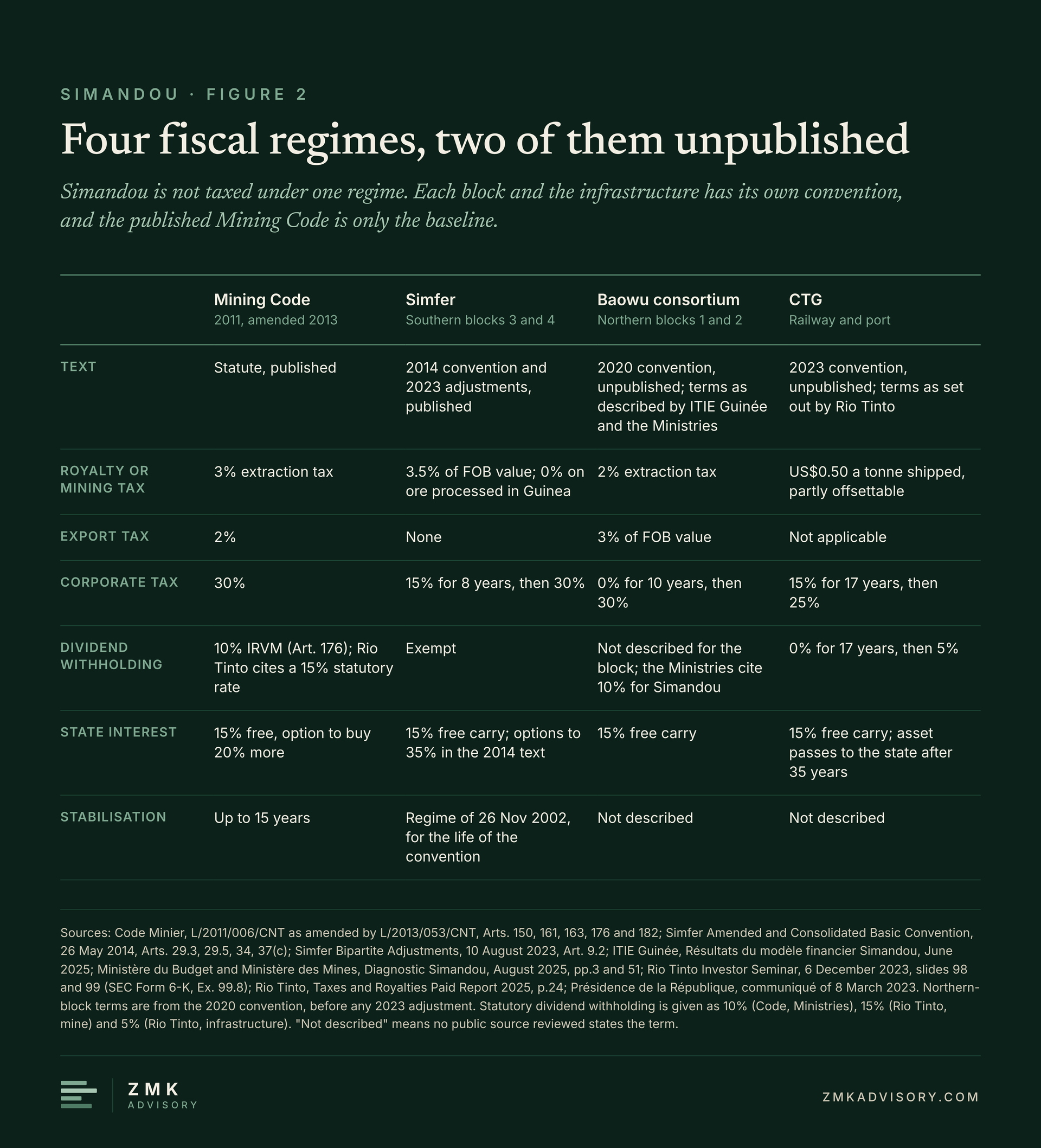
Commentary on Simandou usually refers to a single fiscal regime. For purposes of the fiscal analysis, there are four principal regimes.
The first is the statutory baseline, the Mining Code of 2011 as amended in 2013: for iron ore, an extraction tax of 3 per cent and an export tax of 2 per cent, corporate income tax at 30 per cent, a 15 per cent free state interest with an option to buy 20 per cent more, and fiscal stabilisation capped at fifteen years.12
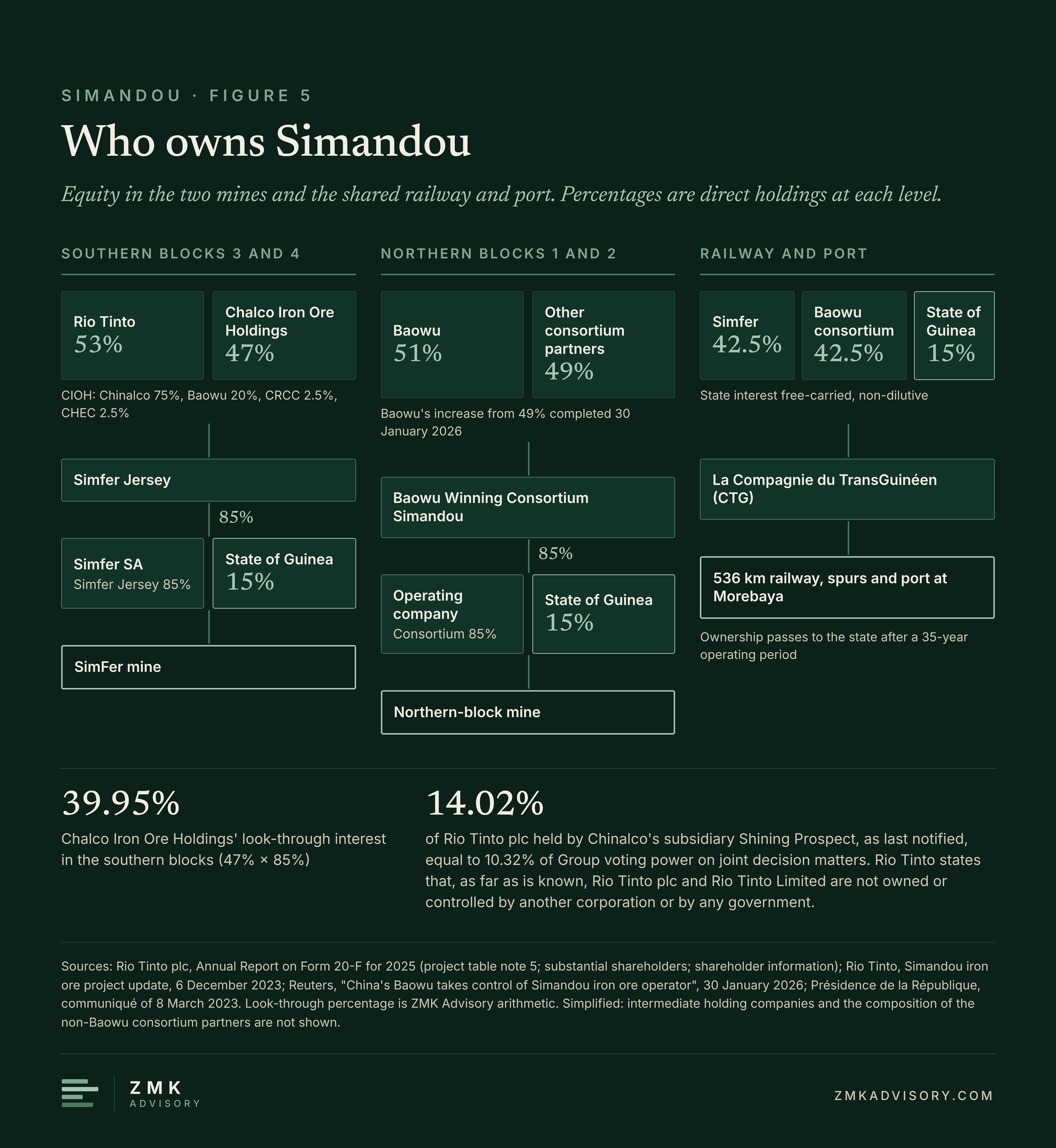
The second governs the southern blocks, 3 and 4, held by Simfer, whose parent is 53 per cent Rio Tinto and 47 per cent Chalco Iron Ore Holdings. Its Amended and Consolidated Basic Convention, executed on 26 May 2014, sets the mining tax at “3.5% of its FOB value” on exported ore and at zero on ore transformed into iron or steel in Guinea (Article 29.5). It exempts dividends from tax and withholding and excludes export duties (Articles 29.3 and 34(a)). It stabilises the tax and customs regime “in force on the day of the signing of the Original Convention”, which was 26 November 2002, for the life of the convention, and provides that its fiscal terms are unaffected by amendments to or replacement of the Mining Code (Articles 34(b) and 37(c)).13 The 2023 bipartite adjustments, citing the OECD’s global minimum tax, replaced the 2014 text’s eight-year corporate tax holiday with a 15 per cent rate for those eight years, reverting to 30 per cent.14
The third governs the northern blocks, 1 and 2, held by the consortium now named Baowu Winning Consortium Simandou. Its 2020 mining convention and the 2023 adjustments to it have not been published. ITIE Guinée and the government’s own fiscal diagnostic, both citing the 2020 text, describe an extraction tax of 2 per cent and an export tax of 3 per cent of FOB value, and a corporate tax exemption for the first ten years of operation, followed by 30 per cent.15
The fourth governs the 536 kilometre railway, its spurs and the port at Morebaya, owned by La Compagnie du TransGuinéen (CTG): Simfer and the Baowu consortium 42.5 per cent each, the state 15 per cent, with the infrastructure ultimately transferring to full state ownership following a 35-year operating period.16 Its Co-Development Convention of 10 August 2023 is also unpublished, but Rio Tinto has set out the main terms. Its December 2023 investor seminar listed corporate tax for the infrastructure at 15 per cent for years one to seventeen and 25 per cent thereafter, a zero dividend withholding tax for the same seventeen years, and a “$0.50/t royalty on tonnes shipped” that can be partly offset against other taxes.17 Rio Tinto’s 2025 tax report confirms the corporate tax and dividend withholding settings and states: “we expect the tax settings for the infrastructure to be published by the Government of Guinea in 2026.”8
The state’s equity has its own history. The 2014 Simfer convention set a path to 35 per cent of Simfer SA in five tranches, the last two of 5 per cent each at market value, available “not before 22 April 2026” and “not before 22 April 2031” (Article 22).13 Under the 2011 settlement, Simfer agreed to pay US$700 million (Article 40), and Rio Tinto’s announcement of it stated that the rail and port would be “jointly owned by the Government of Guinea and the other Simfer partners, with the Government able to hold a maximum stake of 51 per cent”, with each participant required to “fully fund their proportion of the infrastructure capital cost”.18 The March 2023 shareholders’ pact settled on a “participation non contributive et non dilutive de 15%” in the infrastructure and 15 per cent in each mine.19 The public record therefore contains two distinct elements: the 2014 Simfer convention established a pathway to higher state participation, while the 2023 shareholders’ pact established a 15 per cent non-contributory, non-dilutive interest in the mines and infrastructure. I have not located a public document that resolves whether, or on what terms, the earlier Simfer options remain exercisable. No public statement on the 2026 option has been located.
A free carry costs nothing to hold and pays nothing until a dividend is declared. The fiscal diagnostic prepared for the Ministries of Budget and of Mines with World Bank support models the state’s dividends only after partner shareholder loans are repaid: from 2030 for both mines and from 2032 for CTG. On its base case of about US$81 a tonne, the diagnostic projects average state revenue of about US$1.5 billion a year and about US$52 billion in total over its projection period (25 years for the mines, 35 for the infrastructure), with a net present value at 6 per cent of US$18.2 billion. It finds that taxes on profits make up “près de 60%” (nearly 60%) of that revenue and that, for those revenues, “le principal enjeu résidera dans le contrôle des prix de transfert” (the main challenge will lie in the control of transfer prices). Its authors note that “les conventions renégociées en 2023 n’ont pu être consultées” (the agreements renegotiated in 2023 could not be consulted).15
Two features of the official models bear on how their totals are read. First, the infrastructure company is the largest single contributor in the Ministry’s tables: US$29.2 billion over its 35-year operating period, against US$13.1 billion and US$10.1 billion from the two mines over 25 years.15 Its revenue is the tariff paid by the mines of its own shareholders under an agreement that has not been published, so the largest line in the model rests on assumptions the public cannot yet check, in either direction. Second, the ITIE workbook levies royalty on gross revenue at its US$80 price, before freight and crushing costs are deducted, rather than on FOB value, which tends to raise the modelled royalty (see Technical notes).7 Both are reasonable choices for models built without the 2023 texts.
Concentration
One common view is that Simandou transforms Guinea; another, that it hands a strategic asset to China. The documents support a third reading: it concentrates Guinea’s exposure on one commodity, a heavily China-centred demand base and one price.
The concentration is both commercial and geopolitical: Chinese entities occupy significant positions in the northern and southern project structures, while China remains by far the dominant market for seaborne iron ore.
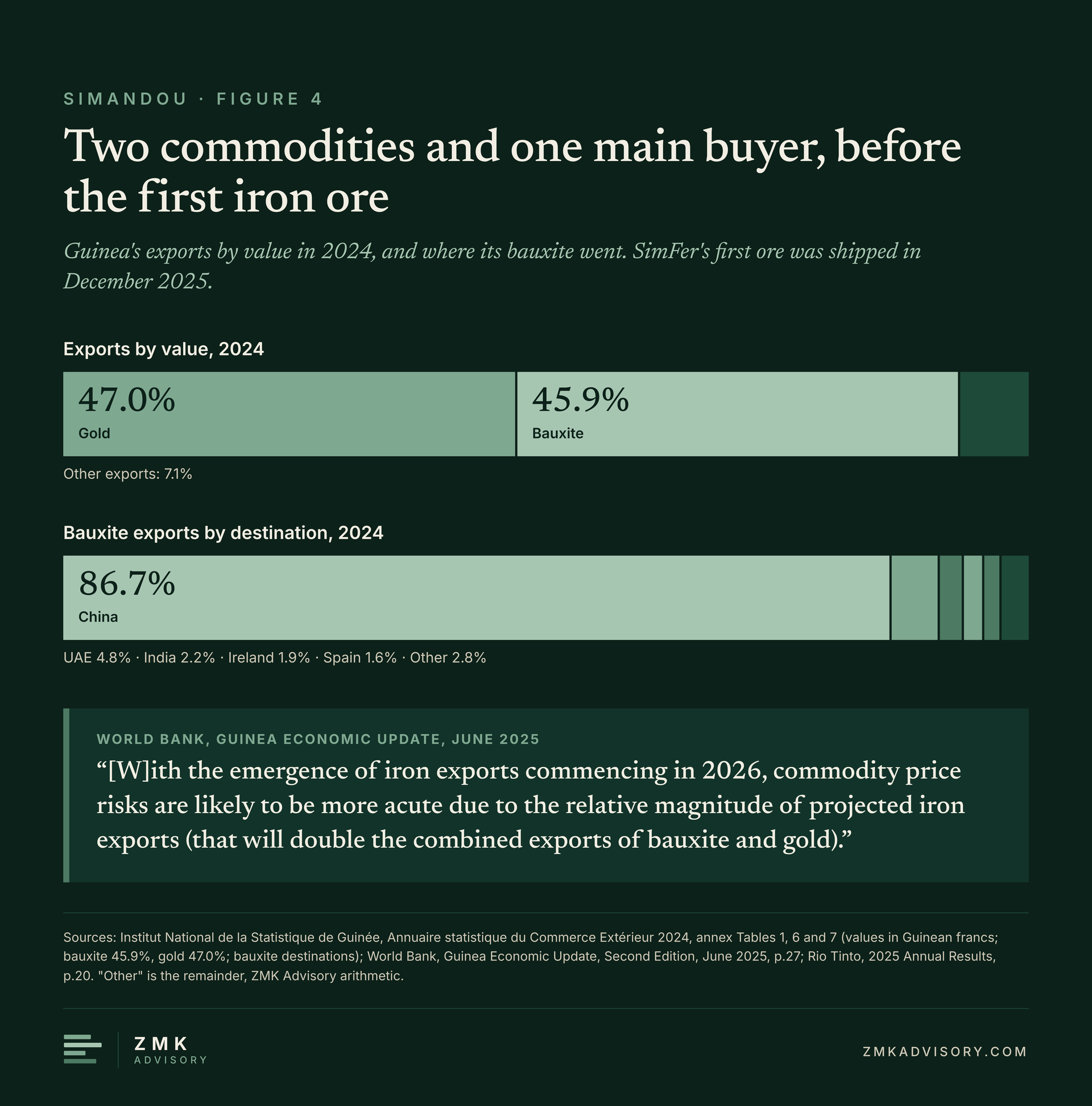
Bauxite and gold made up about 93 per cent of Guinea’s exports by value in 2024, and China took 86.7 per cent of its bauxite.20 The World Bank’s 2025 economic update warns that projected iron ore exports “will double the combined exports of bauxite and gold”, and that commodity price risks are likely to become more acute as a result.21
Each partner’s interest can be traced in the public record. In December 2020, China’s industry ministry set an aim, Reuters reported, of one or two globally significant overseas iron ore mines by 2025, and said that “China will accelerate construction of large iron ore projects in West Africa and Western Australia”.22 Rio Tinto’s Pilbara ore reserves stood at 2,202 million tonnes grading 60.8 per cent Fe at the end of 2025, and its annual report states that “there is currently no economic low-carbon iron and steelmaking technology for low- and medium-grade ores, such as those from the Pilbara”;23 the SimFer mine’s declared ore reserves average 65.3 per cent.16 The Simfer convention sets a zero royalty on ore processed in Guinea (Article 29.5), and in June 2026 Simfer and Baowu submitted a feasibility study for a 2 million tonne pellet plant, without a disclosed cost, schedule or power source.24
Baowu completed its increase from 49 to 51 per cent of the northern-block consortium, which holds 85 per cent of the operating company, on 30 January 2026.25 Baowu also holds 20 per cent of Chalco Iron Ore Holdings, which on a look-through basis holds 39.95 per cent of the southern blocks. Chinalco’s subsidiary Shining Prospect holds 14.02 per cent of Rio Tinto plc, equal to 10.32 per cent of the Rio Tinto Group’s voting power on joint decision matters, and Rio Tinto states that, as far as is known, Rio Tinto plc and Rio Tinto Limited are not directly or indirectly owned or controlled by another corporation or by any government.23 The buyer is organised too: China Mineral Resources Group, the state-run buyer that negotiates for Chinese mills, instructed steelmakers and traders in September 2025 to suspend purchases of dollar-denominated BHP cargoes during contract talks, Bloomberg reported.26
On price, the World Bank’s April 2026 outlook forecasts iron ore at US$97 a tonne in 2026 and US$95 in 2027, against an average of US$100.2 in 2025, and projects the price “to decline to below its 2020 level over the forecast horizon due to ample supply”, citing weak demand growth and “the gradual addition of new low-cost capacity in West Africa”.11 In the ITIE model, a US$10 fall in the iron ore price, from US$80 to US$70, reduces the state’s fifteen-year total from US$20 billion to US$16.3 billion, a decline of 18 per cent.7
Guinea’s recent history is the closest comparator. Bauxite exports rose from 82 million tonnes in 2020 to 127 million in 2023.27 From 2019 to 2024, mining sector taxes stayed between 1.7 and 2.3 per cent of GDP every year, and the international poverty rate rose 7 percentage points, adding 1.8 million people.21 The IMF’s 2024 analysis, drawing on Rio Tinto’s estimates, puts expected government revenue from Simandou at 3.4 per cent of GDP from 2030 to 2039, more than the 2.2 per cent of GDP the state collected from all mining in 2022, and finds real GDP 26 per cent higher by 2030 than without the project.28 That is a substantial gain for a state whose total public revenue was about US$3.6 billion in 2024,6 and most of it arrives from 2030.
In our view, country risk bears less on Simandou than on what Guinea wants to build beside it. In May 2025, the government revoked 129 exploration permits, its fourth such decision in a matter of weeks; Ecofin reported that all had already expired and that the order relied on the Mining Code’s limits on renewal.29 In August 2025, it revoked the Sangarédi bauxite concession of Guinea Alumina Corporation, citing violations of the mining code, and transferred the concession to the state-owned Nimba Mining Company. GAC’s exports had been suspended since October 2024, which Mining.com attributed to its failure to build a promised alumina refinery; the deadline for the refinery, originally 2022, had been extended to 30 September 2026.30 GAC’s owner, Emirates Global Aluminium, recognised a charge of AED 2.5 billion (US$687 million), a full write-down of GAC, and at the time described the government’s actions as amounting to a “de facto expropriation”.31 On 6 May 2026, the Republic of Guinea, GAC and EGA announced an amicable settlement, subject to conditions, under which the Republic is to pay GAC a lump sum, in exchange for the transfer of GAC’s assets to Nimba Mining Company. No party has disclosed the amount.32
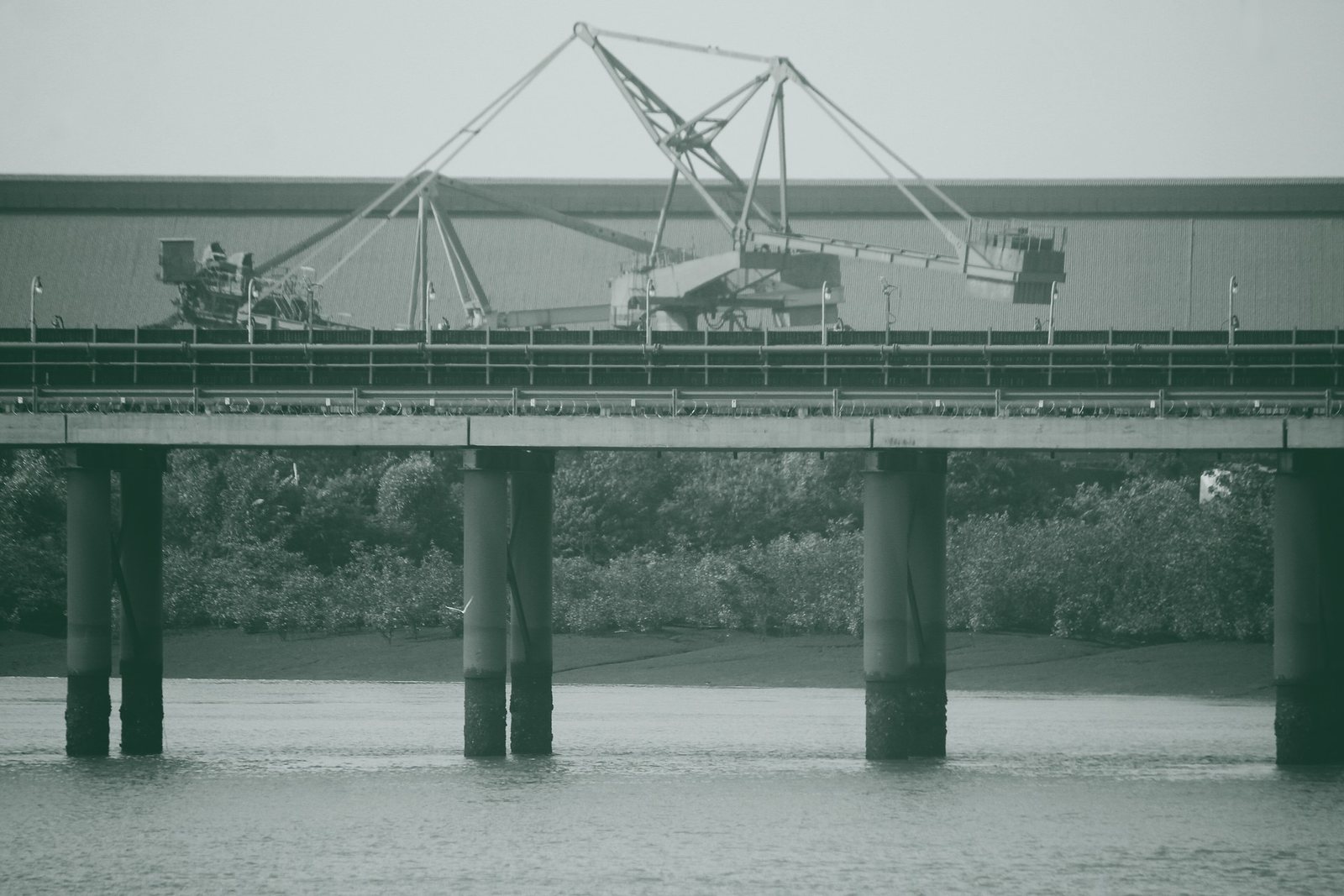
The project has also faced operational and governance scrutiny during construction, including reported worker fatalities; those matters are outside the fiscal analysis undertaken here and are not used to alter the revenue calculations below.
The record cuts both ways. S&P Global Ratings assigned Guinea its first sovereign rating, B+ with a stable outlook, in September 2025, about six weeks after the GAC revocation,33 and revised the outlook to positive on 13 March 2026.34 The widely used country risk dataset maintained by Aswath Damodaran at NYU Stern places Guinea’s total equity risk premium at 15.89 per cent, against 4.23 per cent for a mature market. The dataset is keyed to Moody’s ratings, and Guinea has none; countries rated B1 by Moody’s, the nearest equivalent to S&P’s B+, carry 10.06 per cent in the same table.35 In December 2023 Rio Tinto said it anticipated an internal rate of return “in the low double digits”, 11 to 13 per cent post-tax in real terms, for the Simfer mine and its share of the infrastructure.16 That return and a country risk premium are on different bases and cannot be compared directly. In our view, a project of Simandou’s scale and strategic weight can be priced on considerations that investors in agriculture, power and processing are unlikely to share; they are more likely to rely on generic country-risk references of the kind above.
Figures in circulation
US$200 billion. In official sources, this is the planned cost of the Simandou 2040 programme, as Section I shows. A similar figure also circulates as a measure of the project itself: an opinion piece in a Guinean outlet stated in May 2026 that Simandou represents “plus de 20 milliards de dollars d’investissements, et près de 200 milliards de dollars de valeur sur la durée de vie du projet”, (over $20bn in investments and nearly $200bn of value during the project life-cycle) without stating how the second figure was derived.36 Neither figure measures what the state will receive.
GDP “up to 55%”. The Chair’s statement in Rio Tinto’s 2025 Annual Report says that Simandou “could grow Guinea’s GDP by up to 55% by 2030”; the statement does not cite a source.23 The figure matches the upper end of the range in the IMF’s 2024 Article IV, which found that, “depending on how potential tax revenues are spent”, Guinea’s real GDP “could be 26 to 55 percent larger by 2030” than without the project. In the IMF’s analysis, the upper bound assumes the revenue is used for public investment, and the lower bound assumes it is spent on consumption; both compare the level of GDP in 2030 with and without the project.37
The 55 per cent figure should therefore not be read as a forecast that Simandou will generate 55 per cent GDP growth; it is a modelled difference in the level of GDP in 2030 relative to a counterfactual in which the project does not proceed.
GDP to US$152 billion by 2040. The Prime Minister’s general policy statement of March 2026 set a target of GDP of US$152 billion by 2040, from “environ 35 milliards” (nearly $35bn) today, with average growth of 10.3 per cent a year and more than five million jobs.5 The World Bank puts 2025 GDP at US$28.3 billion, noting that its data do not yet reflect national accounts being rebased.38 Guinea’s rebasing, as reported when S&P first rated the country, raised 2024 nominal GDP to about US$36.3 billion,33 and projects long-run growth of about 6 per cent a year in its business-as-usual scenario once Simandou’s ramp-up is complete.21
Jobs. The Simandou 2040 site’s mining-sector page targets “+35,000 jobs in processing sectors”.1 Reuters reported in December 2025 that construction had employed more than 60,000 people at its peak, and that operations would need fewer than 15,000.39 Rio Tinto reported a workforce of 19,460 across the SimFer mine, rail and port scope in July 2026, 76 per cent of them Guinean.40
Volumes and completion. In February 2025, the Minister of Mines and Geology, Bouna Sylla, told Bloomberg that the government projected the two mines would each produce 30 million tons in their first year.41 Rio Tinto’s 2026 sales guidance for Simandou, which covers the SimFer operation, is 5 to 10 million tonnes on a 100 per cent basis, and Rio Tinto notes a lag between production and sales. In July 2026, its chief executive said that SimFer mine construction and port infrastructure were “both now more than three quarters complete, with full rail commissioning achieved in the first quarter”, and Rio Tinto expects SimFer port commissioning in the first quarter of 2027.40
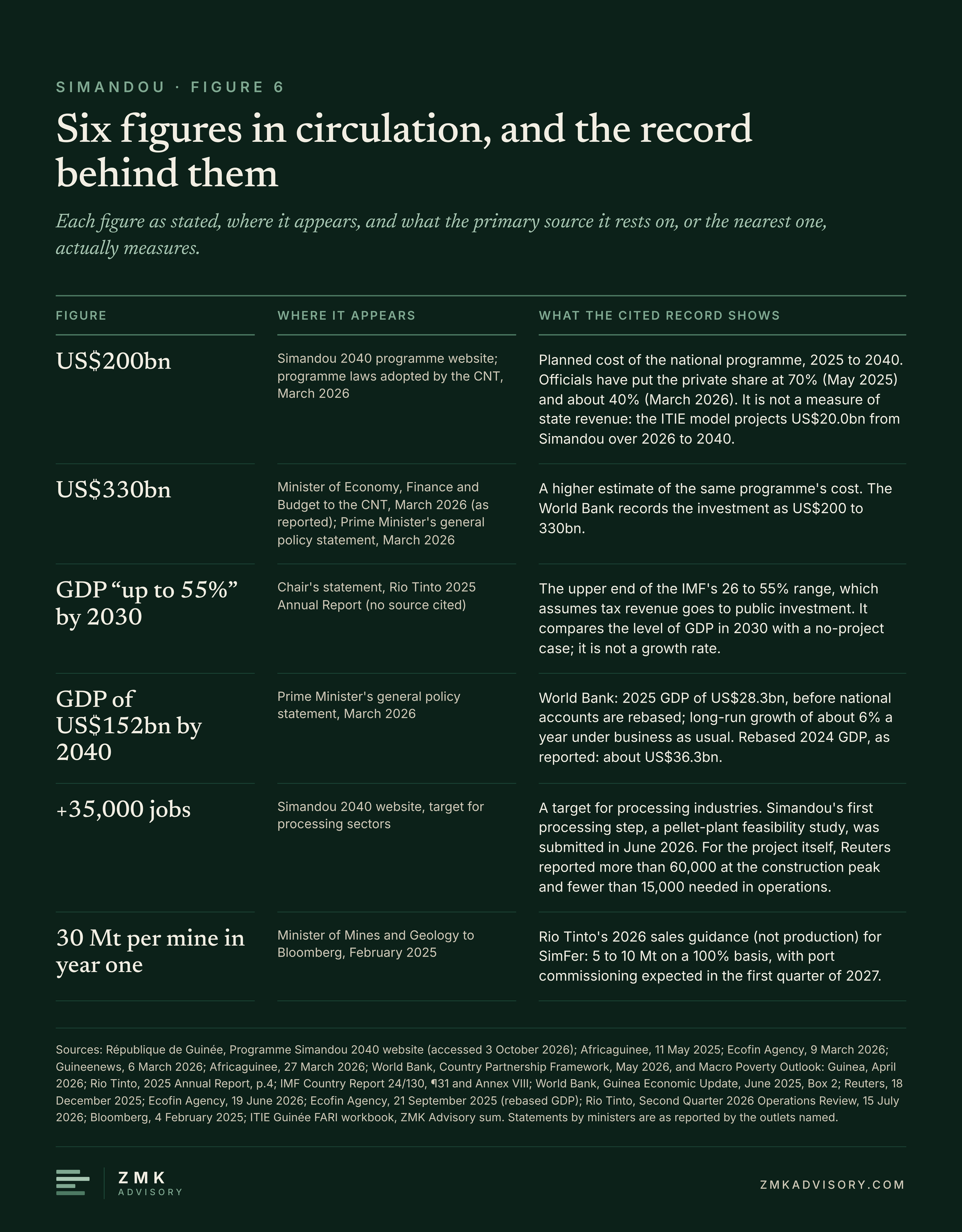
Three measures should not be conflated. Project investment measures capital deployed to build the mines and infrastructure. Government revenue measures the taxes, royalties, and dividends received by the Guinean state. GDP impact measures the additional economic activity generated within Guinea. None, by itself, is a measure of the total economic value of Simandou to Guinea.
What the record supports
The documents support four conclusions, each testable against the sources cited.
First, the state’s projected receipts are a fraction of the programme named after the project: US$20 billion over fifteen years in the official ITIE base case, against US$200 billion of planned investment, with almost nine-tenths of it arriving after 2030 as, in the official models, tax concessions expire, and partner loans are repaid.
Second, a material part of the fiscal settlement is unpublished, including the CTG tariff formula behind the largest line in the Ministries’ model. In our view, publishing it would allow the transfer-pricing risk identified in the government’s diagnostic to be assessed more directly for CTG, particularly because the infrastructure company’s revenue is generated by tariffs paid by its shareholder mines. Nothing in the public record reviewed for this article indicates that the tariff has been set other than on agreed commercial terms.
Third, Simandou deepens an existing concentration by commodity, by counterparty and by price.
Fourth, the instruments Guinea is discussing with the IMF, “a rules-based fiscal framework to manage resource wealth, including a possible sovereign wealth fund”,42 have documented precedents, and they suggest the order matters. The Minister of Planning, Ismael Nabé, said in November 2025 that a fund would launch by the second quarter of 2026 with an initial US$1 billion.43 In September, the finance ministry presented a planned state-owned company with projected endowments of US$4 billion between 2029 and 2035 and the stated aim of making it operational in 2026, and said it would next consolidate the fund’s legal and institutional framework.44 Norway’s fund operates under a rule that limits spending to the fund’s expected real return, currently estimated at 3 per cent.45 Chile’s structural balance rule excludes “the effect on public finances of cyclical fluctuations in economic activity and the price of copper”.46 Guinea’s diversification options are also documented: the IFC’s 2020 private sector diagnostic found that, “from a trade perspective, agribusiness provides Guinea’s best diversification opportunity”,47 and the World Bank reports that Guinea’s Kaléta and Souapiti hydropower plants now export 1,174 GWh a year to Senegal, The Gambia and Guinea-Bissau.48 In our view, on the evidence in Section III, investment in those sectors is likely to be priced off generic country-risk references.
The question for Guinea is therefore not whether Simandou will generate substantial economic value. The available evidence suggests that it will. The harder question is whether the fiscal institutions built around that value will convert a finite mineral windfall into a durable increase in national wealth. That will depend less on the headline size of the project than on the timing and quality of government receipts, the transparency of the fiscal arrangements, the management of commodity-price risk and the allocation of the resulting revenue.
Every Field Note goes live on this site first, then on LinkedIn and X.
Follow ZMK Advisory to see the next one on the day it publishes.
Technical notes
The US$20 billion. ZMK Advisory’s sum of the ITIE Guinée FARI workbook (sheet “Simandou outputs”, base case, real 2023 US$) for calendar years 2026 to 2040 inclusive: US$20,012.9 million. Low case (US$70 a tonne): US$16,349.1 million. High case (US$100): US$27,375.1 million. The total line includes royalties, corporate tax, US$208.4 million of withholding tax on CTG’s interest payments (2027 to 2031), and dividends from the state’s 15 per cent of CTG; the model carries no dividends from the state’s stakes in the two mines. The ITIE report states the price basis as US$80 a dry tonne without specifying CFR or FOB; the workbook’s royalty base is gross revenue, and its Simfer royalty line works out at about 3.75 per cent of gross revenue, which the ITIE report explains as the 3.5 per cent mining tax plus the 0.25 per cent local development contribution; the convention levies the 3.5 per cent on FOB value.
Comparability. The ITIE figures are in real 2023 dollars. The Ministry diagnostic’s horizons are 25 years for the mines and 35 for CTG; its Table 10 adds the CTG total into a figure labelled 25 years, and its total of US$52.8 billion differs from the sum of its entity tables (US$52.4 billion); whether its figures are real or nominal is not stated in the passages reviewed. The US$200 billion programme figure is not stated as real or nominal. IMF and World Bank GDP figures are in current dollars and, as both institutions note, before Guinea’s national accounts rebasing. The IMF’s 26 per cent is a difference in the level of GDP in 2030 against a no-project scenario, not a growth rate. Rio Tinto’s internal rate of return is real and post-tax, as stated in December 2023; Damodaran’s equity risk premium is a nominal US dollar premium. These pairs are presented side by side, not netted.
Fiscal terms. Simfer terms are from the published convention and the 2023 adjustments. Northern-block terms are as described by ITIE Guinée and the Ministry diagnostic from the 2020 convention, before any 2023 adjustment; both give a ten-year corporate tax exemption, although one passage of the diagnostic gives shorter periods. CTG terms are from Rio Tinto’s December 2023 investor seminar and 2025 tax report.
Deliberately omitted. The 2008 to 2019 history of the northern blocks, including the BSG Resources and Vale dispute; the Liberian export route; and the settlement amount for GAC, which no party has disclosed.
Disclosure
Derived figures. The fifteen-year sums in Section I and the technical notes, the share arriving after 2030 (88.5 per cent of the base case), the 18 per cent price sensitivity, the look-through ownership percentages and the “one dollar in ten” comparison are ZMK Advisory’s arithmetic on the cited sources.
Interests. The author led Rio Tinto’s Simandou country strategy team from April 2023 to July 2025. This article draws only on the public documents cited in it, and uses no information obtained in that role. The author holds Rio Tinto shares, share awards and/or other financial interest in Rio Tinto. Other than this holding, neither the author nor ZMK Advisory holds a position, long or short, direct or derivative, in Rio Tinto, Aluminium Corporation of China (Chinalco), Aluminium Corporation of China Limited (Chalco), China Baowu Steel Group or its affiliates, BHP or Vale, or in Guinean government debt, other than through broad market index funds, and neither will trade in any of them for five trading days after publication. ZMK Advisory has no engagement with, and is not presently seeking one from, any party named in this article.
Status. The northern-block and infrastructure conventions are unpublished; their terms are taken from the descriptions of Guinean public bodies and of Rio Tinto, as cited. Nothing in this article asserts unlawful conduct by any party.
Not investment research. This is commentary and analysis. It is not a recommendation to buy, sell or hold any security or commodity, and it has not been prepared in accordance with legal requirements designed to promote the independence of investment research.
Sources
- 1 République de Guinée, Programme Simandou 2040, official website (English and French versions, including the programme pages, the President’s message and the economic transformation page), accessed 3 October 2026. Source for the US$200 billion over 15 years, the three phases of US$65, 75 and 60 billion, the “$20 billion for the Simandou mega-project”, the 122 projects and 36 reforms, “5M+” jobs, and the mining sector targets of “+ $10 billion additional GDP contribution by 2040” and “+ 35,000 jobs in processing sectors”. The site is the government’s primary statement of the programme. https://www.simandou2040.gn/en/
- 2 Africaguinee, report of remarks by Djiba Diakité at a seminar on the sovereign wealth fund, 11 May 2025. Source for the earliest located public statement of the figure, its provisional wording, and the statement that “à peine 30%” is to be financed by the state. https://www.africaguinee.com/simandou-2040-djiba-diakite-affiche-une-ambition-de-200-milliards-usd/
- 3 Ecofin Agency, “Guinea adopts legislative framework for $200 bln ’Simandou 2040’ plan,” 9 March 2026. Source for the CNT’s adoption on Thursday 5 March 2026 of the 2026-2040 planning law and 2026-2030 programming law, the 122 megaprojects and 36 reforms, and total investment “estimated at more than $200 billion” (Ecofin’s description; the article cites a presidency statement for the framework laws). https://www.ecofinagency.com/news/0903-53576-guinea-adopts-legislative-framework-for-200-bln-simandou-2040-plan
- 4 Guineenews, “Simandou 2040 : la Guinée prépare une révolution économique à 330 milliards de dollars,” 6 March 2026. Source for Guineenews’s report that the Minister of Economy, Finance and Budget told the CNT the programme’s cost was estimated at more than US$330 billion (reported speech). The World Bank’s Country Partnership Framework of May 2026 records the investment as “US$200-330 billion”. The same report gives the Minister’s statement that about 40 per cent of the programme’s financing is expected to come from the private sector. https://guineenews.org/2026/03/06/simandou-2040-la-guinee-prepare-une-revolution-economique-a-330-milliards-de-dollars/
- 5 Africaguinee, report of Prime Minister Amadou Oury Bah’s Déclaration de politique générale to the CNT, report dated 27 March 2026. Source for his quoted statement of an investment volume “estimé à 330 milliards de dollars sur quinze ans”, the 2040 GDP target of US$152 billion from about US$35 billion, average growth of 10.3 per cent and more than five million jobs. https://www.africaguinee.com/330-milliards-usd-dinvestissement-5-500-km-de-routes5-millions-demplois-bah-oury-devoile-plan-titanesque-pour-transformer-la-guinee-en-15-ans/
- 6 ITIE Guinée, Résultats du modèle financier Simandou, June 2025, prepared with the IMF FARI model. Source for the model’s price cases of US$70, 80 and 100 a dry tonne, its average of about US$850 million a year over 2026 to 2034 at US$80, total public revenue of about US$3.6 billion in 2024, and the statement that the amended Simfer, WCS and CTG conventions had not been made public. ITIE Guinée is the national multi-stakeholder body implementing the Extractive Industries Transparency Initiative; the model was produced for its steering committee by economist Bernabé Sanchez with the support of the EITI International Secretariat, using the IMF’s FARI tool. https://eiti.org/sites/default/files/ITIE%20Guinee_Resultats-Modele-Financier-Simandou-June-2025.pdf
- 7 ITIE Guinée, Simandou FARI model workbook (IMF mining FARI model, “Simandou outputs” sheet), last saved 18 December 2025. Source for the year-by-year state revenue in the US$70, 80 and 100 cases from which ZMK Advisory computed the 2026 to 2040 totals, and for the composition of the total line. https://eiti.org/sites/default/files/IMF-mining-fari-model-2023-SIMANDOU-Q4-2025_ITIE_GUINEE_0.xls
- 8 Rio Tinto, Taxes and Royalties Paid Report 2025, Guinea country table (p.12), project table (p.14) and Guinea fiscal settings (p.24); with the Taxes and Royalties Paid Report 2024, p.15, for the 2024 figure of US$38.7 million. Source for taxes borne of US$64.8 million in respect of Simandou in 2025 with no royalties or corporate income tax, the mine’s 15 per cent tax rate for eight years and nil dividend withholding for the life of the mine, the infrastructure’s 15 per cent rate and nil dividend withholding for seventeen years, and Rio Tinto’s statement on publication of the infrastructure tax settings. Rio Tinto’s Guinea country total for 2025 (US$94.5 million, p.12) also includes US$28.6 million of corporate income tax from its interest in CBG (Sangarédi bauxite), which is not part of Simandou. https://cdn-rio.dataweavers.io/-/media/content/documents/invest/reports/taxes-paid-reports/rt-2025-taxes-paid.pdf?rev=16a5864ddf5d47979c80f1a05c207397
- 9 Rio Tinto, 2026 Half Year Results, 29 July 2026, p.2 (first high-grade iron ore sales from Simandou in April 2026), read with Rio Tinto, 2025 Annual Results, 19 February 2026, p.20 (train loading from October 2025, first shipment from the WCS port in December 2025). The official launch on 11 November 2025 is reported by Reuters, 18 December 2025 (note 39). https://www.riotinto.com/-/media/content/documents/invest/financial-news-and-performance/results/2026/2026-half-year-results.pdf
- 10 Wood Mackenzie, press release on Simandou and seaborne iron ore supply, 1 April 2026, quoting David Cachot. Public statement, used in place of subscription research. Source for “the single biggest driver of seaborne supply growth over the coming decade”, the expected displacement of higher-cost supply and expected 2026 exports of around 16 million tonnes. https://www.woodmac.com/press-releases/simandou-iron-ore-2026/
- 11 World Bank, Commodity Markets Outlook, April 2026, iron ore section and price forecast table. Source for the 2025 average of US$100.2 a dry tonne, forecasts of US$97.0 (2026) and US$95.0 (2027), the projection of a decline “to below its 2020 level over the forecast horizon due to ample supply”, and “the gradual addition of new low-cost capacity in West Africa”. https://thedocs.worldbank.org/en/doc/f3138644a1e8e2bb631399ae11d6c408-0050012026/original/CMO-April-2026.pdf
- 12 République de Guinée, Code Minier, Law L/2011/006/CNT of 9 September 2011 as amended by Law L/2013/053/CNT of 8 April 2013, consolidated bilingual text. Articles 130 (local development contribution), 150-I (state participation), 161 (extraction tax), 163 (export tax), 176 (corporate tax) and 182 (stabilisation). The consolidated text states that only the official French texts are authoritative; the rates are corroborated by White & Case and Clifford Chance client briefings of 2013. https://www.cms.int/sites/default/files/document/cms_nlp_gin_code_minier_L%3A2011%3A006%3ACNT%3A2011.pdf
- 13 Republic of Guinea and Simfer S.A., Amended and Consolidated Basic Convention, executed 26 May 2014, English version published by Rio Tinto. Articles 22 (state participation, pp.35-36), 29.3 and 29.5 (dividends and mining tax, p.47), 34 (export duties and stabilisation, p.50), 37(c) (priority over the Mining Code, p.53) and 40 (US$700 million settlement sum, p.58). Simfer’s parent ownership (Rio Tinto 53 per cent, CIOH 47 per cent of Simfer Jersey) is from notes 16 and 23. https://www.riotinto.com/-/media/Content/Documents/Sustainability/Ethics-and-integrity/Transparency/RT-Simandou-Amended-consolidated-basic-convention-EN.pdf
- 14 Republic of Guinea and Simfer, Bipartite Adjustments to the Simfer Basic Convention, as of 10 August 2023, Article 9.2 (corporate tax at 15 per cent for eight years from the first year of taxable profit, citing Pillar 2). Ratified by the National Transitional Council on 3 February 2024 and in force from 30 May 2024 per Rio Tinto’s 2025 Annual Report, p.318. https://cdn-rio.dataweavers.io/-/media/content/documents/operations/simfer-bipartite-adjustments.pdf
- 15 Ministère du Budget and Ministère des Mines et de la Géologie, Diagnostic de la collecte des recettes associées au projet Simandou, final report, August 2025, prepared under the World Bank-supported PGRNME programme and published by ITIE Guinée. Source for the northern-block fiscal terms as described from the 2020 convention (pp.3 and 51), the base case of about US$81 a tonne, average revenue of US$1.5 billion a year, US$52 billion over 25 years and NPV at 6 per cent of US$18.2 billion (executive summary pp.2-4), revenue by entity (Tables 7-10, pp.50-56; Table 10’s total of 52,831 differs from the sum of Tables 7-9, 52,381), the timing of state dividends (2030 for both mines, 2032 for CTG; pp.51, 53, 55), the share of profit-based taxation, the transfer-pricing assessment and the statement that the 2023 conventions could not be consulted. https://www.itiedoc-guinee.org/wp-content/uploads/2025/10/PGRNME_Diagnostic-fiscalite%CC%81-Simandou_Rapport-final_vf.pdf
- 16 Rio Tinto, “Simandou iron ore project update,” notice to ASX and LSE, 6 December 2023. Source for the infrastructure scope, CTG’s 42.5/42.5/15 ownership, the transfer of the infrastructure to the state “after a 35 year Operations Period”, Simfer’s US$11.6 billion capital requirement (Rio Tinto share US$6.2 billion) and the expected IRR “in the low double digits”, 11 to 13 per cent post-tax and real (fn 12). https://announcements.asx.com.au/asxpdf/20231206/pdf/05y7lc3pk29hkj.pdf
- 17 Rio Tinto, Investor Seminar presentation, 6 December 2023, filed with the US SEC on Form 6-K as Exhibit 99.8, slides 98 (“Concession life 35-year operating period to cover investment repayment”) and 99 (“Tax settings will provide a sustainable sharing of benefits between partners”), for the infrastructure corporate tax, dividend and interest withholding rates and the US$0.50 a tonne royalty with its offset schedule. https://www.sec.gov/Archives/edgar/data/863064/000162828024000045/ex08d06presentation.htm
- 18 Rio Tinto, “Rio Tinto and Government of Guinea sign new agreement for Simandou iron ore project,” press release, 22 April 2011, as filed in the public record of ICSID Case No. ARB/14/22 (BSG Resources v. Republic of Guinea), Request for Arbitration, Exhibit C-046. Source for the terms of the 2011 settlement as announced: the US$700 million payment, the state’s right to up to 35 per cent including 15 per cent at no cost, joint ownership of the infrastructure with a maximum state stake of 51 per cent fully funded by each participant, reversion of the infrastructure to the state after 25 to 30 years, an eight-year income tax holiday and a 3.5 per cent FOB royalty. https://icsid.worldbank.org/sites/default/files/parties_publications/C3765/Request%20for%20Arbitration%20of%20BSG%20Resources%20%28Guinea%29%20Limited%20and%20BSG%20Resources%20%28Guinea%29%20SARL/Factual%20Exhibits/Request%20for%20Arbitration%20-%20Exhibit%20C-046.pdf
- 19 Présidence de la République de Guinée, Cabinet Civil, communiqué de presse, Conakry, 8 March 2023, on the CTG shareholders’ pact. Source for the “participation non contributive et non dilutive de 15%” in the infrastructure and 15 per cent in the mines. https://lelynx.net/wp-content/uploads/2023/03/COMMUNIQUE-DE-PRESSE-SIM.pdf
- 20 Institut National de la Statistique de Guinée, Annuaire statistique du Commerce Extérieur 2024 (published 2025), annex Tables 1, 6 and 7. Source for bauxite and gold at about 93 per cent of 2024 exports and China’s 86.7 per cent share of bauxite exports. https://www.stat-guinee.org/images/Documents/Publications/INS/annuelles/CE/NOTE_ANALYSE_STATISTIQUE_COMMERCE_EXTERIEUR_2024.pdf
- 21 World Bank, Guinea Economic Update, Second Edition: Domestic Resource Mobilization and Management for Inclusive and Sustainable Development, June 2025. Source for the projection that iron exports “will double the combined exports of bauxite and gold” (p.27), mining sector taxes of 1.7 to 2.3 per cent of GDP over 2019-2024 (Table 1, p.8, 2023-24 estimates), the 7.0 percentage point rise in poverty and 1.8 million additional people (Box 1, p.5), mining revenue rising from 2.4 per cent of GDP in 2025 to 3 per cent in 2027 (p.13) and long-run growth of about 6 per cent under business as usual (Box 2). https://documents1.worldbank.org/curated/en/099062725083124547/pdf/P507241-c1e64111-12fc-4ed4-86e2-d505d9df7e38.pdf
- 22 Reuters, “China to build overseas iron ore mines to ensure supply,” 31 December 2020, as published by Mining.com. Source for the Ministry of Industry and Information Technology’s aim of one or two globally significant overseas iron ore mines by 2025 (Reuters’ description) and its statement on West Africa and Western Australia (direct quotation). https://www.mining.com/web/china-to-build-overseas-iron-ore-mines-to-ensure-supply/
- 23 Rio Tinto plc, Annual Report on Form 20-F for the year ended 31 December 2025, filed with the US SEC February 2026. Source for Pilbara Mineral Reserves of 2,202 Mt at 60.8% Fe at 31 December 2025 and the statement on low-carbon steelmaking technology for Pilbara ores (steel value chain section), the SimFer ownership structure and CIOH’s composition (project table note 5), Shining Prospect’s holding of 14.02 per cent of Rio Tinto plc and 10.32 per cent of Group voting power (substantial shareholders), the Chair’s statement that Simandou “could grow Guinea’s GDP by up to 55% by 2030” (also at p.4 of the 2025 Annual Report), and the statement that, as far as is known, Rio Tinto plc and Rio Tinto Limited are not directly or indirectly owned or controlled by another corporation or by any government (shareholder information). https://www.sec.gov/Archives/edgar/data/863064/000162828026009531/rio-20251231.htm
- 24 Ecofin Agency, “Guinea takes first step toward processing Simandou iron ore at home,” 19 June 2026. Source for the feasibility study for a 2 million tonne a year pellet plant submitted jointly by Simfer and China Baowu, reviewed by the Ministry of Mines on 18 June 2026, the co-development obligation to study a steel mill or pellet plant within two years of production, and the absence of disclosed cost, schedule, financing and power source. https://www.ecofinagency.com/news-industry/1906-56609-guinea-takes-first-step-toward-processing-simandou-iron-ore-at-home
- 25 Reuters, “China’s Baowu takes control of Simandou iron ore operator,” 30 January 2026, as published by Mining.com. Source for Baowu’s increase from 49 to 51 per cent, completion on 30 January 2026, the renaming to Baowu Winning Consortium Simandou and its 85 per cent of the operating company. https://www.mining.com/web/chinas-baowu-takes-control-of-simandou-iron-ore-operator/
- 26 Mining.com, “China freezes BHP iron ore cargoes amid pricing dispute,” 30 September 2025, reporting Bloomberg News. Source for Bloomberg’s report of CMRG’s instruction to suspend purchases of dollar-denominated BHP cargoes. https://www.mining.com/china-freezes-bhp-iron-ore-cargoes-amid-pricing-dispute/
- 27 ITIE Guinée, Rapport ITIE Guinée 2023, independent administrator Moore Insight, published December 2025, Table 11 (bauxite production and exports from Ministry of Mines statistical bulletins). https://eiti.org/sites/default/files/Rapport%20ITIE%20Guin%C3%A9e%202023.pdf
- 28 International Monetary Fund, Guinea: Selected Issues, Country Report No. 24/131, May 2024, Chapter 1. Source for real GDP “26 percent higher” by 2030 than without the project (¶14, p.6) and total expected government revenues of “3.4 percent of GDP from 2030 to 2039, compared to total mining revenues of 2.2 percent of GDP in 2022” (¶8, p.5). The revenue figure is sourced in the report to “Rio Tinto (2023)”. https://www.imf.org/en/publications/cr/issues/2024/05/17/guinea-selected-issues-549127
- 29 Ecofin Agency, “Guinea revokes 129 mining permits in continued sector cleanup,” 28 May 2025. Source for the revocation of 129 exploration permits announced by the Minister of Mines on 26 May 2025, the statement that it was the fourth such decision following two presidential decrees and a ministerial order, that the permits had already expired (2012 to 2024), and the legal basis in Articles 24 and 25 of the Mining Code. https://www.ecofinagency.com/news-industry/2805-47036-guinea-revokes-129-mining-permits-in-continued-sector-cleanup
- 30 Mining.com, “Guinea strips EGA of bauxite rights, hands asset to state firm,” 5 August 2025, with files from Reuters and Bloomberg. Source for the revocation decree announced on state broadcaster Radio Télévision Guinéenne on 4 August 2025, the stated grounds of violations of the mining code, the refinery deadline originally set for 2022 and later extended, and the transfer to Nimba Mining Company. https://www.mining.com/guinea-strips-ega-of-bauxite-rights-hands-asset-to-state-firm/
- 31 Emirates Global Aluminium, H1 2025 results release, 4 September 2025. Source for the AED 2.5 billion (US$687 million) full write-down of GAC and EGA’s characterisation of the revocation at that time. https://media.ega.ae/ega-reports-resilient-h1-financial-performance-with-industry-leading-aluminium-margins-and-strategic-progress-despite-guinea-supply-disruption-and-asset-write-down/
- 32 Emirates Global Aluminium, “Republic of Guinea, GAC and EGA reach agreement,” joint announcement, 6 May 2026. Source for the lump-sum payment, the transfer of GAC’s assets to Nimba Mining Company, the renewal of CBG supply agreements and the negotiation under the auspices of the President of the Paris Bar. No amount is disclosed. https://media.ega.ae/republic-of-guinea-gac-and-ega-reach-agreement/
- 33 Ecofin Agency, “What Guinea’s first S&P rating, a B+, means for its economy,” 21 September 2025. Source for S&P’s assignment of B+/B ratings with a stable outlook in September 2025. S&P’s own research update was not available to ZMK Advisory at publication. Source also for the rebased 2024 nominal GDP of US$36.3 billion. https://www.ecofinagency.com/news/2109-48860-what-guinea-s-first-s-p-rating-a-b-means-for-its-economy
- 34 Financial Afrik, “Guinea’s outlook raised by S&P, sovereign rating confirmed at B+,” 14 March 2026. Source for the revision of the outlook to positive on 13 March 2026. https://www.financialafrik.com/en/2026/03/14/guineas-outlook-raised-by-sp-sovereign-rating-confirmed-at-b/
- 35 Aswath Damodaran, NYU Stern School of Business, “Country Default Spreads and Risk Premiums,” January 2026 update. Source for Guinea’s total equity risk premium of 15.89 per cent and country risk premium of 11.66 per cent, against a mature-market premium of 4.23 per cent. Guinea is shown as unrated (NR) on the dataset’s Moody’s basis; B1-rated countries carry a total equity risk premium of 10.06 per cent. https://pages.stern.nyu.edu/~adamodar/New_Home_Page/datafile/ctryprem.html
- 36 Investigatorguinee, “Simandou 15% : le levier d’or qui propulse la Guinée dans le cercle des nations qui comptent,” 22 May 2026. Opinion piece by Billy Keita. https://investigatorguinee.com/2026/05/22/simandou-15-le-levier-dor-qui-propulse-la-guinee-dans-le-cercle-des-nations-qui-comptent/
- 37 International Monetary Fund, Guinea: 2024 Article IV Consultation, Country Report No. 24/130, May 2024, ¶31 (p.18) and Annex VIII (p.65). Source for real GDP “26 to 55 percent larger by 2030” depending on the use of tax revenue, and Annex VIII ¶4 for the bounds (lower: revenue spent on consumption; upper: public investment). https://www.imf.org/en/publications/cr/issues/2024/05/17/guinea-2024-article-iv-consultation-and-request-for-disbursement-under-the-rapid-credit-549110
- 38 World Bank, Macro Poverty Outlook: Guinea, April 2026. Source for 2025 GDP of US$28.3 billion and the statement that the data “do not yet reflect the rebased national accounts under preparation”. https://thedocs.worldbank.org/en/doc/bae48ff2fefc5a869546775b3f010735-0500062021/related/mpo-gin.pdf
- 39 Reuters, “Mass layoffs overshadow Guinea’s Simandou mega mine as output accelerates,” 18 December 2025, as published by Kitco. Source for the construction peak of more than 60,000 workers and the operational requirement of fewer than 15,000. https://www.kitco.com/news/off-the-wire/2025-12-18/mass-layoffs-overshadow-guineas-simandou-mega-mine-output-accelerates
- 40 Rio Tinto, Second Quarter 2026 Operations Review, notice to ASX, 15 July 2026. Source for the SimFer workforce of 19,460 (76 per cent Guinean), 2026 Simandou sales guidance of 5 to 10 million tonnes (100 per cent basis), the chief executive’s statement on construction progress and rail commissioning, and SimFer port commissioning expected in the first quarter of 2027. https://announcements.asx.com.au/asxpdf/20260715/pdf/071qbxkbq91tvv.pdf
- 41 Bloomberg, “Guinea sees maximum Simandou output in second year of operation,” 4 February 2025, as published by Mining.com. Source for Bloomberg’s report of the Minister’s statement. https://www.mining.com/web/guinea-sees-maximum-simandou-output-in-second-year-of-operation/
- 42 International Monetary Fund, “IMF Staff Completes 2026 Article IV Mission and Reaches Staff-Level Agreement on a 41-Month Extended Credit Facility Arrangement with Guinea,” press release, 12 August 2026, as distributed by APO. Source for the quoted description of the Article IV discussions. https://imf-fmi.africa-newsroom.com/press/international-monetary-fund-imf-staff-completes-2026-article-iv-mission-and-reaches-stafflevel-agreement-on-a-41month-extended-credit-facility-arrangement-with-guinea?lang=en
- 43 Reuters, “Guinea aims to launch Simandou-backed wealth fund in Q2 2026,” 12 November 2025, as published by Mining.com. Source for the planned launch date, the US$1 billion initial size and the Minister of Planning’s statement. https://www.mining.com/web/guinea-aims-to-launch-simandou-backed-wealth-fund-in-q2-2026/
- 44 Guineenews, “Fonds souverain de Guinée : un atelier de restitution pour baliser la voie vers son opérationnalisation,” 9 September 2026 (updated 11 September 2026; the URL carries the original headline “Mines : la Guinée pose les bases d’un fonds souverain doté de 4 milliards USD entre 2029 et 2035”). Source for the workshop held by the Ministry of Economy, Finance and Budget, the planned form of a public limited company wholly owned by the state, projected endowments of US$4 billion between 2029 and 2035, the stated aim of making the fund operational in 2026, and the government’s stated next step of consolidating its legal and institutional framework. https://guineenews.org/2026/09/09/mines-la-guinee-pose-les-bases-dun-fonds-souverain-dote-de-4-milliards-usd-entre-2029-et-2035/
- 45 Norwegian Ministry of Energy and Norwegian Offshore Directorate, Norsk Petroleum, “Management of revenues.” Source for the fiscal rule linking spending to the fund’s expected real return, “currently estimated to 3%”. https://www.norskpetroleum.no/en/economy/management-of-revenues/
- 46 Ministerio de Hacienda de Chile, statement on the Economic and Social Stabilization Fund, August 2021. Source for the structural balance rule’s exclusion of cyclical copper price effects. https://hacienda.cl/english/news-and-events/news/ministry-of-finance-reports-a-us-1-billion-withdrawal-from-the-economic-and
- 47 International Finance Corporation, Creating Markets in Guinea: Country Private Sector Diagnostic, executive summary, October 2020. https://www.ifc.org/content/dam/ifc/doc/mgrt/cpsd-guinea-executive-summary.pdf
- 48 World Bank, “Guinea’s electricity surge powering local small businesses and communities,” feature, 23 October 2025. Source for 1,174 GWh a year supplied to Senegal, The Gambia and Guinea-Bissau. https://www.worldbank.org/en/news/feature/2025/10/23/guinea-electricity-surge-powering-local-small-businesses-and-communities
Note on sources. Every footnote links its principal source. Wood Mackenzie material is limited to its public press release of 1 April 2026; no subscription research is used. S&P Global Ratings’ actions are cited from the reporting outlets named, pending retrieval of S&P’s own research updates.